
Guide
Specialty coffee shop design that justifies €4.50 per coffee (and has a queue) – Madrid 2026
Subscribe to our newsletter!
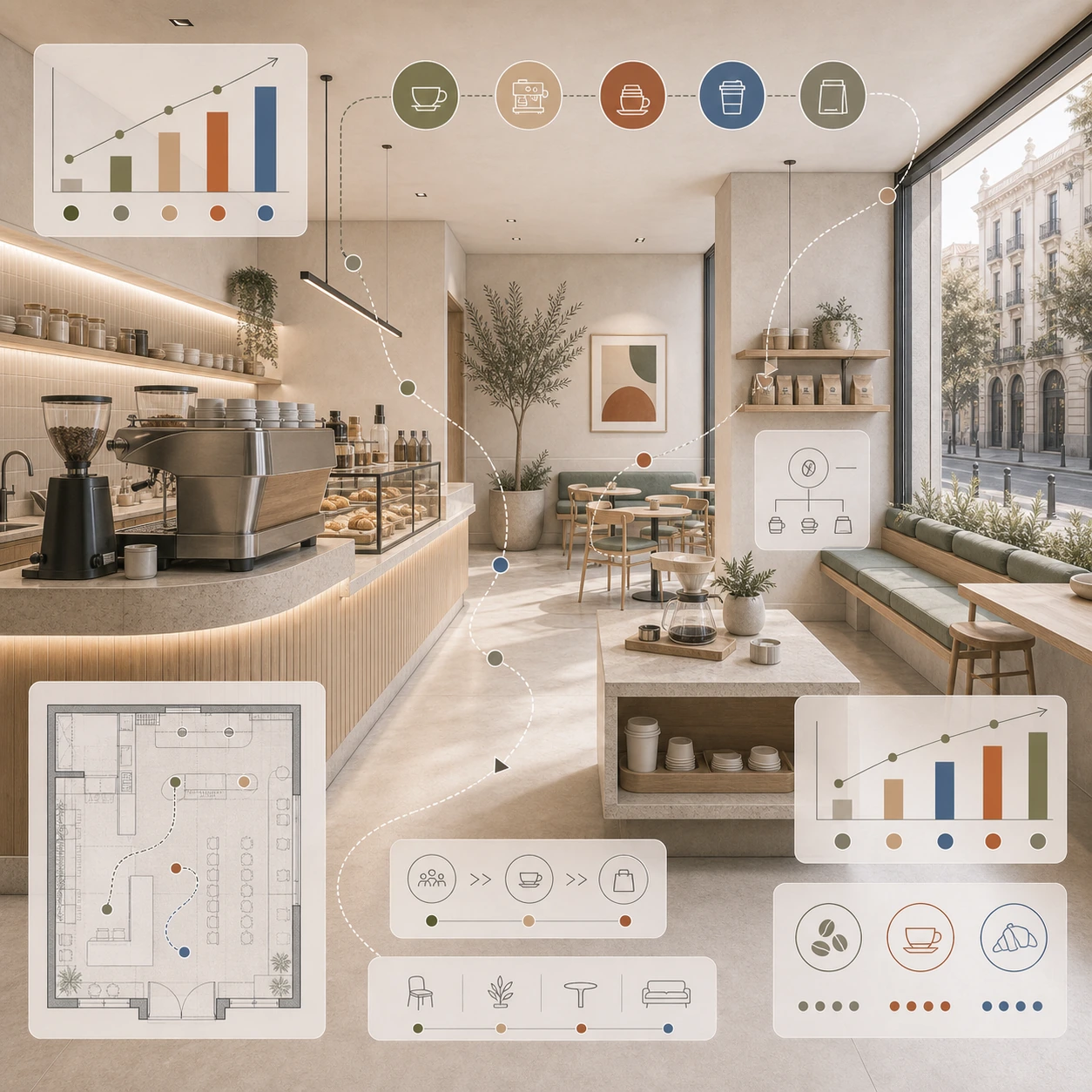
The difference between a coffee shop that charges €1.80 for a coffee and one that charges €4.50 (and has a queue) isn't just the coffee. It's the design.
Well-designed specialty coffee shops in Madrid generate €280-€420 in revenue per square meter per month, compared to €120-€180 for commodity coffee shops. Same square meterage, triple the revenue. Design is the key to that difference.
This article demonstrates, with real-world examples and concrete figures, how the strategic design of specialty coffee shops impacts pricing power, average transaction value, turnover, and profitability. It's not hipster decor. It's margin architecture.
The brutal economics of commodity vs specialty coffee
Real case: Two cafes in Malasaña, separated by 200 meters
Cafeteria A: Traditional "neighborhood cafeteria"
Space:
- 45m² total
- 18 indoor seats + 4 terrace seats
- Design: functional, generic, without personality
Economic:
- Single coffee: €1.80
- Coffee with milk: €2.20
- Average ticket price: €3.80
- Customers/day: 110
- Daily billing: €418
- Monthly billing: €12,540
- Revenue per m²/month: €279
Margins:
- Cost per coffee/customer: €0.45
- Gross margin: 76%
- But: rent €2,400/month (19% of revenue)
- Personal: €4,800/month (38%)
- Operating margin: 18-22%
Cafeteria B: Specialty third wave (200m away)
Space:
- 48m² total (similar)
- 16 indoor seats + 6 terrace seats
- Design: careful, distinctive, Instagrammable
Economic:
- Black coffee (single origin): €3.80
- Coffee with milk (latte art): €4.50
- Average price: €8.20 (includes pastry/brunch)
- Customers/day: 95 (lower volume)
- Daily billing: €779
- Monthly billing: €23,370
- Revenue per m²/month: €487 (+74% vs A)
Margins:
- Cost per coffee customer: €0.85 (best quality coffee)
- Gross margin: 73% (similar)
- Rent: €2,600/month (11% revenue – best ratio)
- Personal: €6,200/month (27% – can afford better)
- Operating margin: 32-38%
Annual difference:
- Cafeteria A: €150,480 revenue → €27k-€33k profit
- Cafeteria B: €280,440 revenue → €90k-€107k profit
Difference in initial investment?
- Cafeteria A: €52,000
- Cafeteria B: €94,000
- Difference: +€42,000
ROI of premium design: Additional profit: €63k-€74k/year. Payback on design surcharge: 6.8-8 months
Why design allows you to charge 2.5x more (without customer resistance)
The psychology of pricing in coffee shops:
1. Quality signals = price justification
Customer enters commodity cafe:
- See: functional space, commercial machine, standard coffee brand
- Think: "Regular bar coffee"«
- Expected price: €1.50-€2.50
- If you charge €4.50 = "expensive, I won't be back"«
Customer enters a well-designed specialty:
- See: statement bar, La Marzocco machine, Mahlkonig grinder, concentrated barista, visible in-house roaster
- Think: "This is serious, they're experts."«
- Expected price: €3.50-€5.50
- If you charge €4.50 = "reasonable for this quality"«
The design communicates quality BEFORE the customer tastes the coffee.
2. Experience > transaction
Commodity cafeteria:
- Customer enters, orders, pays, waits standing up, has coffee, leaves
- Time: 6-8 minutes
- Perception: functional transaction
A well-designed specialty coffee shop:
- Customer enters, appreciates the space, chooses a seat, orders while conversing (coffee origin, brewing method), observes preparation, enjoys the atmosphere, takes photos, and stays for 25-45 minutes
- Perception: complete experience
People pay for experiences, not transactions.
3. Instagramworthiness = free marketing + social justification
Mathematics of organic content:
Instagrammable specialty coffee shop with 180 customers/day:
- 15-25% share on social media (27-45 posts/day)
- 810-1,350 posts/month
- Average reach: 280 followers/post
- Monthly impressions: 226k-378k
- Equivalent paid advertising value: €1,800-€4,200/month
Besides: When a customer shares a €4.50 coffee on Instagram, they can't later complain that it's expensive. Social justification = reduced price friction.
4. Differentiation = pricing power
Madrid has 1,200+ cafes.
Of those:
- 950+ are commodities (they compete on price)
- 180~ are specialty (they compete for experience)
- 40~ are specialty with exceptional design (price without resistance)
In commodity form: Customer chooses based on proximity/price Specialty with design: Customer chooses based on experience, takes a specific trip, and happily pays premium.
The 9 critical elements of a profitable specialty coffee shop design
1. The bar: your stage, your sales pitch
The bar is the 40% of a specialty coffee shop's visual impact.
Common mistake: Functional tapas bar style counter. Customer doesn't see preparation, there's no theatrics.
Solution: statement bar designed as a stage
Critical elements:
A) Strategic positioning
- Visible from the entrance (first impact)
- Coffee machine as the protagonist
- Barista working in view (show)
B) Height and visibility
- Working height: 90-95cm (comfortable barista)
- Customer can view full preparation
- The ritual can be seen from the seats.
C) Materials that communicate quality
- Marble/quartz/granite: premium, visual hygiene
- Solid wood: warmth, handcrafted
- Stainless steel: professional, technical
- Never: cheap Formica, imitation melamine
Statement bar budget: €8,000-€18,000 (4-6 linear meters)
D) Focused lighting
- Overhead light over preparation area
- preparation ritual stands out
- Create drama
E) Integrated display
- Visible cups (brand, design)
- Coffee beans in glass jars (visual + aroma)
- Pastry/products in a designed display case
- Merch (coffee bags, mugs) as functional decoration
F) Space for interaction
- 2-4 seats at the bar (premium, charges +€0.50-€1)
- They allow conversation with the barista
- Coffee educational experience
Total budget for a complete bar: €12,000-€28,000
Case: Specialty coffee shop, Chamberí
Calacatta marble + walnut wood central bar:
- La Marzocco Linea PB machine seen from entrance
- Mahlkonig EK43 mill as a sculptural piece
- 4 bar seats (always occupied)
- Bar investment: €22,000
- The 78% customer photos include the bar
- Bar seat supplement €1: €120-€180/month additional
2. Visible equipment: technology as a sign of expertise
In specialty coffee shops, the team IS part of the design.
Equipment that must be seen (and look good):
A) Espresso machine (€8,000-€25,000)
Not just any machine. Brands that convey seriousness:
- La Marzocco (PB Line, GB5): iconic, instagrammable
- Synesso: high-end, technical
- Slayer: spectacular design
- Victoria Arduino: Italian elegance
B) Professional grinder (€1,200-€4,500)
- Mahlkonig (EK43, E80 Supreme): reference
- Mythos: precision
- Eureka: value for money
C) Visible alternative methods
- V60, Chemex, Aeropress on designed shelving
- Each method is an opportunity for education (and upselling)
- «"Would you like to try your coffee in a V60?" = +€1.50
D) Precision balance
- Barista weighs coffee = sign of precision
- Small detail, big impact on perception
E) Toaster (if you have the space and ambition)
- In-house toaster = maximum differentiation
- It requires space, extraction, know-how
- But: brutal storytelling + margins ++
Budget for small toaster + installation: €25,000-€45,000
Total visible quality equipment: €12,000-€55,000 (according to ambition)
ROI: This equipment is not "decoration". It's a production tool + a selling point + organic content.
Case: Cafeteria with its own roaster, Lavapiés
5kg toaster visible from seating area:
- They roast twice a week on-site
- Scent + visual show
- They sell bags of in-house roasted coffee: €14-€18/250g
- Additional revenue bags: €2,800-€4,200/month
- Toaster payback: 12-16 months
3. Seating: designed for lingering, not just for consumption
The mistake of commodity cafes: maximum seating density.
Result: Uncomfortable, high turnover, low ticket, zero atmosphere.
Specialty's success: fewer seats, more comfortable, longer stay, high ticket price.
Types of seats in specialty:
A) Community tables (30% seats)
- Long table 3-4 meters, 8-12 people
- It fosters community and interaction.
- Digital nomads + freelancers
- Occupancy: 85-95% (11am-6pm)
Budget: €1,200-€3,500 (table + benches/chairs)
B) Tables for 2-4 people (40% seats)
- For couples, small gatherings
- Variety: some near the window (premium), others more private
Budget: €400-€900/full table
C) Window/wall bar (15% seats)
- For individuals working on a laptop
- View of a street or wall with visual stimulation
- Integrated sockets (critical)
Budget: €180-€350/linear position
D) Lounge area (15% seats)
- More comfortable sofas and armchairs
- For reading, relaxed conversation
- Lower occupancy but higher ticket price (long stay)
Budget: €3,500-€8,000 (full area)
Seats vs m² ratio:
- Cafeteria commodity: 0.8-1.2 seats/m² (maximum density)
- Specialty cafeteria: 0.4-0.6 seats/m² (spacious)
Example 60m²:
- Commodity: 48-72 seats (cramped, uncomfortable)
- Specialty: 24-36 seats (comfortable)
Paradox: Fewer seats = more revenue per m²
Why? Higher average ticket price + longer stay + repeat purchase.
Specialty seat features:
Chairs:
- NO cheap stackable chairs
- Comfortable designer chairs (Eames replicas, Tolix, Windsor, Thonet)
- Mixture of styles (eclectic but coordinated)
Budget: €80-€280/chair
Tables:
- Solid wood (oak, walnut, ash)
- NO cheap melamine or Formica
- Generous size (not 60x60 tables where a laptop and coffee won't fit)
Budget: €280-€850/table depending on size
Cushions/textiles:
- On benches and sofas
- They provide comfort + color + texture
- Renewables (visual freshness)
Complete furniture budget (30 seats): €12,000-€28,000
Case: Specialty coffee shop, Retiro
32 seats in 55m² (0.58 seats/m²):
- Mix: communal table for 12 people, 4 tables for 2, window bar for 6, lounge with 2 sofas
- Average stay: 38 minutes
- Average ticket price: €9.40
- Daily rotation: 3.2
- Revenue per seat/day: €30.08
- Revenue per m²/month: €530
Vs nearby commodity cafe (0.9 seats/m²):
- Revenue per m²/month: €285
4. Lighting: from functional to experiential
Lighting is the 35% of a cafe's atmosphere.
Common mistake: Cool white overhead lighting, supermarket type.
Solution: layered lighting that creates atmosphere
Layer 1: Natural light (critical if possible)
- Maximize natural light input
- Windows without heavy curtains
- Plants near windows (biophilia + light)
- Natural light = 40% of visual appeal
Layer 2: General ambient light
- Warm temperature: 2700-3000K
- Not too intense (avoid excessive shine)
- Evenly distributed
Budget: €3,500-€7,000
Layer 3: Focal light (on tables)
- Hanging lamps over tables
- They create intimacy, they define spaces
- Statement pieces (recognizable design)
Budget: €4,000-€12,000
Layer 4: Accent Light
- Illuminate specific elements: art, plants, shelves
- Creates depth, visual interest
Budget: €1,500-€4,000
Layer 5: Decorative Light
- Custom neon (claim, logo)
- Edison bulbs visible
- Instagrammable element
Budget: €1,200-€4,500
Intensity control:
- Different scenes depending on the time of day
- Tomorrow: brighter, more energizing
- Evening/night: dimmer, more relaxing
Specialty complete lighting budget: €10,200-€27,500
Case: Cafe with exceptional lighting, Chueca
Lighting investment: €18,000 (in 52m², high)
- Maximized natural light (full windows)
- 8 statement pendants on tables
- Neon "But First Coffee"«
- Scene control by time of day
Result:
- The 84% customer photos are from their cafe
- Reviews mention "cozy atmosphere": 67%
- Evening/night occupancy (6pm-9pm): 78% (vs 30-40% average)
5. Visual identity and spatial branding
Specialty coffee shops WITHOUT a strong visual identity = commodity in disguise.
Elements of spatial identity:
A) Coherent color palette
Minimalist Scandinavian style:
- Base: white, light grays, light wood
- Accents: matte black, sage green
- Feeling: clean, bright, calm
Warm industrial style:
- Base: exposed brick, concrete, black metal
- Accents: reclaimed wood, dark green, leather
- Feeling: urban, authentic, welcoming
Eclectic bohemian style:
- Base: beige, terracotta, natural wood
- Accents: olive green, mustard, petrol blue
- Feeling: relaxed, artistic, traveler
Japanese wabi-sabi style:
- Base: earth tones, beige, stone gray
- Accents: black, dark wood, ceramic
- Feeling: zen, handcrafted, contemplative
B) Custom typography and signage
- Designed menu (not a chaotic whiteboard with Comic Sans)
- Consistent signage
- Unique, repeating typeface
Graphic design + signage budget: €2,500-€6,000
C) Art and visual elements
- Murals (ideal local artist)
- Curated posters/prints
- Installations (e.g., lamp with hanging cups)
- Large format photograph (origin of coffee, farmers)
Budget: €3,000-€12,000
D) Neon or lettering statement
- Phrase related to coffee/coffee culture
- Strategic location (perfect backdrop for photos)
- Examples Madrid: «But First Coffee», «Drink Coffee Do Good», «Espresso Yourself»
Budget: €1,200-€3,800
E) Consistent packaging
- Takeaway cups with design
- Branded pastry bags
- Bags of coffee for sale
Initial budget: €1,500-€3,500
Total cost of complete visual identity: €8,200-€25,300
ROI: Strong identity = recognition = repeat purchase + recommendation + pricing power
Case: Cafe with a bold identity, Malasaña
Identity «Coffee Traveler» – maps, vintage globes, source photos:
- World map mural with origin of coffees
- Shelves with travel items (vintage suitcases, cameras)
- Neon «Adventure in Every Cup»
- Packaging with map print
Identity investment: €16,500
Result:
- Immediate recognition ("the one on the map")
- Massive UGC (12-18 posts/day)
- Customer makes specific trip (not "the closest one")
- Pricing €4.20 without resistance
6. Product zones and integrated retail
Smart specialty coffee shops generate 15-25% of retail revenue.
Typical retail products:
- Bags of whole bean/ground coffee (€12-€18/250g)
- Branded cups/mugs (€14-€22)
- Brewing methods (V60, Chemex, Aeropress): €18-€55
- Merchandise (tote bags, t-shirts): €12-€28
- Pastries/Takeaway Products
Retail area design:
A) Statement shelving visible from entrance
- Products such as functional decor
- Focused lighting
- Careful organization (not chaotic)
Budget for designed shelving: €1,200-€3,500
B) Refrigerated display case for pastry/food
- It should be pretty (not an ugly industrial display case)
- Warm interior lighting
- Well-presented products
Budget: €3,500-€8,000
C) Clear but discreet price signage
- No posters printed on A4
- Small chalkboards or designed labels
Revenue retail example:
Cafeteria 180 customers/day:
- 12% buy bags of coffee: 22 bags/day × €15 = €330/day
- 6% buy takeaway pastry: 11 units × €3.50 = €38.50/day
- 3% buy occasional merch: 5 items/day × €18 = €90/day
Total retail/day: €458.50 Total retail/month: €13,755 % total revenue: 18%
Retail margin:
- Coffee beans: 65-75% (green purchases, roasting)
- Merch: 55-65%
- Pastry: 60-70% (if local supplier)
Case: Cafeteria with strong retail presence, Chamberí
Prominent retail area:
- 3m wood and metal shelving unit with lighting
- 8 references to whole bean coffee
- Merch (mugs, t-shirts, tote bags)
- Brewing accessories
Retail revenue: €16,200/month (22% of the total) Retail margin: 68% Contribution to charity: €11,000/month
7. Bathroom: small but critical for perception
The bathroom says as much about your coffee shop as the bar.
Common mistake: Neglected bathroom, questionable cleanliness, gas station design.
Consequence: The entire perception of "specialty premium" collapses.
Solution: a bathroom that maintains the standard
Critical elements:
- Impeccable cleaning (checked every 2 hours during peak times)
- Quality materials (tiles, faucets)
- Adequate lighting (well-lit mirror)
- Amenities (good liquid soap, not a cheap dispenser)
- Subtle air freshener (not harsh chemicals)
- Decoration consistent with the rest (plants, small art)
- Optional humor sign ("Wash your hands, you filthy animal")
Specialty bathroom budget: €4,500-€9,000 (complete renovation)
Impact: Reviews never mention the bathroom = success. If they mention it negatively = reputation disaster.
8. Plants and biophilia: mandatory, not optional
Specialty coffee shops without plants = cold, incomplete.
Correct plants:
- Minimum 8-12 medium/large floors (60-80m²)
- Mix of heights and types
- Indoor hardy species (Monstera, Pothos, Ficus, Kentia)
- Coherently designed flowerpots
Budget: €1,200-€3,500 (plants + pots)
Strategic location:
- Near windows (they take advantage of the light)
- On shelves (visual height)
- Hanging from the ceiling (dramatic)
- As natural space dividers
Maintenance:
- Bi-weekly service: €60-€120/month
- Staff trained in basic care
Benefit:
- They improve air quality (actual)
- They soften the sound (minimal absorption but it helps)
- They give life, freshness, humanity
- They are photogenic (a recurring element in photos)
9. Acoustics: the invisible factor that determines the size of a room
Cafes with bad acoustics = short stay = low bill.
Typical acoustic problem:
- Hard materials (concrete, tile, glass, metal)
- Music + conversations + coffee machine = 70-78dB noise
- Impossible to converse or concentrate
Acoustic solution in cafeteria:
A) Acoustic ceiling
- Cloud-like absorbent panels
- Or a complete acoustic ceiling
- Reduces reverberation 40-60%
Budget: €3,500-€8,000
B) Decorative panels on walls
- Acoustic panels disguised as art/decoration
- They absorb mid-to-high frequencies
Budget: €2,000-€5,000
C) Abundant textiles
- Cushions, curtains, upholstery
- Natural absorption
D) Plants (slight absorption but it adds up)
E) Properly calibrated background music
- Volume: should allow for normal conversation
- Genre: consistent with identity (indie, jazz, lofi, soft electronica)
- System: Sonos or similar (quality, easy management)
Audio budget: €800-€2,200
Acoustic objective: Noise level 58-65dB (comfortable conversation)
Case: Cafeteria with treated acoustics, Lavapiés
Initial problem: concrete + metal space, 76dB noise.
Solution:
- Suspended acoustic cloud-type ceiling
- 6 upholstered wall panels
- Abundant textiles
- Large plants
Acoustic investment: €9,500
Result:
- Noise reduced to 61dB
- Average stay: 28 min → 42 min (+50%)
- Average ticket: €6.80 → €9.20 (+35%)
- Reviews mention "perfect work environment": 54%
Actual budgets by type
Basic specialty coffee shop 40-55m² (without own roaster)
Civil works and preparation:
- Demolition of existing premises: €3,500
- Reinforced electrical installation: €6,500
- Plumbing and drainage: €4,500
- Extraction and ventilation: €8,000
- Flooring (vinyl or parquet): €3,200
- Painting and finishing: €4,500
- Subtotal work: €30,200
Cafeteria equipment:
- Professional espresso machine (La Marzocco Linea, 2 groups): €14,500
- Espresso grinder (Mahlkonig E65S): €2,200
- Filter mill (Mahlkonig EK43): €2,800
- Alternative methods (V60, Chemex, press): €600
- Refrigerated pastry display case: €4,500
- Under-counter refrigerator: €1,200
- Sink + dishwasher: €3,500
- Kitchenware (cups, jugs, utensils): €1,800
- Subtotal equipment: €31,100
Furniture:
- Statement bar (4.5m): €12,000
- 24 seats (assorted chairs and tables): €9,600
- Window bar (4 seats): €1,400
- Retail + decorative shelving: €2,200
- Subtotal furniture: €25,200
Lightning:
- Complete multi-layer system: €8,500
- Custom neon: €2,200
- Subtotal lighting: €10,700
Design and identity:
- Spatial branding (signage, menu): €3,500
- Art/decoration: €4,200
- Plants + pots: €1,800
- Subtotal identity: €9,500
Acoustics:
- Basic treatment: €4,500
Bathroom:
- Complete renovation: €5,500
Technology:
- Audio system: €1,200
- POS terminal + tablet: €1,500
- WiFi: €800
- Subtotal tech: €3,500
Project and direction:
- Design + project management: €9,500
TOTAL INVESTMENT: €129,700 Per m² (50m²): €2,594/m² Per seat (24): €5,404
Projected Revenue:
- 140 customers/day × €8.20 average ticket = €1,148/day
- Monthly: €34,440
- Per m²/month: €689
Break-even: 65-72% capacity Payback: 14-18 months
Premium specialty coffee shop 60-80m² (with brunch + strong retail)
Total investment: €195,000-€255,000 Per m²: €2,750-€3,600/m²
Includes:
- More robust equipment (3-group machine)
- Brunch cooking (grill, oven)
- Furniture for 35-45 seats
- Premium visual identity
- Advanced acoustics
Projected Revenue:
- €48,000-€62,000/month
- Per m²/month: €600-€880
Payback: 12-16 months
Micro-roastery café 70-100m² (own roaster + retail)
Total investment: €280,000-€380,000 Per m²: €3,500-€4,200/m²
Includes all of the above PLUS:
- Toaster 5-12kg: €28,000-€45,000
- Specialized extraction toaster: €12,000-€18,000
- Separate roasting area
- Green coffee storage
Projected Revenue:
- Coffee consumption: €42,000-€55,000/month
- Retail toasted bags: €8,000-€15,000/month
- Wholesale to other coffee shops: €12,000-€25,000/month
- Total: €62,000-€95,000/month
Payback: 14-20 months (longer due to larger investment but multiple revenue streams)
Locations in Madrid: where Specialty operates
Prime areas for specialty (high success):
1. Malasaña / Triball
- Young, conscious, digital audience
- Willing to pay premium
- High density of freelancers/creatives
- Rent: €32-€48/m²/month
Profitability: High Competence: Very high (critical differentiation)
2. Chueca
- Residents + LGBTQ+ tourism + international
- High quality expectations
- Local + tourist mix works
- Rent: €35-€52/m²/month
3. Footbath
- Artistic, multicultural, authentic
- A slightly more affordable price is needed.
- Strong, loyal community
- Rent: €24-€36/m²/month
4. Chamberí / Trafalgar
- Young families, professionals
- High purchasing power
- Less crowded than Malasaña
- Rent: €28-€42/m²/month
5. Salamanca / List
- Maximum purchasing power
- Luxury/premium expectations
- Requires a high level of finish.
- Rent: €38-€58/m²/month
6. Retreat / Ibiza
- Residential, quiet
- Loyal local customers
- Hearty brunch on weekends
- Rent: €26-€38/m²/month
Emerging areas (opportunity):
7. Ambassadors / Arganzuela
- Gentrification in progress
- More affordable rents
- High potential if you are a pioneer
- Rent: €20-€30/m²/month
8. Prosperity / Chamartín
- Corporate areas with offices
- High demand on working days
- Weak weekends
- Rent: €22-€32/m²/month
Common mistakes that kill margins
Mistake 1: Investing in professional equipment but mediocre design
The symptom: La Marzocco machine €15k but generic space.
Consequence: You can't justify premium pricing. Customer sees professional equipment but a mediocre environment = confusion = resistance to €4.50.
The solution: Balance. Pro team + pro design. One without the other doesn't work.
Cost of error: Pricing limited to €2.80-€3.20 = insufficient margins
Error 2: Too many seats (commodity density)
The symptom: 50 seats in 55m² = overcrowding.
Consequence: Uncomfortable, noisy atmosphere, short stay, low price.
The solution: Fewer seats = more comfort = longer stay = higher ticket price.
Optimal specialty: 0.4-0.6 seats/m²
Cost of error: Revenue per m² -30-40%
Error 3: Skimping on lighting
The symptom: Cool overhead functional lighting.
Consequence: Unwelcoming atmosphere, bad photos, short stay.
The solution: Warm multi-layer lighting. It's 15-18% budget but 35% ambiance.
Cost of error: Occupancy -25%, photos UGC -60%
Error 4: Not having a clear visual identity
The symptom: A mix of styles without coherence.
Consequence: It looks like a "nice" but generic cafe. Zero memorability.
The solution: Define your identity BEFORE you design. Everything must be consistent.
Cost of error: Zero differentiation = price competition
Error 5: Neglected bathroom
The symptom: Functional but ugly/dirty bathroom.
Consequence: Negative reviews, perception of quality collapses.
The solution: Bathroom must maintain the standard of the rest of the bathroom. Investment of €5k-€9k is mandatory.
Cost of error: Damaged reputation, buyback -40%
Error 6: Poor acoustics
The symptom: Noisy space, impossible to talk/work.
Consequence: Short stay, workers don't return, low ticket price.
The solution: Acoustic treatment €4k-€10k. Non-negotiable.
Cost of error: Average ticket -25%, late occupancy -50%
Complete success stories
Case 1: Micro-roastery cafeteria, Malasaña
Profile:
- New project, entrepreneur with barista experience
- Objective: Specialty referral in a saturated area
- Differentiation: Our own roasting
Space:
- 72m²
- Open-plan space (former clothing store)
Investment:
- Design + construction + equipment: €298,000
- Key elements:
- Giesen W6A toaster visible from street
- Black Marquina marble central bar + walnut
- 28 seats (0.39/m²) mix styles
- Dramatic lighting on toaster
- Neon "Roasted With Love"«
- Mural by local artist depicting the coffee process
- Treated acoustics (ceiling + panels)
Revenue model:
Year 1:
- Cafeteria consumption: €38,400/month
- Retail coffee bags: €6,200/month
- Wholesale (8 client cafes): €9,400/month
- Total: €54,000/month
Per m²/month: €750
Margins:
- Consumption: 74%
- Retail: 71%
- Wholesale: 52%
- Weighted margin: 68%
Year 1 Results:
- Break-even month 7
- Profit year 1: €92,000
- Investment payback: Projected 38 months
Year 2 (current):
- Consumption: €42,800/month
- Retail: €8,900/month
- Wholesale (14 clients): €16,200/month
- Total: €67,900/month
Profit year 2: €168,000
Success factors:
- Clear differentiation (one of the few with its own toaster in Malasaña)
- Unquestionable product quality
- Design that communicates "this is serious"«
- Brutal organic marketing (18-25 posts/day from clients)
- Wholesale grew organically (coffee shops seek them out)
Quote owner: «"The investment in design seemed crazy at first. €298k for 72m² = €4,139/m². But the design is what allows us to charge €4.50 without anyone batting an eye. And it's what makes other cafes want to buy our coffee. It paid for itself in 3 years, and now it generates a net €168k/year."»
Case 2: Specialty Brunch Cafe, Retiro
Profile:
- Young couple, one chef, one barista
- Concept: Specialty coffee + real brunch (not standard toast)
- Market: Families + digital nomads area
Space:
- 65m²
- Corner unit with large windows (brutal natural light)
Investment:
- Total: €162,000
- Key elements:
- Coffee bar + open kitchen brunch
- Synesso MVP machine (statement)
- 32 seats in separate areas
- Natural lighting + statement pendants
- Warm Scandinavian palette (white + wood + green)
- XXL Plants (18 units)
- Small kids corner area (families)
Revenue model:
Revenue distribution:
- Coffee: 45% (€19,800/month)
- Brunch/food: 48% (€21,120/month)
- Retail: 7% (€3,080/month)
- Total: €44,000/month
Per m²/month: €677
Special features:
- Weekends = 55% weekly revenue (brunch explosion)
- Saturday/Sunday: queue 20-30 min (11am-2pm)
- Reservations required for weekend brunch
Year 1 Results:
- Average weekly ticket: €7.80
- Average weekend ticket: €16.40 (full brunch)
- Weekly occupancy: 68%
- Weekend occupancy: 98%
- Profit year 1: €118,000
Year 2 (current):
- Revenue: €51,000/month
- Profit: €156,000/year
Success factors:
- Dual concept (weekday coffee + weekend brunch) = balanced occupancy
- Real food (not just pastries)
- Family area (kids corner) = parents return weekly
- Spectacular natural light = amazing photos
- Loyal residential location
Challenge:
- Maximum capacity reached (long lines on weekends)
- Considering expansion or second location
Co-owner quote: «"The kids' corner was a last-minute idea, an extra €2,200. It generates an additional €8,000-€12,000/month from families who come because 'the children are entertained'. ROI: immediate."‘
Case 3: Minimalist specialty coffee shop, Chamberí
Profile:
- Entrepreneur, ex-consultant, life change
- Concept: Japanese minimalism, coffee as a ceremony
- Target: Professionals 30-45, seeking calm
Space:
- 48m²
- Narrow but deep
Investment:
- Total: €118,000 (adjusted)
- Minimalist concept = fewer elements but maximum quality
- Key elements:
- Japanese cedar wood bar + white marble
- La Marzocco Linea PB machine (white)
- 18 seats only (0.375/m² – very spacious)
- Wabi-sabi style diffused lighting
- Japanese handcrafted ceramics (unique mugs)
- Bonsai and kokedama type plants
- Absence of superfluous decoration
Revenue model:
- Clients/day: 95 (low but intentional volume)
- Average ticket: €9.80 (high)
- Revenue/month: €27,930
- Per m²/month: €582
Special features:
- It doesn't have WiFi (strategic decision – seeks disconnection)
- Japanese ambient music only
- Barista explains the origin of each coffee (educational)
- Longer preparation time (ritual)
Customer profile:
- 78% are regulars (very high rebuy)
- Average age: 38 years
- Average stay: 25 min (short but intense)
- No workspace = efficient rotation
Year 1 Results:
- Profit: €94,000
- Payback: 15 months
Year 2:
- Stable revenue (intentional slow growth)
- Profit: €108,000
Success factors:
- Radical differentiation (unique in Madrid with this pure concept)
- A niche audience, but loyal and willing to pay
- Low operating costs (small space, team of 2-3 people)
- Very high margins (70%+)
Quote owner: «"Everyone told me I'd fail without WiFi. But that's precisely my advantage. People come to disconnect, not to work. 15 minutes of peace and quiet with good coffee = they come back all week. Fewer customers, higher profit margin, more happiness."»
Working with EOLOS in your specialty coffee shop
We design specialty coffee shops in Madrid with an average ticket price of €7.80-€10.50 and a revenue of €420-€750 per m²/month.
Our approach:
1. Revenue-driven design from concept
We don't design "pretty cafes". We design profit-generating machines.
We model P&L BEFORE designing:
- Projected revenue by category
- Realistic break-even
- Investment payback
- Sensitivity to key variables
Design is optimized for a better investment/profitability ratio.
2. Identity that justifies pricing
We work on brand identity IN PARALLEL to spatial design:
- Naming (if new project)
- Visual concept
- Storytelling
- Tone of communication
Result: Spatial design + identity = total coherence = pricing power.
3. Selection of curated equipment
We did not specify "any professional machine".
We balance:
- Technical capacity (you need X coffees/hour)
- Visual impact (machine as statement)
- Budget (best options by price range)
- Maintenance (Technical service availability Madrid)
4. Photographic design from renders
Every decision considers: "How does it look in a mobile phone photo?"«
Testing in the design phase using renders + mock-ups.
Result: Spaces that generate 12-25 posts/day effortlessly.
5. Permission and timing management
We coordinate:
- Licenses (activity, opening)
- Certificates (health, fire safety)
- Timing with equipment suppliers
- Work without delays (penalty in contract)
Timing guarantee: If we manage the entire project, we meet the deadline (except in cases of force majeure).
Investment in design + PM: 10-13% of the total project cost
Frequently Asked Questions
How much does it really cost to open a specialty coffee shop in Madrid?
Total investment (includes everything):
- Micro 35-45m²: €95k-€140k
- Standard 50-65m²: €130k-€195k
- Premium 70-90m²: €195k-€280k
- With own toaster: +€40k-€70k
Per m²: €2,400-€3,800/m² (specialty level, not commodity)
Is the equipment included?
Yes. Quotes include EVERYTHING:
- Construction and finishes
- Professional espresso machine
- Mills
- Display case, refrigerators, kitchenware
- Complete furniture
- Lightning
- Decoration
- Project and direction
How long does it take to open?
From decision to opening: 4.5-7 months
- Local search: 3-8 weeks
- Design: 4-6 weeks
- Leave: 6-10 weeks (parallel)
- Construction: 6-10 weeks
- Testing and soft opening: 1-2 weeks
Is a specialty coffee shop profitable?
Well executed: YES, very profitable.
Typical margins:
- Cafeteria commodity: 15-22% operating margin
- Well-run specialty coffee shop: 28-38%
Difference: pricing power + high average ticket price.
Typical break-even point: 60-75% capacity Payback: 14-24 months
Do I need barista experience?
Ideally, one of the partners would.
Options:
- Experienced operating partner
- Hire head barista with equity/participation
- Intensive training (3-6 months working in specialty beforehand)
Open without product knowledge = high risk.
Do I need my own toaster?
Not mandatory. Many successful specialty coffee shops work with local roasters.
Advantages of having your own toaster:
- Total quality control
- Higher margins
- Differentiation
- Revenue wholesale
Disadvantages:
- Investment +€40k-€70k
- Specialized know-how
- Greater operational complexity
Recommendation: Phase 1 without a toaster. If it works, consider adding a toaster in Phase 2.
Which locations work best?
In Madrid:
- Prime areas: Malasaña, Chueca, Chamberí, Salamanca
- Emerging neighborhoods: Lavapiés, Embajadores, Arganzuela
Key factors:
- Pedestrian traffic (3,000+ people/day)
- Residential + office mix
- Medium-high purchasing power
- Competition (paradoxically, area with other specialties = validated demand)
WiFi: Yes or no?
It depends on the concept:
- Work-friendly model: WiFi mandatory (generates occupancy 10h-18h)
- Experiential/Disconnection Model: No Intentional WiFi (Faster Rotation)
Both can work. Define your positioning.
How many staff do I need?
In turn:
- Micro (<50m²): 1-2 people
- Standard (50-70m²): 2-3 people
- Large (70m²+): 3-4 people
Total team:
- Head barista
- 2-4 baristas
- 1-2 helpers/cleaning
Personnel cost: 28-35% of revenue (well managed)
Does design style affect profitability?
Style matters less than EXECUTION and CONSISTENCY.
A well-executed Japanese minimalist > mediocre industrial trend.
Having said that:
- Warm minimalism: more timeless, fewer renovations
- Industrial: can be dated in 3-5 years
- Eclectic: requires expert treatment (high risk)
Recommendation: Choose a style that reflects your authentic identity, not trends.
Conclusion: Design is not decoration, it's your selling point
In 2026, Madrid will have more than 1,200 cafes competing for the same customer.
Your competitive advantage cannot be just "I have good coffee" (many do).
It should be: "I have a complete experience that justifies €4.50 and generates a queue."«
The numbers are clear:
A well-designed specialty coffee shop:
- Average ticket: €7.80-€10.50 vs €3.50-€4.80 commodity
- Revenue per m²: €420-€750/month vs €120-€280
- Operating margin: 28-38% vs 15-22%
Investment in specialty design vs commodity design:
- Commodity: €1,200-€1,800/m²
- Specialty: €2,400-€3,800/m²
- Difference: +€1,200-€2,000/m²
In 60m²: +€72k-€120k initial investment
But: Additional annual profit: €95k-€180k Payback on overcost: 5-15 months
You don't design specialty because it's "prettier".
You do it because it's more profitable.
Design is what allows:
- Earn 2.5x more without resistance
- Generate €18k-€28k monthly in organic marketing
- Create a loyal community that returns daily
- Compete on experience, not price
In Madrid, where rent eats up 15-25% of revenue, you need pricing power.
Design IS your pricing power.
The decision is yours. The numbers are clear.
Do you need help with your project?
At EOLOS Design Lab we design commercial spaces that generate measurable results: more customers, better experience, greater profitability.
Tell us: available square meters, location, concept (in-house roaster, brunch, etc.), estimated budget. We'll help you design a profitable coffee shop.