
Guide
Boutique gym design that justifies €180/month (and has a waiting list)
Subscribe to our newsletter!
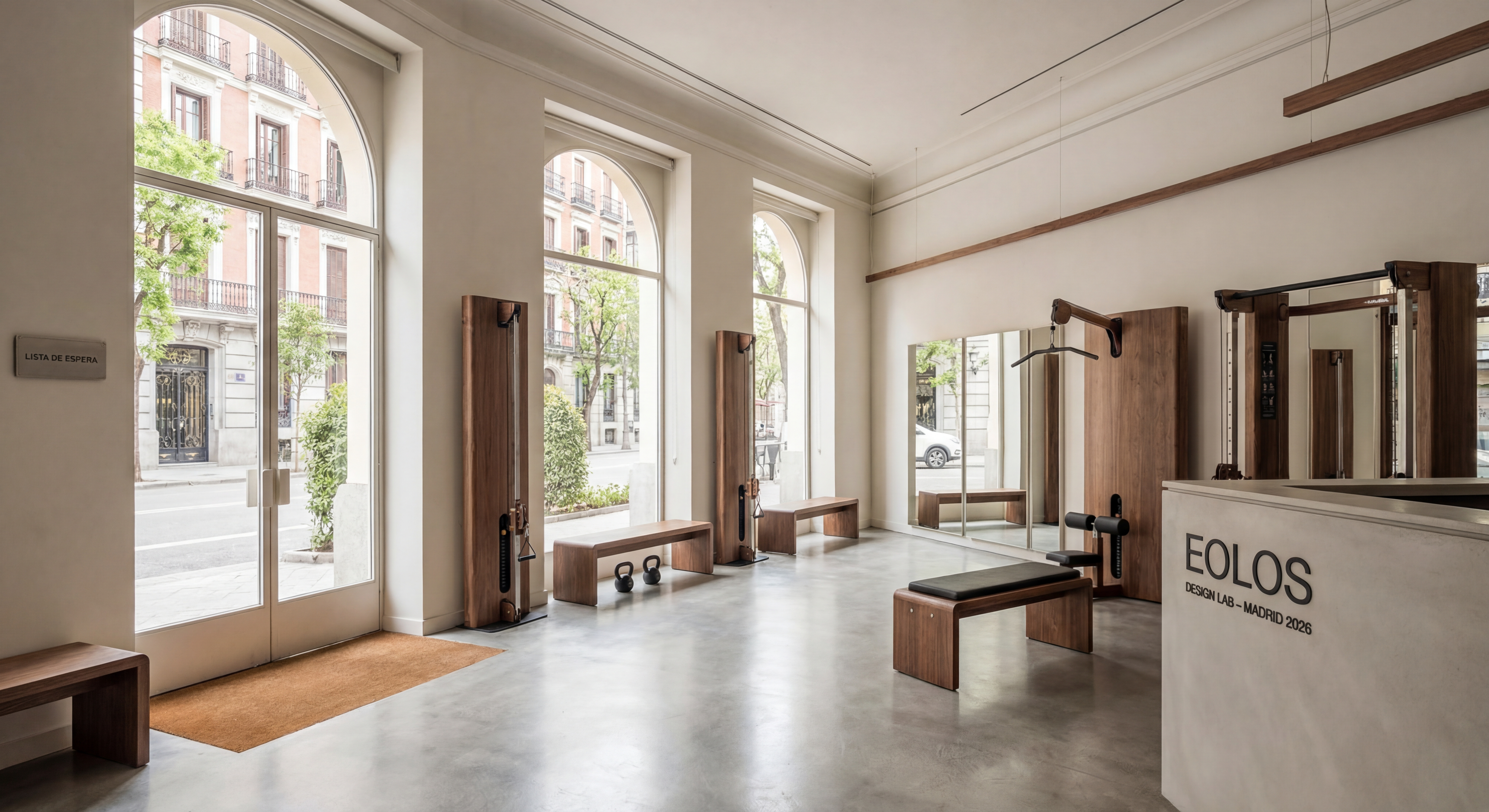
The difference between a low-cost gym that charges €29.90/month with a 28% retention rate and a boutique gym that charges €180/month with a waiting list isn't the equipment. It's the design.
Well-designed boutique gyms in Madrid generate €85-€142 in revenue per m²/month versus €22-€38 for low-cost gyms. Same space, four times the revenue. Design is the key to that difference.
This article demonstrates, through real-world case studies and behavioral economics, how the strategic design of boutique gyms impacts retention, LTV/CAC, average ticket price, and profitability. It's not Instagram-worthy decor. It's transformational experience architecture.
The brutal economics of low-cost vs boutique fitness
Real case: Two gyms in the Salamanca district, separated by 600 meters
Gym A: Low-cost national chain
Space:
- 850m²
- 120 cardio + strength machines
- Design: industrially functional, lacking personality
- Atmosphere: commercial music, TVs, white lights
Economic:
- Fee: €29.90/month
- Active members: 1,240
- Actual occupancy rate: 32%
- 12-month retention: 28%
- Monthly billing: €37,076
- Revenue per m²/month: €43.60
LTV/CAC:
- LTV (lifetime value): €179 (6 months average × €29.90)
- CAC (cost of acquisition): €42 (ads + promo)
- LTV/CAC ratio: 4.26x
Margins:
- Gross margin: 68%
- Personal: €18,600/month (50% revenue)
- Rent: €14,000/month (38%)
- Operating margin: 8-12%
Gym B: Boutique specialty (600m away)
Space:
- 320m²
- 24 machines + functional area + studio classes
- Design: warm industrial, strong identity, photogenic
- Atmosphere: curated music, statement lighting, community
Economic:
- Base fee: €180/month
- Unlimited classes: €220/month
- PT 2x/week: €380/month
- Active members: 186
- Occupancy rate: 79%
- Monthly billing: €38,280 (mix of plans)
- Revenue per m²/month: €119.62 (+174% vs A)
LTV/CAC:
- Average LTV: €3,336 (18.6 months × €180 average)
- CAC: €200 (mainly organic referrals)
- LTV/CAC ratio: 16.68x
Margins:
- Gross margin: 76%
- Personal (qualified trainers): €14,200/month (37%)
- Rent: €8,500/month (22% – smaller space)
- Operating margin: 34-42%
Annual difference:
- Gym A: €444,912 revenue → €36k-€53k profit
- Gym B: €459,360 revenue → €156k-€193k profit
Difference in initial investment:
- Gym A: €680,000 (850m²)
- Gym B: €224,000 (320m²)
- Per m²: €800 vs €700
ROI of the boutique model:
- Additional annual profit: €120k-€140k
- Smaller investment: -€456k
- Superior ROI in all aspects
Why the design allows charging 6x more (same treadmill)
1. From functional gym to transformational sanctuary
Client fitness psychology 2026:
Low-cost gym client:
- He enters: "I should do some sport"«
- Motivation: Guilt, New Year's resolution
- Expectation: Machines available, hot shower
- Frequency: 0.8 visits/week (actual average)
- Stay: 4-7 months
- Annual spending: €149-€209
Gym boutique client:
- Enter: "This is MY space for transformation"«
- Motivation: Identity, community, progress
- Expectation: Complete experience, motivation, belonging
- Frequency: 3.4 visits/week
- Stay: 18-26 months
- Annual expenditure: €2,160-€2,880
What changed? DESIGN transformed obligation into an identity ritual.
2. Motivational environment = adherence = LTV
The big problem with fitness: 721% of gym members stop going within 4 months.
But they continue to pay for 2-4 more months (zombie income).
The low-cost model DEPENDS on those zombie revenues:
- Actual revenue: 32% from active partners
- 68% pay but don't go
- Model = sell more memberships than the space can support
Boutique model DEPENDS on active retention:
- 79% of members go regularly
- Retention 18+ months
- Model = loyal community that refers
Design that creates adherence:
A) Energizing lighting:
- Temperature 4000-5000K (cardio-active zones)
- 2800-3200K (stretching/yoga zones – relax)
- RGB LED in functional area (changes according to the time of day)
- NEVER flat fluorescent lights
- Create drama = amazing photos = UGC
B) Music as fuel:
- Professional audio system (not cheap speakers)
- Playlists curated by time (morning vs afternoon)
- BPM coordinated with training type
- Zoned volume control
C) Integrated Instagrammable Zones:
- Statement wall (mural, motivational neon)
- Area with logo, well lit
- Equipment statement (CrossFit rig, boxing bags)
- Customer shares = organic referrals
D) Subtle smells:
- Diffusers with energizing oils (mint, eucalyptus)
- NO harsh chemical air fresheners
- Perceived freshness = perceived cleanliness
3. Differentiation through specialization
Low-cost gym: «"We have something for everyone" (generic)
Boutique gym: «"We are the best in X" (specific)
Specializations that work in Madrid:
A) Boutique Strength/Powerlifting:
- Target: Serious, strong men aged 25-45
- Equipment: Racks, Olympic bars, platforms
- Design: Dark industrial, metal, chalk
- Community: Competitive, expertise
B) Functional/CrossFit Boutique:
- Target: Mixed 25-40, looking for intensity + community
- Equipment: Rig, ropes, sleds, boxes
- Design: Warehouse, urban, motivational
- Community: Classes, friendly competition, social
C) Boutique Wellness/Yoga + Strength:
- Target: Women 28-50, holistic approach
- Equipment: Yoga studio + weights + pilates
- Design: Warm, natural, plants, wood
- Community: Supportive, mindfulness
D) Boutique Boxing/MMA:
- Target: Mix 22-42, looking for intensity + skill
- Equipment: Ring/cage, bags, gloves
- Design: Dark, intense, fight club aesthetic
- Community: Competitive, technical, camaraderie
Specialization = justified premium pricing
4. A designed community, not a random one
Low-cost gym: Partners are anonymous (convenience of the model)
Boutique gym: Partners know each other by name (heart of the model)
Design that fosters community:
A) Pre/post training social zone:
- Small lounge with benches
- Coffee/smoothie bar
- Board with photos/achievements of members
- Area for conversation outside the training zone
B) Open layout:
- Without excessive divisions
- Open lines of sight
- You train "with" others, not "near" others
C) Changing rooms as a continuation of the experience:
- NO industrial metal lockers
- Wood, carefully crafted aesthetics
- Showers with good pressure/temperature
- Amenities (shampoo, gel, towels)
D) Classes on a visible calendar:
- Digital screen with schedules/instructors
- Facilitates spontaneous registration
- Creates social momentum ("I'm going to the 7:00 p.m.")
Result: Customer makes friends = never leaves
💡 Are you thinking of opening a boutique gym or transforming an existing one?
We design boutique gyms in Madrid with retention 18+ months, LTV/CAC 14-18x, and revenue €95-€142 per m²/month.
The 7 critical elements of a profitable boutique gym design
1. Reception: first impression defines expectations
Low-cost gym reception: Generic counter, lathes, transactional environment.
Reception gym boutique: A statement that communicates "this is different.".
Critical elements:
A) Custom desk statement:
- Material: Solid wood + industrial metal
- Focused lighting on logo/brand
- Height: 90-105cm (ergonomic)
- Integrated tablet/screen for check-in
- NOT a generic office counter
Budget: €3,500-€8,500
B) Branding wall (behind reception):
- Illuminated volumetric logo
- The identity mural
- Or a neon sign with a motivational tagline
- First element that client photographs
Budget: €2,800-€7,000
C) Retail product display:
- Branded clothing, shakers, accessories
- As functional decoration
- Generate additional revenue 8-15%
D) Mini waiting area:
- 2-3 comfortable seats
- Table with curated fitness/lifestyle magazines
- Water/lemon infusion available
E) Aroma and music from the entrance:
- Complete first sensory impression
- Define the tone of experience
Complete reception budget: €8,500-€18,000
Case: Boutique gym Chamberí
Reception desk with walnut wood + black metal + neon "No Excuses":
- 67% of new leads take photo at reception
- Lead → trial conversion: 54%
- NPS (Net Promoter Score) mentions reception: 38%
2. Layout: strategic distribution by energy
Low-cost layout: Maximum equipment in minimum space.
Boutique layout: Zones defined by energy type and use.
Strategic distribution 320m² example:
Zone 1: Cardio (25% space = 80m²):
- Treadmills, ellipticals, rowing machines, bikes
- Near the entrance (less intimidating)
- View of windows/exterior (natural light)
- Energizing lighting
Zone 2: Guided Force (20% = 64m²):
- Selectorized machines
- For less advanced users
- Accessible, intuitive layout
Zone 3: Free weights (30% = 96m²):
- Racks, platforms, benches, bars
- Heart of the boutique gym
- Dramatic lighting
- Full wall mirrors
Zone 4: Functional (15% = 48m²):
- Rig, battle ropes, sleds, boxes
- Transformable open space
- Special flooring (turf, thick rubber)
Zone 5: Study classes (10% = 32m²):
- Multipurpose (yoga, HIIT, spinning)
- Soundproofed from the rest
- Adjustable lighting
- Independent audio
Layout/distribution budget (includes special flooring): €18,000-€38,000
Clue: Acoustic and visual separation between zones = multiple simultaneous experiences without conflict.
3. Equipment: visible quality
In a boutique gym, the equipment is part of the design.
A) Cardio equipment (€35,000-€65,000):
- Professional brands: Technogym, Life Fitness, Matrix
- NO semi-commercial brands
- Integrated screens (entertainment)
- Aesthetically consistent (same manufacturer)
Typical 320m²:
- 6 professional tapes: €24,000
- 4 elliptical machines: €12,000
- 4 bikes: €8,000
- 2 Concept2 oars: €2,000
B) Selectorized force equipment (€22,000-€45,000):
- 8-12 professional machines
- Layout that facilitates circuit
C) Free weight equipment (€28,000-€58,000):
- 3-4 racks power: €12,000-€18,000
- Lifting platforms: €4,500
- Olympic bars (8-10): €3,000
- 1,500kg bumper discs: €6,000-€9,000
- Adjustable benches: €3,500
- Dumbbells 5-50kg: €8,000-€12,000
D) Functional equipment (€18,000-€32,000):
- CrossFit/functional rig: €8,000-€14,000
- Battle ropes, sleds, boxes: €4,000
- Kettlebells, medicine balls: €3,000
- TRX, bands: €1,500
E) Audio and screens (€8,000-€16,000):
- Audio zone system: €5,000-€10,000
- Screens (classes, motivation): €3,000-€6,000
Complete equipment: €111,000-€216,000 (35-50% total investment)
Crucial: Professional equipment conveys seriousness = justifies pricing.
4. Lighting: energy and drama
Lighting determines 40% of the training environment.
Multi-layer system:
A) Adjustable general lighting:
- LED 4000-4500K (neutral-cool) cardio/strength zone
- Adjustable by time of day
- Tomorrow (6-10am): 85% intensity
- Afternoon (3-7pm): 100%
- Night (7-10pm): 75%
B) Dramatic focus lighting:
- Directional spotlights over free weights area
- Creates shadows, depth
- "Scenario" effect«
C) Accent lighting:
- LED strips on racks, mirrors
- Optional RGB for special events/classes
- Motivational neon signs
D) Maximized natural lighting:
- Uncovered windows (ideal cardio zone)
- Natural light = well-being + energy savings
Complete lighting budget (320m²): €15,000-€32,000
Case: Boutique gym with RGB lighting functional area
System that changes by class type:
- HIIT: Intense pulsating red
- Yoga/stretch: Soft blue
- Strength: Neutral white
Result:
- Instagram stories shared: +340%
- Class attendance: +28%
- «"Amazing atmosphere" in reviews: 61%
5. Changing rooms and showers: they are not secondary
Changing rooms communicate as much as a reception area.
Boutique specifications:
A) Designed lockers:
- Wood with digital locks
- NOT painted industrial metal
- Proper spacing (not tight)
- Integrated USB/Sockets
Budget: €8,000-€16,000
B) Real showers:
- Actual pressure (pump if necessary)
- Stable temperature
- Glass partition (not a curtain)
- Good quality faucets (Grohe, Hansgrohe)
Budget: €6,000-€14,000
C) Restroom area with amenities:
- Shampoo, gel, body cream, deodorant
- Professional hair dryers
- Well-lit mirrors
D) Towels included:
- Laundry service
- Good quality towels (not rough paper)
- Cost: €120-€180/month
E) Materials:
- Large format tiles (not public changing room type)
- Warm wood/ceramic
- Warm (not cool) lighting
F) Odors:
- Powerful ventilation
- Diffusers with oils
- Cleaning 3x/day
Budget for complete changing rooms (men + women): €28,000-€52,000
Impact: Mediocre clothing ruins the entire premium feel. Don't skimp.
6. Social area/cafe: retention by community
The secret of boutiques with 18+ month retention: social area.
Cafe/lounge area (20-35m²):
Items:
- Small bar with:
- Espresso machine
- Protein/Smoothie Shaker
- Refrigerator with drinks
- Healthy snacks
- Seats 8-12 people
- High tables + stools
- achievements/partner photos board
- Screen with upcoming classes/events
Budget: €12,000-€24,000
Additional revenue coffee/snacks: €1,800-€4,200/month (65% margin)
But the true value:
- Partners socialize pre/post training
- Conversations = friendships = retention
- Events (nutrition talks, challenges) = community
Case: Boutique gym with spacious coffee area
28m² lounge area with specialty coffee + smoothies:
- 54% of members regularly use the area
- Time spent at the gym: 72 min → 94 min
- Retention month 12: 82% (vs 63% before zone)
- Direct coffee revenue: €3,400/month
- Additional retention value: €12k-€18k/year
7. Total visual identity: spatial branding
Boutique gym WITHOUT a strong identity = expensive low-cost.
Elements of identity:
A) Coherent color palette:
Option 1: Modern Industrial
- Base: Black, dark gray, cement
- Accents: Energetic yellow/orange
- Feeling: Urban, intense, serious
Option 2: Contemporary Wellness
- Base: White, light gray, light wood
- Accents: Sage green, terracotta
- Feeling: Clean, balanced, mindful
Option 3: Athletic performance
- Base: Charcoal, navy blue
- Accents: Red, white
- Feeling: Competitive, technical, pro
B) Murals/motivational art:
- Statement wall with mural
- Or motivational vinyl phrases
- Large format photography (athletes, movement)
Budget: €4,000-€12,000
C) Neon signs with taglines:
- «Earn Your Shower»
- «"Train Insane or Remain The Same"»
- «"Sweat is Just Fat Crying"»
- «"No Pain No Gain" (classic)
Budget: €1,500-€4,000/neon
D) Complete signage:
- Signs in areas
- Equipment instructions
- Rules/etiquette
- Everything designed coherently
Budget: €2,000-€5,000
E) Branded merchandising:
- T-shirts, tank tops, sweatshirts
- Bottles, towels, bags
- As retail + as a walking identity
Total visual identity budget: €12,000-€28,000
Result: A recognizable, memorable, Instagrammable gym.
Actual budgets by type
Boutique strength gym 280-350m² (specialized in strength)
Civil works and preparation:
- Demolition/preparation: €8,500
- Special flooring (platforms, rubber): €18,000
- Walls (industrial brick/cement): €12,000
- Roof (exposed industrial): €6,500
- Partial soundproofing: €9,000
- Subtotal work: €54,000
Facilities:
- Reinforced electric: €14,000
- Powerful air conditioning: €22,000
- Ventilation: €8,000
- Plumbing (showers): €6,500
- Subtotal installations: €50,500
Equipment:
- Basic cardio: €18,000
- Selected (minimum): €12,000
- Free weights (focus): €52,000
- Lightweight and functional: €8,000
- Subtotal equipment: €90,000
Furniture and areas:
- Reception: €8,000
- Changing rooms + showers: €32,000
- Small social area: €6,000
- Subtotal furniture: €46,000
Lightning:
- Complete dramatic system: €18,000
Identity:
- Space branding: €12,000
- Murals + neon: €6,500
Technology:
- Audio: €6,000
- Management software: €2,500
- Access control: €3,500
- Subtotal tech: €12,000
Project and direction:
- Design + PM: €14,000
TOTAL INVESTMENT: €303,000 Per m² (310m²): €977/m²
Projected Revenue:
- 165 members × €165 average = €27,225/month
- Retail: +€2,800/month
- Additional PT: +€4,200/month
- Total: €34,225/month
- Revenue/m²/month: €110
Break-even: 112 members (68% capacity) Payback: 22-28 months
Functional boutique gym 320-400m² (CrossFit style)
Total investment: €285,000-€385,000 Per m²: €815-€1,080/m²
Includes:
- Large CrossFit Rig (6-8 stations)
- Large functional open area
- Various equipment (ropes, sleds, boxes, oars)
- Timing/leaderboard system for classes
Projected Revenue:
- 180 members × €195 (unlimited classes) = €35,100/month
- Revenue/m²/month: €97-€117
Break-even: 118 members Payback: 24-30 months
Boutique wellness gym 350-450m² (hybrid yoga + strength)
Total investment: €320,000-€425,000 Per m²: €800-€1,060/m²
Includes:
- Large yoga studio (80m²)
- Strength zone equipped
- Pilates/TRX Zone
- Warm design (wood, plants, natural light)
- Spa-like changing rooms
Projected Revenue:
- 210 members × €180 average = €37,800/month
- Drop-in classes: +€3,200/month
- Wellness products: +€2,400/month
- Total: €43,400/month
- Revenue/m²/month: €108-€123
Break-even: 135 members Payback: 20-26 months
Boutique pricing models
Model 1: Simple (standard) membership
Plans:
- Unlimited access: €165-€195/month
- Off-peak (mornings): €125-€145/month
- Unlimited classes: €195-€240/month
Target: Self-employed users Retention: 16-22 months on average
Model 2: Membership + Hybrid PT
Plans:
- Access + 2 PT/week: €320-€380/month
- Access + 4 PT/week: €520-€620/month
- Access only: €165/month
Target: Users who want guidance Retention: 22-28 months Higher average ticket price
Model 3: Classes exclusively
Plans:
- 8 classes/month: €110-€145
- 16 classes/month: €185-€225
- Unlimited: €220-€280
Target: CrossFit, HIIT, cycling boutiques Stronger community Occupancy per critical session
Model 4: Corporate Membership
Business plan:
- Agreement with nearby companies
- Price: €145/employee (company pays 50-100%)
- Minimum 12 employees
Benefit:
- Constant pipeline
- High retention (company pays)
- It occupies off-peak (midday)
Complete success stories
Case 1: Strength boutique gym, Salamanca
Profile:
- Former powerlifting athlete + investment partner
- Concept: "The house of serious strength"«
- Target: Passionate, strong men 25-45
Space:
- 295m²
- Basement premises (advantage: high ceiling, natural soundproofing)
Investment: €289,000
Key elements:
- Dark industrial design (black, gray, metal)
- Top strength equipment (Eleiko, Rogue)
- 4 competition racks
- 6 lifting platforms
- 2,200kg calibrated discs
- Neon "Earn Your Strength"«
- Large photo mural of powerlifting
- Minimal cardio zone (only rowing, air bikes)
Pricing:
- Membership: €185/month
- Customized programming: +€65/month
- Technical coaching: €45/session
Year 1 Results:
- Members: 142
- Occupancy: 76%
- Average ticket price: €203 (many take coaching)
- Billing: €28,826/month
- Revenue/m²/month: €97.71
Retention:
- Month 6: 88%
- Month 12: 79%
- Month 18: 71%
Success factors:
- Radical specialization (strength only, nothing else)
- Equipment that enthusiasts recognize
- Ego-free but competitive environment
- Scientifically-based programming
- Small but committed community
Quote owner: «"Low-cost sells access. Boutique sells transformation + community. Our members happily pay €185 because they progress, have friends here, and the gym reflects who they want to be."»
Case 2: Boutique functional gym, Malasaña
Profile:
- Couple (he's a CrossFit trainer, she's a marketer)
- Concept: CrossFit-style without official licensing (more accessible)
- Target: Mixed 25-40, looking for intensity + social
Space:
- 340m²
- Renovated industrial warehouse
Investment: €312,000
Differentiation:
- Small classes (max 14 people)
- Daily programming in our own app
- Spectacular central rig (focal point)
- Open gym area + separate classroom area
- Digital Leaderboards
- Monthly events (friendly competitions)
Pricing:
- Unlimited classes: €195/month
- 12 classes/month: €145/month
- Open gym only: €135/month
Year 1 Results:
- Members: 198 (mix of plans)
- Average ticket price: €178
- Billing: €35,244/month
- Revenue/m²/month: €103.66
Special features:
- 67% of members come to classes (not open gym)
- Average class attendance: 11.4 people
- 4-5 classes/day (morning, midday, afternoon x2, evening)
- Coaches 4 (2 full-time, 2 part-time)
Community:
- Active WhatsApp group (178 members)
- Monthly social events (dinners, outings)
- Quarterly internal competitions
- Instagram: 4,200 followers (UGC of partners)
Retention month 12: 81%
Success factors:
- Small classes = personalized attention
- Varied programming = never boring
- Competitive but supportive environment
- Excellent coaches = experience
- Real community = retention
Co-owner quote: «"We sell fitness, but what we really sell is belonging. Our members don't just come to work out. They come to see their friends. It's their tribe."»
Case 3: Boutique wellness gym, Retiro
Profile:
- Entrepreneur ex-corporate with burnout
- Concept: Holistic fitness (strength + mobility + mindfulness)
- Target: Women 30-55, professionals seeking balance
Space:
- 380m²
- Ground floor with full windows (brutal natural light)
Investment: €348,000
Concept:
- 50% strength/cardio
- 30% yoga/pilates
- 20% social area/cafe
Design:
- Palette: Beige, terracotta, sage green, light wood
- Plants everywhere (28 large ones)
- Soft, warm lighting
- Yoga studio with large windows + garden views
- Café with wellness menu (smoothies, matcha, healthy snacks)
Services:
- Traditional gym
- Yoga classes (vinyasa, yin, restorative)
- Pilates (machines + mat)
- Workshops (nutrition, mindfulness, hormonal health)
Pricing:
- All access: €220/month
- Gym only: €165/month
- Unlimited yoga/pilates classes only: €180/month
- Flexible combos
Year 1 Results:
- Members: 224 (98% women)
- Average ticket price: €198
- Gym billing: €44,352/month
- Coffee: +€4,800/month
- Workshops: +€1,400/month
- Total: €50,552/month
- Revenue/m²/month: €133
Special features:
- Morning occupation (7-10am): 88% (yoga classes)
- Midday occupancy (12-14h): 72% (express force)
- Evening occupancy (6-8pm): 91% (mixed)
- Coffee builds community + revenue
- Workshops = added value + marketing
Retention month 18: 83% (very high)
Success factors:
- Holistic approach (not just brute force)
- very specific female target audience
- Welcoming (vs. intimidating) design
- Supportive community, zero judgment
- Natural light = real well-being
Owner quote: «"Many gyms are masculine spaces in disguise. We designed a space FOR women, with a feminine sensibility. Result: members come 4-5 times a week and constantly bring friends. Our CAC is €140 (80% referrals)."»
Retention strategies (the real secret)
Retention is the core of the boutique model.
LTV depends on retention:
- 6-month retention: LTV = €1,080 (€180 × 6)
- 12-month retention: LTV = €2,160 (2x)
- 18-month retention: LTV = €3,240 (3x)
- 24-month retention: LTV = €4,320 (4x)
Design strategies that increase retention:
1. Flawless Onboarding
The first 30 days are critical:
- Dedicated induction zone (separate)
- Personalized tour 20-30 min
- Free introductory session
- Check-ins week 1, 2, 4
- Social integration (introduction to other members)
Gyms with designed onboarding: Retention month 3: 92% vs 68% without it
2. Tracking visual progress
App + screens in gym:
- Partners see their progress (PRs, attendance, achievements)
- Friendly leaderboards
- Monthly challenges
- Public recognition of achievements
Gamification = adherence
3. Variability of experience
Gym with a single offer: Boredom = churn
Gym with variety:
- Different classes (HIIT, strength, yoga)
- Themed challenges
- Educational workshops
- Guest coaches/athletes
Variety = freshness = retention
4. Active community
Beyond the gym:
- Monthly social events
- Friendly competitions
- WhatsApp/Slack Groups
- Celebrations (members' birthdays)
Friendships = 2.4x higher retention
5. Accessible Personalization
Boutique vs low-cost:
- Low-cost: Anonymous
- Boutique: Staff knows your name, goals, and progress
Coaches who remember = partners who stay
Locations in Madrid: where boutiques operate
Prime areas (high success):
1. Salamanca / Goya / List
- Target: High-income professionals
- Willing to pay premium
- High quality expectations
- Rent: €14-€22/m²/month
Ideal concept: Boutique wellness or strength premium
2. Chamberí / Trafalgar
- Young families, professionals
- Good purchasing power
- They seek quality and proximity
- Rent: €12-€18/m²/month
Ideal concept: Hybrid boutique (strength + classes)
3. Retreat / Ibiza
- Residential, quiet
- Professionals + families
- High loyalty
- Rent: €11-€16/m²/month
Ideal concept: Wellness, family-friendly
4. Malasaña / Chueca
- Target young adult 25-40
- Fitness/wellness conscious
- They are looking for experience + social interaction
- Rent: €13-€19/m²/month
Ideal concept: Functional, CrossFit-style, trendy boutique
Corporate areas (opportunity):
5. Four Towers / AZCA
- High concentration of offices
- Demand during working hours (middays, after work)
- Corporate memberships
- Rent: €10-€15/m²/month
Ideal concept: Express training, classes during working hours
6. Prosperity / Arturo Soria
- Residential + corporate
- Less boutique saturation
- Affordable rents
- Rent: €9-€13/m²/month
Ideal concept: Affordable, family-friendly boutique
Areas to avoid:
- Tourist resort: Fluctuating, not a loyal base
- Very low-income neighborhoods: No pricing power
- Areas without parking/transport: Limiting
Common mistakes that kill retention (and margins)
Mistake 1: Invest in equipment, skimp on design
The symptom: €120k in machines, €25k in design.
Consequence: It looks like an expensive low-cost gym. It does not justify premium pricing.
The solution: Balance 55% equipment, 45% design/experience.
Cost of error: Pricing limited to €100-€130/month = unsustainable
Error 2: Layout that maximizes equipment vs. experience
The symptom: Machines packed tightly, areas without definition.
Consequence: Overwhelming, non-premium feeling.
The solution: Spaciousness > density. 2-2.5m² per simultaneous user.
Cost of error: Retention -35%, low-cost perception
Error 3: Mediocre changing rooms
The symptom: Cheap lockers, poor showers, questionable cleanliness.
Consequence: The entire premium perception is destroyed.
The solution: Changing rooms as a continuation of the experience. Investment 15-20% of the total.
Cost of error: NPS -40 points, retention -28%
Error 4: No social/community area
The symptom: Equipment only, no interaction spaces.
Consequence: Partners not connecting = low retention.
The solution: Mandatory lounge/café area. 8-12% of the space.
Cost of error: Retention month 12: 52% vs 79% with social zone
Error 5: Functional lighting without drama
The symptom: Flat white office-type lights.
Consequence: Demotivating atmosphere, bad photos, zero UGC.
The solution: Dramatic multi-layered lighting. 10-12% budget.
Cost of error: UGC -75%, referrals -45%
Error 6: Lack of a strong visual identity
The symptom: "Nice" but generic design.
Consequence: Not memorable, not differentiated.
The solution: Unique pre-designed identity. Palette, style, storytelling.
Cost of error: Zero recognition = more expensive marketing
Error 7: Untrained staff in the community
The symptom: Staff only operational, not relational.
Consequence: Cold, transactional atmosphere.
The solution: Staff must know partners, facilitate connections, and create a positive environment.
Cost of error: Retention -30%, low-cost environment
Working with EOLOS in your boutique gym
We design boutique gyms in Madrid with retention rates of 75-85%, LTV/CAC rates of 14-18x, and revenue of €95-€142 per m²/month.
Our approach:
1. Retention-oriented design
We don't design pretty gyms. We design gyms where members stay for 18+ months.
Every decision asks itself: "Does this increase retention?"«
- Layout facilitates socialization
- Differentiated zones = variety
- Premium changing rooms = complete experience
- Strong identity = pride of belonging
2. Integrated financial modeling
Before designing, we model:
- Capacity (simultaneous vs. total members)
- Break-even by membership type
- Projected LTV by retention
- Investment payback
Design is optimized for a better investment/LTV ratio.
3. Defined specialization
Your boutique should have personality:
- Strength, functional, wellness, hybrid?
- Target audience: men, women, or a mix?
- Age, economic level?
Specialization = differentiation = pricing power.
4. Sourcing of strategic equipment
We balance:
- Quality (professional required)
- Aesthetics (should look premium)
- Budget (best options by range)
- Maintenance (suppliers in Madrid)
We connect you with professional suppliers offering better terms.
5. Launch Strategy
We designed a pre-opening plan:
- Founder membership presale
- Soft opening to test operations
- Launch event to generate buzz
- Referral strategy from day 1
Design + PM Investment: 10-14% total project cost
Frequently Asked Questions
How much does it cost to open a boutique gym in Madrid?
Total investment (all inclusive):
- Small 250-320m²: €240k-€330k
- Medium 320-420m²: €305k-€425k
- Large 420-550m²: €410k-€580k
Per m²: €850-€1,150/m² (boutique level, not low-cost)
Is a boutique gym profitable?
Yes, with proper execution.
Margins:
- Memberships: 75-82% gross margin
- PT/premium classes: 70-75%
- Retail: 60-70%
- Average: 76%
Break-even: 60-70% maximum capacity Payback: 20-30 months
Key: Retention 16+ months for healthy LTV/CAC.
How many partners do I need?
It depends on the square meters and the model:
Physical capacity: 0.8-1.2 simultaneous members per 10m²
Example 320m²:
- Simultaneous capacity: 26-38 people
- Total members: 180-220 (considering occupancy)
Typical break-even point: 55-65% capacity
What equipment is critical?
Mandatory professional quality:
- Cardio: Technogym, Life Fitness, Matrix
- Strength: Eleiko, Rogue, Hammer Strength
- Functional: Rogue, Again Faster
Do not skimp: Equipment conveys seriousness = justifies pricing.
Semi-commercial equipment = low-cost perception.
Class system or open access?
Viable models:
Free access + optional classes:
- Flexibility
- It appeals to self-employed users
- More distributed occupation
Classes exclusively (CrossFit-style):
- Stronger community
- More guided experience
- Concentrated occupancy (requires more classes/day)
Hybrid (recommended):
- Free access + classes included
- Best of both
- Higher retention
Which locations are working?
Prime areas in Madrid:
- Salamanca, Chamberí, Retiro: Target premium
- Malasaña, Chueca: Trendy young target
- AZCA, Cuatro Torres: Corporate (midday)
Key factors:
- Medium-high purchasing power
- Residential or office density
- Accessible parking or transport
- Existing boutique competition (valid demand)
Do I need fitness experience?
Ideally, yes, one of the partners.
Options:
- You're a coach: Perfect
- You're not a coach: Partner with an experienced coach + your management
- Investor only: Riskier (you depend on employees)
The "investor-only" model requires a very robust system.
How many staff do I need?
By operational shift:
- Reception: 1 person
- Gym floor: 1-2 (depending on size)
- Classes: Dedicated Instructor
Complete equipment:
- Manager/Head Coach
- 2-4 coaches
- 1-2 Reception/Admin
- Cleaning (can be outsourced)
Personal cost: 32-42% revenue
How do I compete with low-cost carriers?
You're not competing. You're playing in a different league.
Low-cost sells: Cheap access, convenience, no commitment
Boutique sells: Experience, community, results, identity
Low-cost client: «"I should go to the gym" (goes 0.8 times/week)
Boutique client: «"The gym is part of who I am" (goes 3.4x/week)
Different client, different proposal, different pricing.
Conclusion: Boutique is not fashion, it's a superior model
In 2026, the Madrid fitness market is polarized:
- Low-cost: €19.90-€39.90/month, retention 28%, LTV €179
- Boutique: €165-€240/month, retention 79%, LTV €3,336
There is no viable middle ground.
The customer is looking for either the lowest price or the highest experience.
The numbers are clear:
Low-cost gym:
- Investment: €680k (850m²)
- Revenue/m²/month: €43
- Retention: 28%
- LTV/CAC: 4.26x
- Margin: 8-12%
Well-designed boutique gym:
- Investment: €305k (320m²)
- Revenue/m²/month: €119
- Retention: 79%
- LTV/CAC: 16.68x
- Margin: 34-42%
Lower investment. Higher profitability. Superior model.
You don't design boutiques because "it's fashionable".
You do it because:
- Brutal retention = High LTV = Amortized CAC
- Community = organic referrals = low CAC
- Pricing power = healthy margins = sustainable business
- Smaller space = smaller investment + lower rent
In Madrid, with 300+ gyms, standing out by "I have good machines" is not enough.
You need comprehensive experience that justifies 6x the low-cost price.
Design IS that experience.
The decision is yours. The numbers are clear..
Do you need a retention strategy for your gym?
At EOLOS Design Lab we design boutique gyms in Madrid with a focus on retention for 18+ months through spatial design + experience + community.
Tell us about your project. We'll help you design a gym that generates real customer retention.
 Español
  English