
Guide
Design of Headquarters for Foundations and Associations that Communicate Impact (Madrid 2026)
Subscribe to our newsletter!
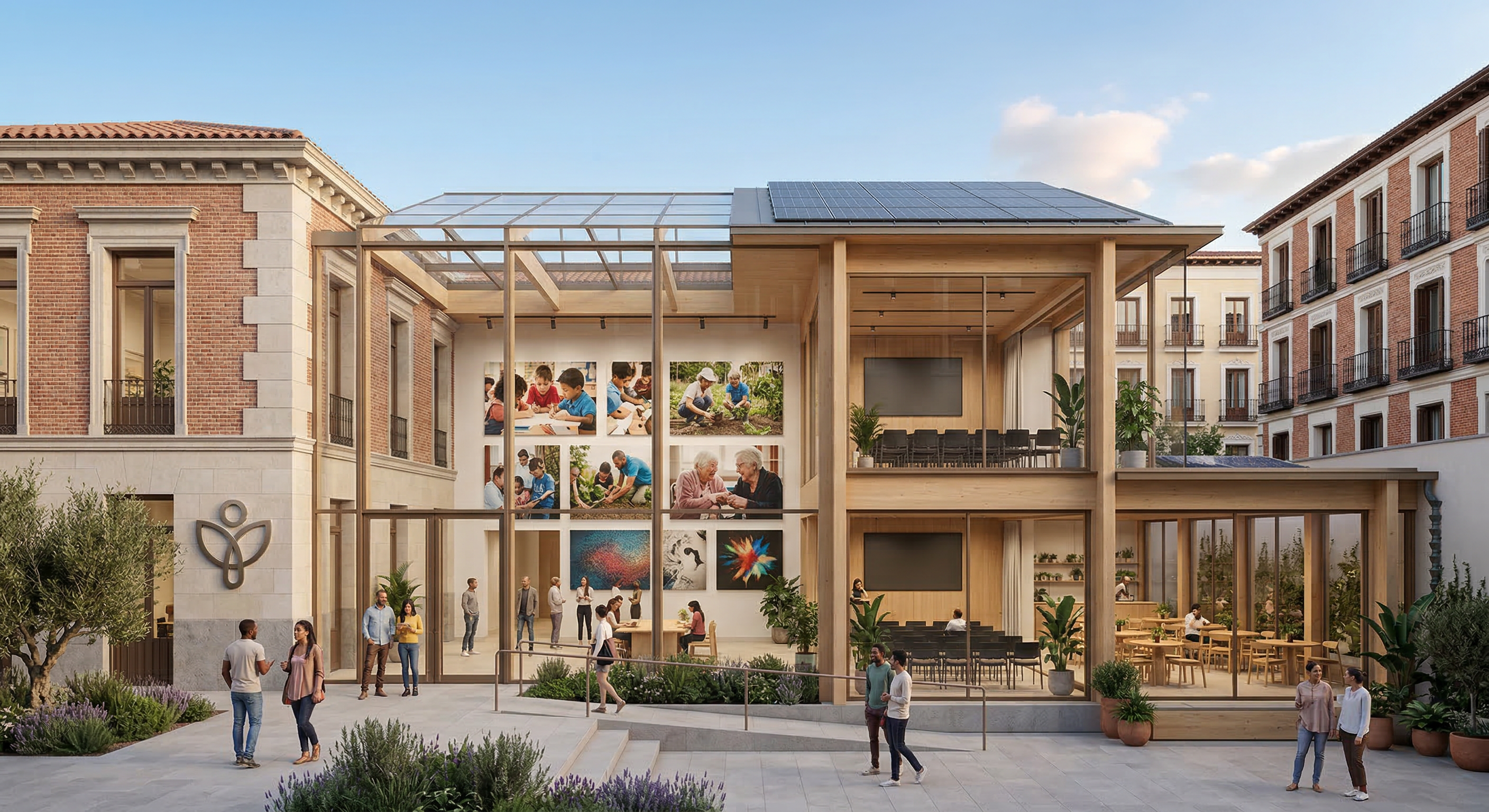
Foundations and associations face a specific design challenge: their spaces need to convey impact and seriousness to attract donors and institutions, but without appearing to spend money irresponsibly. It's a delicate balance that many organizations struggle to achieve, opting for spaces so austere they convey disorganization. The usual result is a space that communicates nothing positive: functional, austere, and lacking personality.
Why design impacts fundraising
A corporate or institutional donor visiting a foundation's headquarters is assessing whether the organization is reputable, capable of managing resources effectively, and whether the project warrants the investment. A neglected space conveys disorganization, even if the organization itself is impeccable. A well-maintained yet functional space conveys responsibility and seriousness. There's a fine line between the two, but it's a line that design can cross without incurring exorbitant costs.
Design principles for the third sector
Transparency and order as visual values
An organization with streamlined processes reflects this in its workspace: accessible yet organized files, clear work areas, well-presented communication materials, and nothing that appears neglected. This doesn't require a large investment. It simply requires attention to order and a few design elements that thoughtfully structure the space.
The meeting space with stakeholders: the most critical
The room where the foundation meets with donors, institutions, and strategic partners is the most important space in the headquarters. It doesn't have to be luxurious: it needs to be cohesive, organized, well-lit, have functioning presentation technology, and be furnished comfortably for two-hour meetings.
Impact communication integrated into the space
A foundation that can visually showcase the impact of its work in the space where it receives visitors has a tremendous advantage in fundraising conversations. A well-designed panel with success stories, an installation displaying real impact figures, well-presented project photographs: these aren't decorations. They're fundraising arguments integrated into the space.
The team's work area: a sign of culture
The team's workspace reflects the organization's culture. A team that works in a well-designed environment, with good lighting and spaces for both concentration and collaboration, performs better and experiences lower turnover. In the non-profit sector, where salaries are competitive with the private sector, the work environment is a key retention factor.
Actual budget: Foundation headquarters 100-150m² in Madrid
- Civil works and distribution: €10,000–€16,000 — Work area (open office + offices): €12,000–€20,000
- Main meeting room: €8,000–€14,000 — High-impact communication zone: €5,000–€9,000
- Lighting: €6,000–€10,000 — Finishes and signage: €4,000–€7,000
- Project and management: €5,000–€9,000
- Total: €50,000–€85,000. For a foundation that needs to raise €500,000 in annual donations, improving the perceived credibility of donor visits in a 15% (presumably a specific website or platform) could translate into an additional €75,000 in fundraising. The cost is justified in the first year.
Do you have a foundation or association in Madrid that needs a better space?
Tell us about your space, what works and what doesn't, and your stakeholder profile. We'll design a headquarters that works for you.