
Guide
Commercial Terrace and Garden Design that Increases Revenue without More Staff (Madrid 2026)
Subscribe to our newsletter!
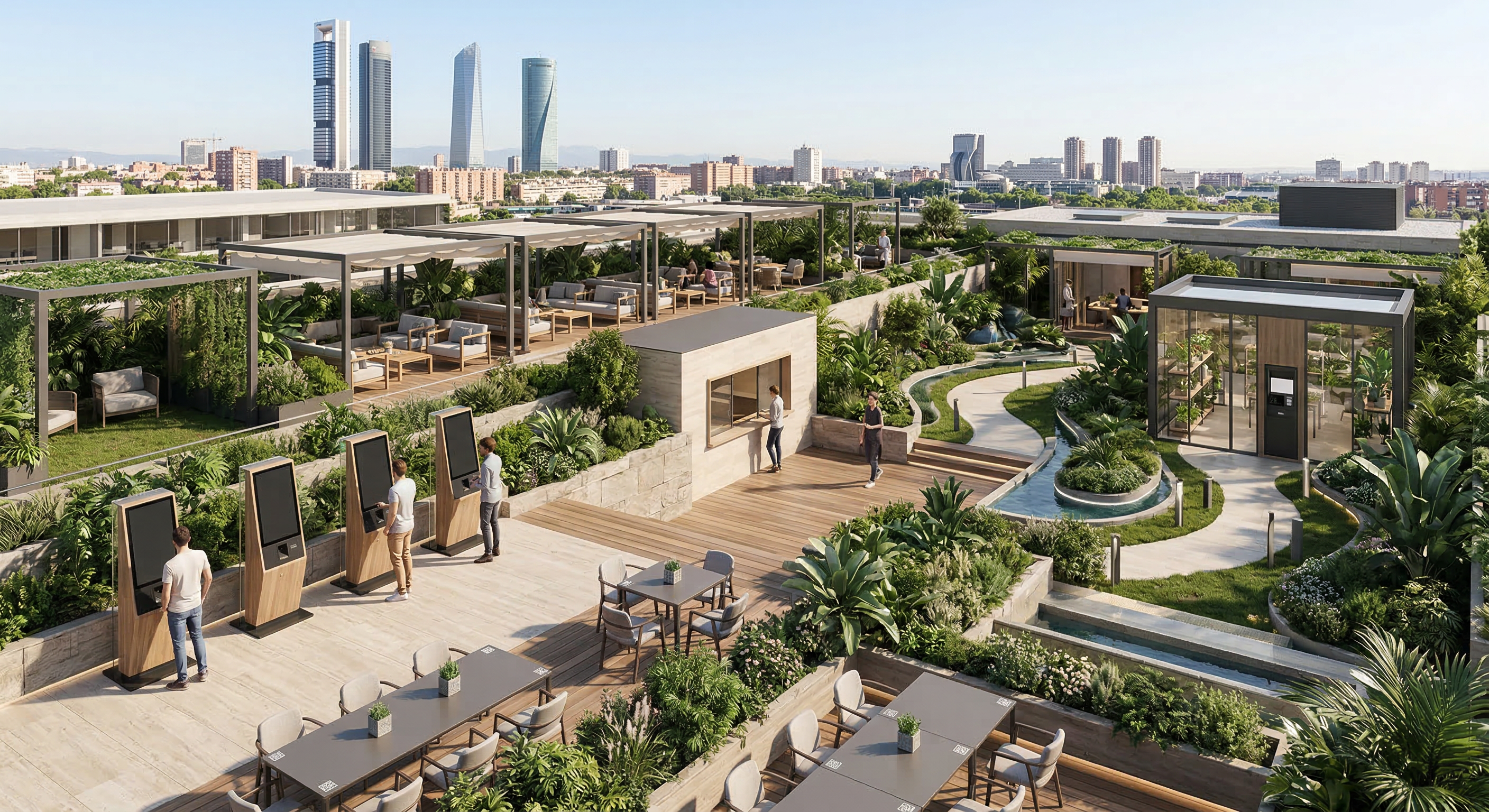
Madrid boasts one of the best climates in Europe for enjoying outdoor spaces. A well-designed terrace at a restaurant, hotel, or commercial business is not just an add-on. It's a huge revenue generator that many owners are failing to tap into.
And the most common mistake isn't not having a terrace. It's having a terrace that doesn't work because it's poorly designed.
What a business loses with a poorly designed terrace
A terrace with generic plastic chairs and tables, lacking proper shade, evening lighting, and anything to entice people to linger, is a terrace that only works during the two-hour midday window in spring. The rest of the year it's empty.
A well-designed terrace extends the season, increases operating hours, and boosts sales. Customers on an attractive terrace order more and stay longer.
The elements that make a terrace work
The shadow well resolved
In Madrid, the main problem with terraces in summer isn't the rain. It's the direct heat. A terrace without adequate sun protection is unusable from June to September between 12 pm and 5 pm.
Well-designed solutions range from pergolas with vegetation (longer installation time, greater visual impact) to quality retractable awning systems (quick installation, flexibility) or side-mounted parasols (no permanent structure, maximum flexibility). The design criterion is not just functionality: the shade solution must be consistent with the business's image. A cheap, generic system on a mid-to-high-end restaurant terrace ruins the overall impression.
The lighting: from a terrace that closes at 7 to a terrace that charges until 12
The lighting on a terrace determines how many hours a day it generates revenue. Without well-designed lighting, the terrace dies when the sun goes down.
Quality terrace lighting combines elevated light sources (pergolas, walls, structures), table lighting (candles, small battery-operated lamps, integrated furniture lighting), and ambient lighting that creates a pleasant ambiance without glare. An investment of €8,000–€20,000 in terrace lighting can add 4–5 hours of service per day for 8 months of the year. In a 20-table restaurant, that extra time can be worth €40,000–€80,000 annually.
The furniture: neither plastic nor display furniture
Terrace furniture in Madrid must meet three conditions: it must be comfortable for 90-120 minutes, weather-resistant, and visually consistent with the interior of the business. The mid-to-high-end range of outdoor furniture offers excellent options: technical materials that mimic teak or rattan, cushions with quality outdoor fabric, and finishes that won't fade in the sun.
Vegetation: the cheapest element with the greatest visual impact
Well-chosen and well-maintained plants transform a hard terrace into a pleasant space. Olive trees, lemon trees, lavender, rosemary, and well-trained bamboo are all excellent choices. Vegetation on a terrace creates privacy screens between tables and generates organic content on social media as people photograph the plants. The budget for plants can range from €2,000 to €6,000, with a visual impact that far outweighs the investment.
Actual budget: restaurant terrace 40-80m² in Madrid
- Flooring (decking, stone, exterior microcement): 8,000-16,000 euros
- Shade system (pergola or quality awnings): 12,000-22,000 euros
- Complete terrace lighting: 9,000-18,000 euros
- Furniture (tables + chairs + accessories): 10,000-22,000 euros
- Plants and flowerpots: 3,000-6,500 euros
- Heating systems for the cold season: 4,000-8,000 euros
- Project and management: 4,000-8,000 euros
- Total: 50,000-100,500 euros
A well-designed terrace at a Madrid restaurant can add 30-50 extra covers per service for 8-9 months of the year. With an average check of €35 and two services per day, that's a potential additional revenue of €75,000-€135,000 annually.
Do you have a terrace in Madrid that isn't performing as it should?
Tell us about the space, how many square meters you have, and what limitations there are (orientation, regulations, structure). We'll tell you what can be done and how much it would cost to do it properly.