
Guide
Fashion store design that turns visits into sales: layout, lighting and conversion (Madrid 2026)
Subscribe to our newsletter!
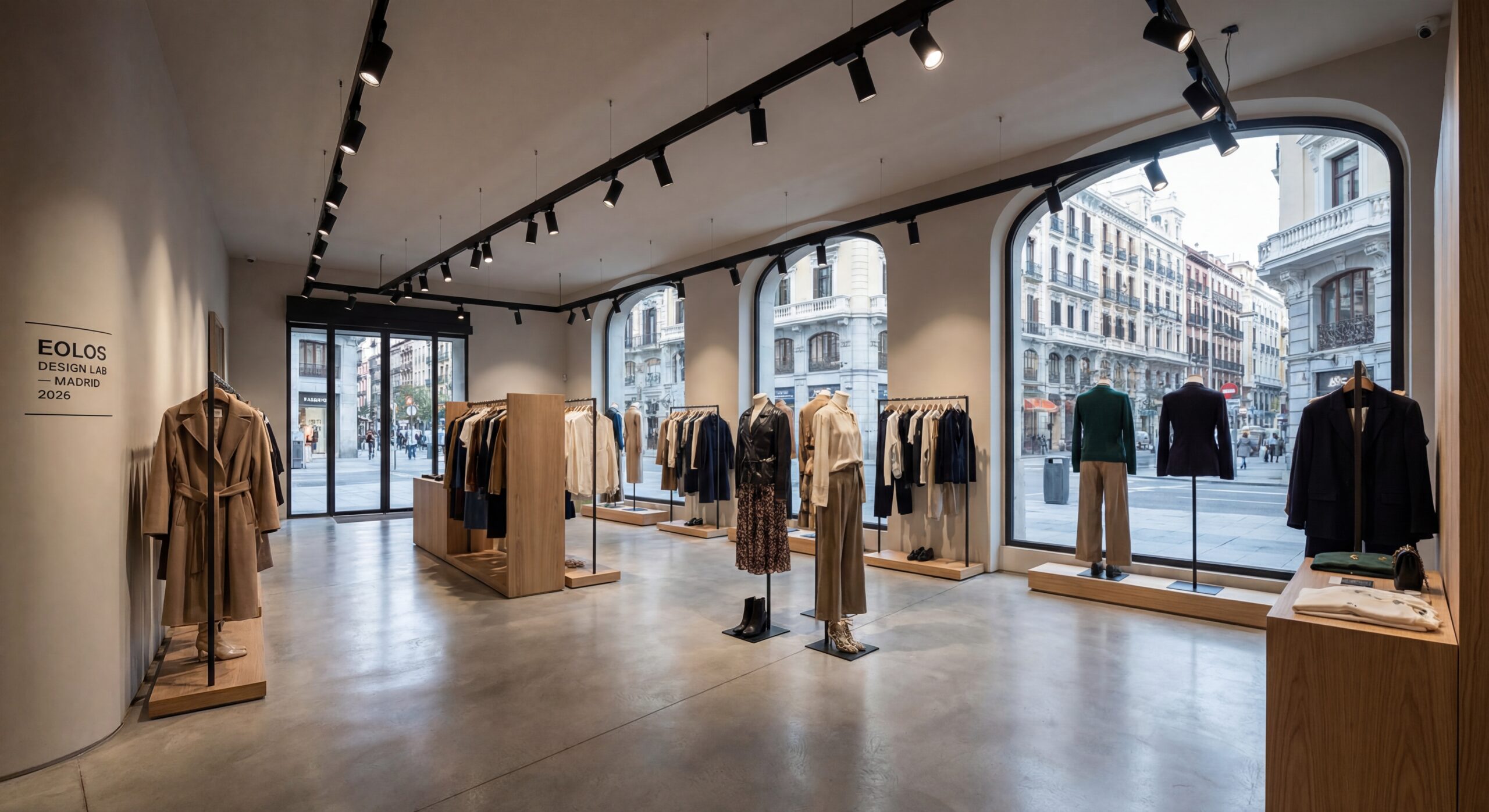
The difference between a store that converts 12% visits and one that converts 28% is rarely the product. It's the design.
Well-designed fashion stores in Madrid generate €8,500-€18,000 in sales per m²/year vs. €3,200-€6,500 for stores with mediocre design. Same product, same price, triple revenue per m².
This article demonstrates, with real-world examples and behavioral science, how retail design directly impacts conversion rates, average order value, dwell time, and profitability. It's not decoration. It's conversion architecture.
The brutal science of conversion in retail
Real case: Two women's fashion stores, Madrid city center
Store A: Functional "traditional store"
Spatial characteristics:
- 85m² in Fuencarral
- Linear layout, corridor type
- Standard white overhead lighting
- Standard commercial furniture
- Basic testers at the back
Metrics (6 months):
- Visits/day: 48
- Conversion: 11.5%
- Average ticket price: €67
- Sales/day: €370
- Sales/month: €11,100
- Sales/m²/year: €1,567
Store B: Strategic Conversion Design
Spatial characteristics:
- 82m² in Fuencarral (200m away)
- Circular layout with «power wall» entrance
- Multi-layer lighting + spotlights
- Designer furniture
- Fitting rooms experience at the center
Metrics (6 months):
- Visits/day: 52 (+8%)
- Conversion: 26.9% (+134%)
- Average ticket: €94 (+40%)
- Sales/day: €1,315
- Sales/month: €39,450
- Sales/m²/year: €5,774 (+269%)
Difference in initial investment:
- Store A: €68,000
- Store B: €142,000
- Difference: +€74,000
ROI of strategic design:
- Additional sales year 1: €339,600
- Gross margin 50%: €169,800 additional profit
- Payback: 5.2 months
Why design affects conversion (applied neuroscience)
1. The first 5 seconds: the moment of truth
The customer who enters your store performs an unconscious scan in 3-5 seconds:
Your brain is looking for answers to:
- Is this site for me? (identity)
- Can I afford it? (price perception)
- Is it worth exploring? (visual stimulation)
- Do I feel comfortable? (atmosphere)
If the answers are "yes": Explore 8-12 minutes, probability of purchase 25-40% If the answers are "no/maybe": Available in 90 seconds, purchase probability <5%
Design elements that answer these questions:
A) Power wall (entrance wall):
- First 3m of visibility from the door
- Define identity immediately
- You must showcase your best star product/collection
- Dramatic spotlighting
Common mistake: Entry with promotions/discounts. Message: "We're desperate, we're not premium."«
Best practice: Entrance featuring a hero product, impeccable styling, and gallery lighting. Message: "This is special, we're curators."«
B) Clear view of the entire space:
- Customer needs to see store depth
- Layout that invites exploration (not an intimidating hallway)
- Visually appealing destinations (focal points)
C) Absence of psychological barriers:
- No counter blocking entrance
- Friendly but not aggressive staff
- Music/ambience appropriate to the target audience
2. The route: designed to maximize time and exposure
Poorly designed stores: Straight linear layout. Customer enters, sees everything in 30 seconds, leaves.
Well-designed stores: Layout that creates a journey. Customer explores multiple zones, 8-15 minutes, high probability of "discovery".
Principles of layout conversion:
A) Strategic deceleration (speed bumps):
Elements that force the customer to stop:
- Central tables with tactile products (touch = emotional connection)
- Statement mannequins in key locations
- Visual installations that interrupt
- Level changes (step, platform)
- Changes in flooring material (wood → carpet)
B) Forced (but not obvious) circulation:
A layout that guides without feeling pressured:
- Right entry (natural pattern: turn right)
- Circular or oval path (not linear)
- Visually appealing destinations (store background)
- Inability to see everything at the entrance (creates curiosity)
C) Zones differentiated by function:
- High traffic area (entrance): New arrivals, must-haves, high margin
- Discovery Zone (Medium): Complete collections, variety
- Destination zone (background): Special product, high involvement, testers
- Transition zone (boxes): Cross-selling, add-ons, impulse
3. Fitting rooms: closing the sale
80% of purchase decisions are made IN the fitting room.
Poorly designed fitting rooms:
- Hidden at the back
- Small, uncomfortable
- Horrid lighting (fluorescent overhead lighting)
- Single front mirror
- Clothes hanger (only)
Result: Customer looks bad, doesn't buy.
Strategic testers:
A) Visible and accessible location:
- Not hidden (customer shouldn't have to look for them)
- Ideally in a visible central or lateral area
- Easy access from anywhere
B) Generous size:
- Minimum 2m² (not 1.2m² cage)
- Allows for comfortable movement
- Space for bag, coat, shopping
C) Lighting that favors:
- Warm light (2800-3000K)
- Side/diagonal lighting (not overhead)
- Without harsh shadows
- Ideal adjustable
Budget for fitting room lighting: €800-€2,200/unit
D) Triple mirror:
- Front + sides
- Customer sees 360° without needing help
- Increases confidence in buying
E) Comfortable seat:
- Padded bench
- To rest, to leave things
- "Take your time" sign«
F) Plenty of hooks + shelf:
- Minimum 4-5 hooks
- Handbag/mobile phone holder
- Organization = convenience
G) Quality curtain/door:
- Complete closure (privacy)
- High-quality material (not a cheap plastic curtain)
H) Closure elements:
- Large mirror outside fitting room (customer steps out to see themselves)
- Staff nearby for "Do you need a different size?"«
- Display of accessories nearby (cross-selling)
Full premium tester budget: €3,500-€8,000/unit
ROI: Conversion to tester increases from 42% (standard) to 68% (premium designed)
Case: Sustainable fashion store, Malasaña
Fitting rooms redesigned as "suites":
- 3.2m² each (generous)
- Adjustable LED side lighting
- Triple mirror + exterior mirror
- Velvet seat
- Plants + small art
- Boutique-style clothing rack
Investment for 3 fitting rooms: €18,000
Result:
- Conversion to tester: 71% (vs previous 38%)
- Average fitting room ticket: €127 (vs €84)
- Reviews mention testers: 43%
- Attributable sales increase: €84,000/year
- Payback: 2.6 months
📬 Subscribe to our strategic design newsletter
Receive real-world case studies, up-to-date budgets, and design strategies that work for growing businesses.
✓ Practical guides and ROI analysis
✓ Trends with data, not opinions
✓ Common mistakes (and how to avoid them)
✓ Only useful content, zero spam
The 8 critical elements of high-converting retail design
1. Showcase: your 24/7 advertisement
A well-designed shop window is your best salesperson:
- Work 24/7 without pay
- Attracts qualified traffic
- Communicates identity instantly
- Generates stops (stopping power)
Principles of conversion showcase:
A) The 3-second rule: A customer walking down the street has a 3-second attention span. Your storefront must communicate WHAT YOU SELL in less than 3 seconds.
Mistake: Chaotic shop window with 18 different products. Better: Showcase with 1-3 hero products, clear message.
B) History vs catalog:
Catalogue showcase: It displays too many products. Result: The customer doesn't know where to look and walks right past.
Showcase history: Tell a story with the product as the star. Result: The customer stops, connects emotionally, and enters.
C) Viewing height:
- Main focal length: 120-160cm (eye line)
- Hero product at that height
- Secondary elements above/below
D) Dramatic lighting:
- Spotlights directed at the product (not general lighting)
- Light/shadow contrast (depth)
- Temperature at different times:
- Daytime: 3500-4000K (looks good in natural light)
- Night: 2800-3200K (warm, cozy)
Shop window lighting budget: €2,500-€6,000
E) Minimum bi-weekly change:
- Static shop window >2 weeks = invisible to local businesses
- Frequent change = feeling of novelty
F) Relationship with interior:
- What's on display MUST be available inside
- Customer enters looking for that specific thing
Complete shop window budget (design + elements + lighting): €6,000-€18,000 (initial setup) Maintenance: €400-€900/month (styling + changes)
Case: Shoe store, Salamanca
Redesigned shop window with a storytelling concept:
- Previously: 12 shoes on shelves (catalog)
- Next: 1 hero shoe + related art installation (story)
Example: Autumn season: Boot on real dried leaves + branches + warm lighting = "Walk the Autumn"«
Result:
- Stopping rate: 18% → 34% (% of pedestrians stopping)
- Conversion of stops to entries: 28% → 41%
- Store traffic: +52%
2. Lighting: the variable that most affects conversion
Lighting is the 40% of product perception.
Common mistake: Uniform white overhead lighting, supermarket type.
Result:
- The product looks flat, without texture.
- Distorted colors
- Customer does not connect emotionally
Conversion retail lighting system:
Layer 1: General ambient light (30% brightness)
- Soft, diffused light
- Temperature 3000-3500K (warm neutral)
- He shouldn't be the protagonist
Layer 2: Product accent light (50% brightness)
- Spotlights directed at product on display
- 3:1 ratio vs ambient light (product 3x brighter)
- Create visual hierarchy
- Customer looks where the light is
Layer 3: Architectural Light (15% luminosity)
- Illuminate structure (walls, ceilings, architectural elements)
- It gives spatial depth.
- Create an atmosphere
Layer 4: Decorative light (5% brightness)
- Statement lamps
- Lighting installations
- Design element, not functional
Critical technical specifications:
CRI (Color Rendering Index):
- Minimum: CRI 90 (colors look natural)
- Ideal: CRI 95+ (perfect colors)
- Never: CRI <80 (color distortion)
Color temperature per product:
- White/light-colored clothes: 3500-4000K (prevents yellowing)
- Dark clothes/saturated colors: 3000-3200K (warm, rich)
- Jewelry/metal: 4000-4500K (brightness, reflection)
- Leather/wood: 2800-3000K (warmth, texture)
Intensity control:
- Zone-adjustable system
- Scenes according to time of day
- Tomorrow: brighter
- Evening/night: more intimate
Retail lighting budget (80m²):
- Basic functional: €4,500-€8,000
- Professional multi-layer: €12,000-€22,000
- Premium with scene control: €22,000-€38,000
ROI premium lighting:
The 85m² store invested €24,000 in strategic lighting:
- Dwell time: 4.2 min → 8.7 min (+107%)
- Conversion: 13% → 24% (+85%)
- Average ticket: €71 → €89 (+25%)
- Sales increase year 1: €198,000
- Payback: 1.4 months
Case: Lingerie store, Chueca
Specific lighting by zone:
- Showcase: Dramatic 3000K spotlights
- Product area: 3200K spotlights with CRI 95 (perfect colors)
- Testers: 2900K LED side (favorable)
- Cashier area: 3500K (functional)
Investment: €19,500
Result:
- Product looks 3x better (textures, colors)
- Conversion: +19 points
- Reviews mention "everything looks beautiful": 38%
3. Furniture: functional but experiential
Retail furniture has a dual function:
- Display product efficiently
- Create brand experience
Types of retail furniture:
A) Clothes racks / Racks:
Mistake: Industrial clothing racks overflowing (80+ items). Result: Overwhelmed customer, doesn't browse.
Best practice:
- Clothes racks with <30 garments (curing)
- Mix of heights and types
- Space between garments (visual breathing room)
- Design consistent with identity
Budget: €280-€850/unit (depending on design)
B) Presentation tables:
Function: Tactile product, invites you to touch.
Specs:
- Height 75-85cm (comfortable for exploring)
- Surface 100x100cm or 120x80cm
- Maximum 8-12 pieces per table
- Careful styling (not chaotic stacking)
Budget: €450-€1,200/table
C) Wall shelves:
Function: Vertical display, makes use of walls.
Design:
- Reconfigurable modular system
- Allows you to change according to the season
- Mix of shelves + bars + hooks
Budget: €180-€420/linear meter
D) Display cases:
Function: Premium product, jewelry, accessories.
Specs:
- Tempered glass
- LED interior lighting
- Locks (security)
- Height 85-110cm
Budget: €1,200-€3,500/display case
E) Mannequins:
Function: Show product in context, suggest styling.
Guys:
- Realistic: For classic/formal fashion
- Abstracts: For contemporary fashion
- Busts: For upper part
- Ghosts (invisible): For conceptual fashion
Budget: €180-€650/mannequin
F) Seating elements:
Function: Comfort, companion awaits.
Strategic location:
- Near fitting rooms
- Footwear area (testing)
- Corner "waiting for a partner"«
Budget: €350-€1,200/seat
Total store furnishings for 80m²:
- Basic commercial: €12,000-€22,000
- Custom design: €28,000-€52,000
- Premium all-in-one: €52,000-€95,000
Case: Men's fashion store, Recoletos
Custom-designed 100% furniture:
- Black metal coat racks + walnut
- Marble and brass center tables
- Modular shelving in solid wood
- Display cases for accessories with integrated lighting
- 4 designer armchairs (waiting area)
Furniture investment: €68,000 (in 95m²)
Result:
- Furniture as part of visual identity
- Customer photos include furniture: 67%
- Premium perception = pricing +35% without resistance
4. Materials and finishes: signs of value
The materials communicate positioning before you see the price.
Low-cost store:
- Flooring: inexpensive vinyl
- Walls: basic white paint
- Furniture: melamine, chromed metal
- Message: "Cheap, functional"«
Mid-market store:
- Flooring: laminate flooring, microcement
- Walls: quality paint + one textured wall
- Furniture: wood + matte black metal
- Message: "Right quality, thoughtful design"«
Premium store:
- Flooring: solid wood, marble, terrazzo
- Walls: high-quality wall coverings, designer wallpaper, paneling
- Furniture: all custom-made, using high-quality materials
- Message: "Luxury, exclusivity, investment"«
Retail materials palette Madrid 2026:
For contemporary women's fashion:
- Base: Off-white + light wood (oak, ash)
- Accents: Gold metal/brass, white marble, soft textiles
- Feeling: Luminous, feminine without being childish, sophisticated
For men's fashion:
- Base: Dark gray + dark wood (walnut, wenge)
- Accents: Black metal, leather, concrete
- Feeling: Masculine, understated, high-quality
For unisex fashion/streetwear:
- Base: White + exposed concrete/brick
- Accents: Industrial metal, neon, graffiti/urban art
- Feeling: Urban, authentic, energetic
For sustainable fashion:
- Base: Earth tones, reclaimed wood
- Accents: Abundant plants, natural fibers, ceramics
- Feeling: Natural, conscious, handcrafted
Budget for finishes (80m²):
- Floors: €3,500-€12,000
- Walls: €4,500-€15,000
- Ceilings: €2,500-€8,000
- Total: €10,500-€35,000
5. Checkout area: the last (critical) contact
The 30% purchases are lost at the checkout due to a bad experience.
Common mistakes:
- Box blocking exit (feels like a trap)
- Queue visible from the entrance (discourages entry)
- Long wait with no entertainment
- Disorganized/stressed staff
Strategic checkout area design:
A) Location:
- Visible but not obstructive
- Side or back (not entrance)
- It allows you to leave without going through the checkout if you don't buy anything (psychology of freedom)
B) Counter:
- Height 90-100cm (not a high barrier)
- Design consistent with identity
- A space to wrap yourself in calm.
- Integrated technology (POS, tablet)
Budget: €2,500-€6,500
C) Pulse Display:
- Small accessories near the checkout
- «"While you wait, check this out"»
- Products <€30 (low decision threshold)
Ticket increase: €4-€12 per transaction (15-20% customers)
D) Visible packaging:
- Branded bags hung or on a pretty display
- Sign of "we'll wrap this carefully"«
- Packaging = part of the experience
E) Mirror nearby:
- Customer can see the product before buying
- Final visual confirmation
Case: Accessories store, Malasaña
Redesigned checkout area:
- Wooden and marble counter (consistent with the store)
- Impulse display: socks, pins, stickers (€8-€15)
- Eye-catching packaging (rigid boxes + designed bags)
- Large side mirror
Result:
- Boost sales: +€8,400/month
- Average ticket price: +€9.20
- Packaging is shared on Instagram: "unboxing" photos«
6. Music and aroma: the forgotten senses
Music:
Proven effect:
- Fast tempo music (>120 BPM): Fast movement, impulsive buying
- Slow tempo music (<80 BPM): Slow movement, exploration, high ticket
- Music that aligns with the brand: Emotional identification
Recommended system:
- Sonos or similar (quality, easy control)
- Volume: It should allow for conversation (it shouldn't be the main focus)
- Playlists curated according to the moment:
- Tomorrow: Energizing
- Afternoon: Relaxed
- Weekend: More lively
Budget: €1,200-€3,000 + subscription €20-€40/month
Scent:
Effect:
- Coherent aroma = olfactory identity = memory
- Customer associates scent with brand
- Increased stay time 15-20%
System:
- Professional diffusers (not spray air fresheners)
- Subtle (not overpowering) fragrances
- Consistent with the brand:
- Luxury fashion: Oud, amber, leather
- Women's fashion: Soft floral, vanilla, cotton
- Sustainable fashion: Eucalyptus, white tea, cedar
Budget: €600-€1,800 system + €60-€120/month consumables
Case: Sustainable fashion store, Chamberí
Complete sensory identity:
- Music: Indie folk, slow tempo, acoustic
- Scent: Eucalyptus + cotton (fresh, natural)
Result:
- Time spent: +18%
- «"Smells amazing" in reviews: 28%
- Customers ask "what scent is it" → they sell the same one (€18 candle)
7. Integrated (but invisible) technology
Technology in retail 2026:
A) Management system:
- Real-time inventory
- Integrated CRM (customer history)
- Sales analytics
B) Modern POS:
- Tablet/mobile (no bulky cash register)
- Mobile payment (Apple Pay, Google Pay, contactless)
- Email receipt (reduces paper)
C) Smart mirrors (premium option):
- Customer sees product in different colors without trying it on
- Request sizes without leaving the fitting room
- Share photo with friends for feedback
Budget: €3,500-€8,000/mirror
D) Click & collect:
- Buy online, pick up in store
- Dedicated area for quick pickups
E) WiFi for customers:
- Permission for post-marketing
- Traffic analytics (heat maps)
Complete technology budget: €8,000-€25,000
8. Signage and wayfinding: subtle but present
Retail signage should be:
- Clear but not intrusive
- Consistent with visual identity
- Functional without being cold and corporate
Items:
- Signposted sections/categories
- Sizes clearly indicated
- Visible prices (transparency)
- Schedules, return policies
- Universal iconography (fitting rooms, restrooms, exit)
Complete signage budget: €1,500-€4,500
Do you need help designing or renovating your store?
At EOLOS Design Lab we designed fashion stores in Madrid that increased conversion rates.
Complete the form and receive:
✅ Free initial consultation (30 minutes)
✅ Conversion analysis of your current space
✅ Investment estimate and projected ROI
✅ Guaranteed response in less than 24 business hours
Tell us: store size (m²), product type, approximate current sales, and budget. We'll show you how to increase conversion through strategic design.
Detailed budgets by type
Women's fashion store 60-80m² (medium-high level)
Civil works and preparation:
- Demolition: €3,500
- Flooring (oak decking): €4,800
- Walls (paint + 1 textured wall): €5,500
- Ceiling (false ceiling + technical lighting): €6,200
- Subtotal work: €20,000
Lightning:
- Professional multi-layer system: €16,000
- Shop window: €3,500
- Fitting rooms: €2,400
- Subtotal lighting: €21,900
Furniture:
- Shop window (items + mannequins): €4,500
- Clothes racks (8 units): €4,800
- Presentation tables (4): €3,200
- Wall shelves (12m): €4,800
- Indoor mannequins (6): €2,400
- Fitting rooms (3 complete units): €18,000
- Cashier area: €4,500
- Seats (3): €2,100
- Subtotal furniture: €44,300
Technology:
- Audio system: €1,800
- POS terminal + tablet: €2,200
- Professional WiFi: €1,200
- Security systems: €3,500
- Subtotal tech: €8,700
Identity and decoration:
- Signage: €2,500
- Art/decoration: €4,200
- Plants: €1,500
- Aroma system: €900
- Subtotal identity: €9,100
Project and direction:
- Design + PM: €12,000
TOTAL: €116,000 Per m² (70m²): €1,657/m²
Projected Revenue:
- Target conversion: 22%
- Average ticket price: €82
- Sales/m²/year: €6,800
- Payback: 16-22 months
Men's fashion store 80-100m² (premium)
Total investment: €165,000-€215,000 Per m²: €1,833-€2,389/m²
Includes:
- Premium finishes (solid wood, marble)
- Custom-designed furniture
- Advanced lighting with scene control
- Suite-type fitting rooms (4-5 units)
- Complete technology including smart mirrors
Projected Revenue:
- Conversion: 24-28%
- Average ticket: €140-€180
- Sales/m²/year: €9,500-€13,000
Payback: 14-19 months
Showroom/Concept store 100-150m² (high design)
Total investment: €280,000-€420,000 Per m²: €2,333-€3,500/m²
Includes:
- Architectural design statement
- Exclusive premium materials
- Custom-made furniture 100%
- Art gallery-style lighting
- Integrated art installations
- Complete advanced technology
- Integrated event area
Projected Revenue:
- Conversion: 28-35%
- Average ticket price: €220-€350
- Sales/m²/year: €12,000-€18,000
Payback: 18-26 months (longer but with a higher margin)
Advanced conversion strategies
1. The golden triangle rule
Concept: Three high-conversion zones in any store:
- Power wall/Input (first 3m)
- Right mid-zone (natural route)
- Store stock (destination)
Strategy:
- Entry: New/hero/high margin product
- Media: Breadth (full variety)
- Background: Fitting rooms + premium product
2. The technique of "forced discovery"«
Concept: Layout that forces you to pass through multiple zones before reaching your destination (fitting rooms).
Implementation:
- Fitting rooms at the back (not immediately visible)
- Winding path, not a straight line
- Attractive displays along the route
Result: +40-60% product exposure
3. Strategic cross-merchandising
Concept: Complementary products together (not by traditional category).
Example:
- Dress + belt + shoes + bag = complete outfit
- Customer sees styling, not isolated products
Result: Average ticket +25-40%
4. Areas of "high involvement"«
Concept: Areas where customers stop for >2 minutes = high probability of purchase.
Elements that create high involvement:
- Touch tables (invite you to touch)
- Excellent testers
- Seating areas with product
- Large mirrors (client mental test)
5. The psychology of discounting
Mistake: "50% OFF" signs throughout the store. Message: "Our product is not worth the original price."«
Better:
- Discreet outlet area (no entrance)
- Discounts without shouting (small tag)
- Maintaining a perception of value
📬 Subscribe to our strategic design newsletter
Receive real-world case studies, up-to-date budgets, and design strategies that work for growing businesses.
✓ Practical guides and ROI analysis
✓ Trends with data, not opinions
✓ Common mistakes (and how to avoid them)
✓ Only useful content, zero spam
Complete success stories
Case 1: Sustainable women's fashion store, Malasaña
Initial situation:
- 72m² on a secondary street in Malasaña
- A functional store, but lacking personality.
- Conversion: 9.8%
- Average ticket: €54
- Sales/month: €18,400
Challenge: Standing out in a saturated market + communicating sustainability without being "hippie"«
Design solution:
Concept: «"Conscious luxury" – premium sustainability
Key elements:
- Materials: Reclaimed wood + linen + handmade ceramics
- Palette: Earth + sage green + off-white
- Lighting: Warm (2900K) gallery type
- Furniture: restored vintage 60% + custom 40%
- Showcase: Storytelling about the origin of materials
- Fitting rooms: Spacious with plants + flattering lighting
- Signage: Transparent information about each garment (origin, materials, impact)
- "Textile library" area: Fabric samples, information on processes
Investment: €128,000
Year 1 Results:
- Conversion: 9.8% → 26.3% (+169%)
- Average ticket: €54 → €97 (+80%)
- Time spent: 3.8 min → 11.2 min
- Sales/month: €18,400 → €61,200 (+233%)
- Sales/m²/year: €10,200
Success factors:
- Design communicates values without preaching
- The atmosphere encourages customers to take their time (not rush).
- Transparent information builds trust = less price friction
- Excellent testers = 73% conversion who tests
- Instagram: 14-22 posts/day from clients
Payback: 8.3 months
Owner quote: «"Design isn't decoration, it's our silent selling point. It communicates our values in 5 seconds, better than any speech. Customers who walk in are already pre-qualified; they know they'll pay a premium."»
Case 2: Men's shoe store, Salamanca
Initial situation:
- 65m² in Serrano
- Traditional neighborhood shoe store«
- Conversion: 11.2%
- Average ticket price: €89
- Problem: Young target audience not fitting in (outdated perception)
Design solution:
Concept: «"Modern classic" – updated heritage
Items:
- Layout: From linear to circular with central statement table
- Materials: Green marble + black metal + dark walnut
- Lighting: Dramatic, jewelry-type lighting (shoes = jewelry)
- Illuminated display cases for limited editions
- Testing area: Designer armchairs + full-length mirror + boutique-style service
- Small bar: Coffee/whiskey while you sample (target male)
- Art: Large format photograph of the shoe's artisanal process
Investment: €148,000
Year 1 Results:
- Conversion: 11.2% → 22.8%
- Average ticket: €89 → €168 (prices increased 15% without resistance + upselling)
- Target: 55+ years → 35-55 years
- Sales/month: €31,200 → €68,400
- Sales/m²/year: €12,620
Surprise element: The small bar (investment €8,000):
- Start conversation, break the ice
- Male customer relaxes, spends time
- Companions (partners) also enjoy it = less pressure
- It became the store's signature item.
Payback: 10.2 months
Case 3: Multi-brand concept store, Chueca
Profile:
- New project: curating independent brands
- 95m² corner with double shop windows
- Objective: Destination for fashion-conscious, not step
Design solution:
Concept: «"Fashion Gallery" – art + fashion + culture
Items:
- Gallery-style layout (spacious, artwork among products)
- Lighting: Tracks with movable spotlights (reconfigurable)
- Furniture: Sculptural (design piece + functional)
- Central area: Rotating installation of artists (changes every 2 months)
- Shop windows: Collaborations with local artists
- Fitting rooms: Boutique suite style (spacious, luxurious)
- Events area: Presentations, talks, showcases
- Coffee corner: Integrated Specialty coffee
Investment: €245,000
Hybrid business model:
- Fashion sales: 70% revenue
- Private events: 15%
- Coffee: 10%
- Collaborations/content: 5%
Year 1 Results:
- Conversion: 31% (very high for multi-brand)
- Average ticket price: €186
- Fashion sales/month: €88,000
- Total revenue/month: €125,000
- Sales/m²/year (fashion only): €11,116
Success factors:
- Differentiated concept (not "just another store")
- Events build community + PR
- Coffee = reason to enter without pressure to buy
- Excellent scar healing
- Instagram: 25-40 posts/day
Payback: 20 months (longer due to high investment but sustainable model)
Founder's quote: «"We didn't design a store, we designed a cultural destination. Fashion is the product, but the experience is what sells. Customers come for an event, have coffee, see an installation, and while they're at it, buy €200 worth of clothes."»
Working with EOLOS in your retail business
We design fashion stores in Madrid with an average conversion increase of +21 points and sales per m² of +124%.
Our approach:
1. Conversion audit before designing
We analyze your current store (if one exists) or competition (if a new project):
- Heat mapping (where customer spends time)
- Bottlenecks (where sales are lost)
- Behavioral analysis
- Mystery shopping
Design addresses specific conversion problems.
2. Customer journey-based design
We don't design "pretty spaces." We design conversion journeys:
- Entry: Capture attention
- Exploration: Maximize exposure
- Evaluation: Facilitates decision
- Test: Close sale
- Purchase: Last positive impression
Each zone optimized for its function in the journey.
3. A/B testing in the design phase
Using photorealistic renders and mock-ups:
- We tested different layouts
- Different lighting schemes
- Different product displays
We chose the option with the highest probability of conversion.
4. Implementation with an operating store (if applicable)
Existing store renovation:
- Night work when possible
- Phased to minimize closure
- Maximum 2-3 weeks total closure
We minimize sales loss during the transition.
5. Post-opening optimization
First 3-6 critical months:
- Behavioral analytics
- Minor layout adjustments
- Display optimization
- Team training in space use
Investment in design + PM: 11-14% of the total project cost
Does your store need to increase conversion rates?
Tell us: square meters, product type, approximate current sales (if applicable), objective, and budget. We'll send you an analysis and optimization proposal.
Frequently Asked Questions
How much does it really cost to design/renovate a store in Madrid?
Total investment (includes everything):
- Small shop 40-60m²: €70k-€120k
- Average store size 60-90m²: €110k-€180k
- Large store 90-150m²: €180k-€320k
Per m²: €1,400-€2,800/m² (mid-high to premium level)
Is the furniture included?
Yes. Quotes include EVERYTHING:
- Civil works and finishes
- Complete lighting
- Furniture (shop window, interior, fitting rooms)
- Technology (POS, audio, security)
- Decoration and signage
- Project and construction management
How long has the project been taking?
From decision to opening: 3-5 months
- Design: 4-6 weeks
- Leave (if required): 3-6 weeks
- Construction: 6-10 weeks
- Installation and styling: 1-2 weeks
Is it profitable to invest so much in design?
Well executed: Absolutely.
Typical ROI: 12-22 months Year 1 Sales Increase: 80-220% Conversion Increase: 12-32 points
The design pays for itself quickly if it increases conversion.
Can I renew while the store is open?
It depends on the magnitude:
- Cosmetic renovation (painting, lighting, decoration): YES, minimal disruption
- Structural renovation (layout, fitting rooms, floors): 2-4 week closure recommended
We can phase in to minimize closures.
What differentiates a successful store from a mediocre one?
After analyzing 40+ stores in Madrid:
High conversion stores (22-35%):
- First "wow" impression in 3-5 seconds
- Layout that invites exploration (non-linear)
- Multi-layer professional lighting
- Excellent fitting rooms (spacious, flattering lighting)
- Clear visual identity
- Thoughtful details (music, scent, temperature)
Low conversion stores (8-14%):
- First impression generic/confusing
- Obvious/Boring Layout
- Cool functional lighting
- Basic/uncomfortable fitting rooms
- Without clear identity
- Careless details
It's rarely about budget. It's about strategic design.
Does design style affect sales?
Style matters less than EXECUTION and CONSISTENCY with your brand.
A well-made minimalist > mediocre industrial.
But there are trends:
- Warm minimalism: timeless, works in the long run
- Industrial: can be dated in 3-4 years
- Maximalist: high risk but high reward if it matches the target
Choose a style that reflects YOUR authentic identity.
Do you work with all fashion categories?
Yes. Experience in:
- Women's fashion (7 projects)
- Men's fashion (3 projects)
- Footwear (2 projects)
- Lingerie/bathroom (2 projects)
- Multi-brand concept stores (3 projects)
- Accessories (2 projects)
Each category has particularities that we know.
Conclusion: Conversion is not luck, it's design
In 2026, with e-commerce eating up 28% of fashion sales, your physical store must justify its existence.
It's not enough to "have a nice product" (Amazon has that too).
Your advantage is the EXPERIENCE that only physical space can provide.
The numbers are brutal:
Mediocre design store:
- Conversion: 8-14%
- Sales/m²/year: €3,200-€6,500
Strategic design store:
- Conversion: 22-34%
- Sales/m²/year: €8,500-€18,000
Additional investment: +€800-€1,400/m² Increase in sales: +165-277%
Payback: 10-22 months
You don't design a store to be "pretty".
You design it to CONVERT.
Design is your tool for:
- Capture attention (shop window + entrance)
- Maximize exploration (layout + lighting)
- Facilitate decision-making (displays + information)
- Close the sale (fitting rooms + experience)
Every square meter should work for you.
In Madrid, where retail rents are €40-€85/m²/month in prime areas, you can't afford square meters that don't generate revenue.
Strategic design maximizes revenue per m².
The decision is yours. The numbers are clear.
📬 Subscribe and receive exclusive content about retail design
Conversion strategies, case studies with real numbers, analysis of trends that work (and those that are pure smoke), updated budgets.
✓ Optimization guides by category
✓ Applied Buyer Psychology
✓ Common mistakes in retail Madrid
✓ Monthly content, zero spam
Do you need help with your project?
At EOLOS Design Lab we design commercial spaces that generate measurable results: more customers, better experience, greater profitability.
Complete the form and receive:
✅ Free initial consultation (30 minutes)
✅ Feasibility analysis of your project
✅ Investment estimate personalized
✅ Guaranteed response in less than 24 business hours
Whether it's a restaurant, hotel, office, clinic or retail space: tell us about your project and we'll help you make it a reality.