
Guide
Designer of Signature and Fine Dining Restaurants that Justifies Prices of €120 per Diner (Madrid 2026)
Subscribe to our newsletter!
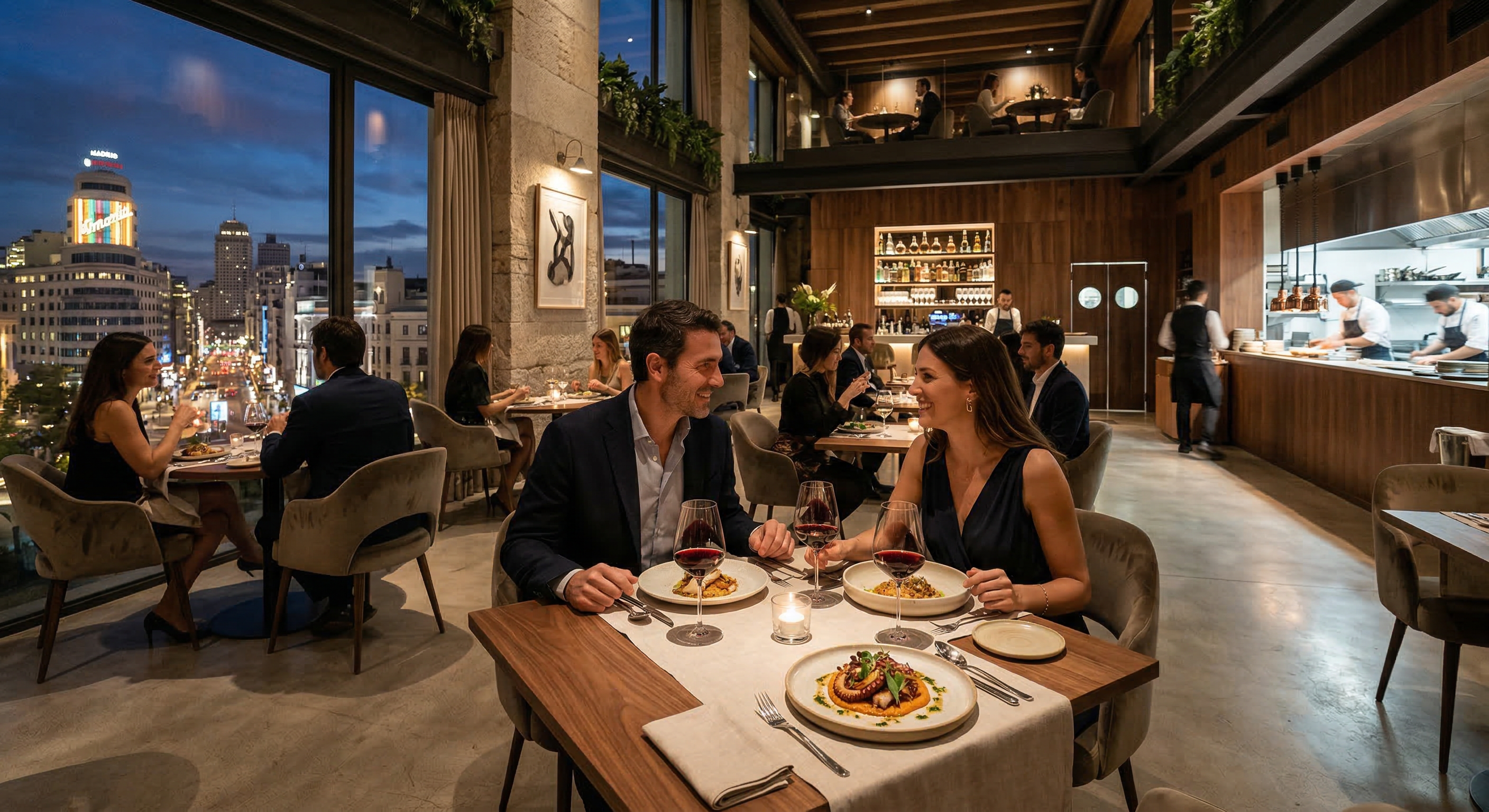
In Madrid, there are restaurants with €95 tasting menus that have a two-month waiting list. And there are restaurants with €95 menus that close within their first year.
The cuisine matters, of course. The chef matters. But the space also makes a difference. A signature restaurant with a generic interior is limiting its ability to charge what its offering is worth. And vice versa: a well-designed space elevates the perception of the product even before the first course arrives.
What design brings to fine dining that it doesn't bring to any other segment
In budget restaurants, design helps but isn't the deciding factor. In fine dining, design is part of the product. The customer who pays 120-180 euros per person isn't just buying food. They're buying an experience that begins when they walk through the door and ends when they leave.
If the experience begins with a space that doesn't live up to the price, there's a dissonance that the menu has to compensate for. And compensating for dissonance is very expensive: it requires exceptional dishes, impeccable service, and even then the customer may leave feeling that the price was high.
If the experience begins with a space designed for that level of service, the customer arrives predisposed to perceive quality. And that predisposition makes the menu itself seem better, the service more highly valued, and the final bill seem reasonable.
The design elements that define a high-level fine dining experience
Acoustics: the most ignored and most critical element
A high-end restaurant where you can't have a conversation without raising your voice has failed in a fundamental way. Acoustics in fine dining are not a luxury. They are a necessity.
Acoustic treatment in a high-end restaurant involves sound-absorbing ceilings, panels integrated into the wall design, and a choice of materials and upholstery that do not reflect sound. The goal is that in a full room, the sound level allows for normal conversation at your table without overhearing the conversation at the next table.
An investment of €15,000-€25,000 in well-designed acoustics radically changes the experience. And that cost is recouped in reviews: acoustics are one of the most frequently mentioned factors in negative reviews of high-priced restaurants.
The lighting: each table has to be a stage.
Lighting in fine dining has a specific function: to make the dish the star and to ensure that the person sitting across from it appears well-lit. These two things are difficult to achieve with the same light source.
The solution is layered lighting: focused light over the table (overhead, warm, intense enough to make the colors of the dish look good), low ambient light that creates atmosphere without darkening, and accent light that defines the space architecturally.
A dimmer switch is mandatory. The lighting for the midday shift cannot be the same as that for the evening shift. The same space must feel different at each time of day.
The distances between tables: the privacy that the customer pays for
In high-volume restaurants, the distance between tables is minimized to maximize capacity. In fine dining, the opposite is true: the distance between tables is a price point.
A customer paying 150 euros per person doesn't want to hear the conversation at the next table. They don't want the waiter to have to ask permission to walk between tables. And they don't want to feel like they're in a crowded place when there are only a few tables.
The correct ratio in fine dining is 2.5 to 3 square meters per diner (including circulation areas). This means that a 120m² dining room has a realistic capacity for 40-48 diners, not 70. This reduction in capacity must be offset by a proportionally higher price per diner.
The materials: luxury that doesn't shout
The most common mistake in designer restaurants is confusing luxury with ostentation. The fine dining customer in Madrid in 2026 doesn't want gold and velvet. They want carefully chosen, high-quality materials: marble that isn't just off the shelf, wood with a story, and fabrics that offer texture, not just color.
What conveys sophistication in fine dining isn't the price of the materials. It's the consistency between them and the precision in the details: the upholstery stitching, the finish of the table edge, the weight of the napkin, the menu design. Each element tells a story, and they must tell the same story.
The table: the main product of the space
In fine dining, the table is the space where everything happens. Its design must consider: enough surface area for the mise en place without it looking crowded before the first course arrives, the right height to be comfortable for two hours, and a material that complements the tableware, cutlery, and tablecloth, if there is one.
A well-designed, custom-made table in a high-quality material costs between 800 and 2,500 euros per unit. In a restaurant with 12 tables, that's between 9,600 and 30,000 euros. It's an investment that the customer notices from the moment they sit down.
The chef's table: the restaurant's most profitable asset
If space allows and the concept permits, the chef's table is the most profitable option in any fine dining establishment. A space for 6-10 people with a view of the kitchen, a personalized experience, and an exclusive menu can charge 50-80 euros more per person than the standard menu.
With 6 people at €180 each, three services per week, that's an additional €16,200 per month for a 15-20m² space. The investment in designing that space well is recovered in 2-3 months.
Actual budget: signature restaurant 120-180m² in Madrid
- Civil works and distribution: 18,000-30,000 euros
- Installations (electricity, air conditioning, extraction): 25,000-42,000 euros
- Layered lighting with dimming: 18,000-32,000 euros
- Acoustic treatment: 15,000-25,000 euros
- Custom-made living room furniture (tables, chairs, benches): 28,000-55,000 euros
- Bar / reception area: 10,000-18,000 euros
- High-end wall coverings and finishes: 20,000-38,000 euros
- Chef's table (if applicable): 12,000-22,000 euros
- Project and construction management: 14,000-24,000 euros
- Total: 160,000-286,000 euros
A signature restaurant with 40 diners, an average check of €130, and occupancy of the 75% four nights a week, generates around €81,000 in revenue per month. The design pays for itself in less than four months of full operation.
Are you opening or renovating a signature restaurant in Madrid?
Tell us about your concept, the available space, and your desired average check. We design dining spaces that justify the price.