
Guide
Independent Bookstore Design That Makes People Want to Stay (Madrid 2026)
Subscribe to our newsletter!
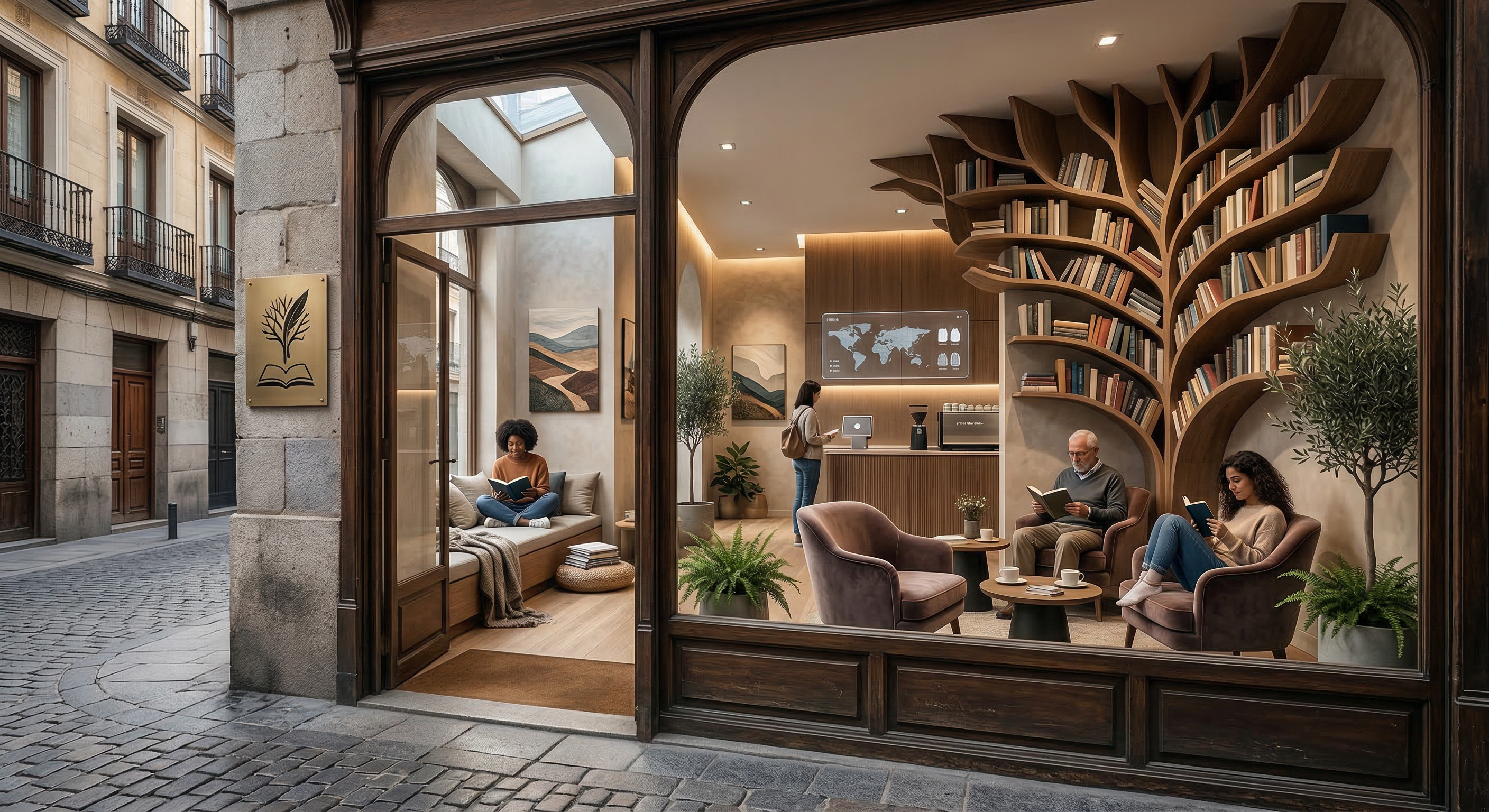
The independent bookstore that competes solely on price with Amazon lost that battle years ago. The one that competes on experience, community, and curated selection has an advantage no platform can replicate: physical space.
Madrid has some of the best independent bookstores in Europe. The ones that thrive aren't the biggest or the ones with the most titles. They're the ones with the most character, the ones that make walking in a pleasure even if you're not planning to buy anything, and the ones that have built a community of readers who choose them week after week.
Space as an argument for existence
A well-designed independent bookstore justifies its existence through its space. It's a place you want to be even if you don't have anything specific in mind. Where the books are arranged according to a different set of criteria than those of large retailers. Where the space naturally guides you from one book to the next.
That type of experience generates discovery purchases, which are the most profitable for an independent bookstore: the customer who comes in looking for one title and leaves with three that they didn't know they wanted.
The design elements that make a boutique bookstore work
The shelves: the most distinctive element
The bookshelves of an independent bookstore are its most visible architectural feature. They must be tall enough to create the sense of abundance that characterizes a bookish space, but with stairs or access points that make reaching the highest books part of the experience, not an obstacle.
The combination of fixed perimeter shelving with central table displays for new products and recommendations is the scheme that works best: it provides structure while also allowing the flexibility to easily change the featured selection.
The corners: where purchases are decided
A customer who finds a comfortable corner to sit and browse a book is three times more likely to buy it. Reading nooks in a bookstore aren't a luxury. They're a sales tool.
An armchair, a chair with a cushion, a small table to set your coffee on: spaces that invite you to linger are spaces that invite you to buy. And the customer who stays longer, buys more.
The events area: the asset that generates community and PR
A physical bookstore with space for 20-30 people, where presentations, book clubs, talks, and workshops can be held, has a competitive advantage that no online bookstore can match. These events generate traffic on typically slow days, free PR on social media, and a community of customers who feel like they belong.
The design of the event space needs to be flexible: stackable chairs, adjustable lighting, good acoustics so that you can hear well even with a lot of background noise, and a basic audio system for presentations with a microphone.
Actual budget: independent bookstore 80-150m² in Madrid
- Custom-made perimeter shelving: 14,000-24,000 euros
- Central and new product displays: 6,000-11,000 euros
- Reading nooks (furniture + lighting): 5,000-9,000 euros
- Flexible event area: 7,000-13,000 euros
- Warm, focused lighting: 6,000-11,000 euros
- Counter and checkout area: 4,000-7,000 euros
- Cladding and finishes: 5,000-9,000 euros
- Project and management: 5,000-9,000 euros
- Total: 52,000-93,000 euros
An independent bookstore in Madrid with 30 daily customers at an average ticket price of €22 and 8 monthly events at €15 per attendee (with 25 people per event) generates around €22,800 in revenue per month. The difference between an average ticket price of €14 and €22 at that volume represents an additional €7,200 per month that the space design can generate.
Are you opening an independent bookstore in Madrid?
Tell us about your space, the type of selection you want to offer, and whether you'd like to incorporate events or a café. We design bookstores that make people want to stay.