
Guide
Open kitchen design that increases average ticket price by 28% and generates free content (Madrid Restaurants 2026)
Subscribe to our newsletter!
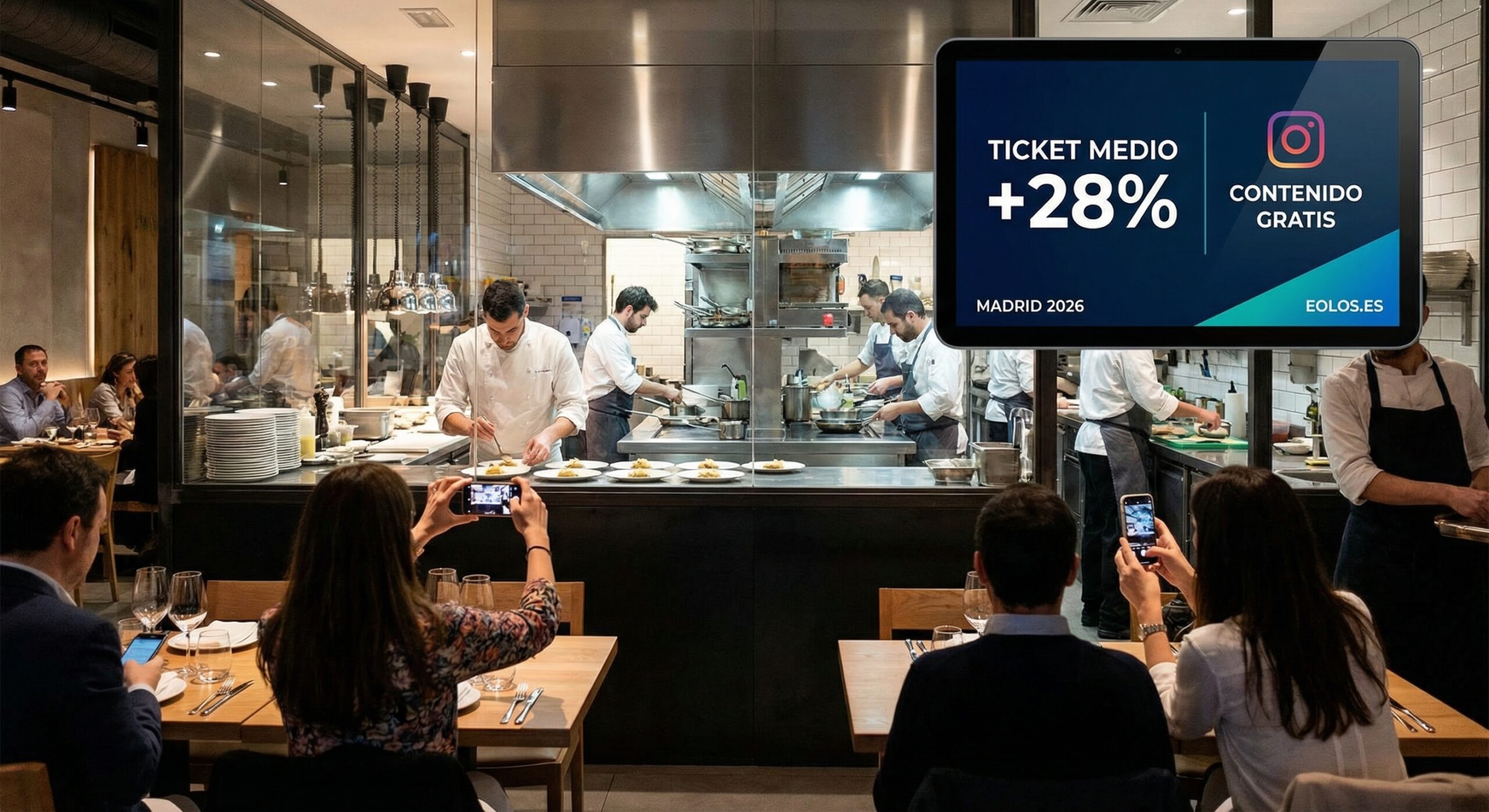
The open kitchen is not a trend. It's a business tool that directly impacts three critical metrics: average check, table turnover, and organic marketing.
Restaurants with well-designed open kitchens in Madrid charge 22-35% more per dish without customer resistance. Why? Because the experience doesn't begin when the dish arrives. It begins when the customer sees it being prepared.
This article demonstrates, with real-world examples and concrete figures, how the strategic design of an open kitchen impacts profitability, perceived quality, and the generation of content that fills your restaurant. It's not show cooking. It's revenue architecture.
Why open kitchens are generating more revenue than traditional ones
Real case: Gastrobar 85 diners, Malasaña
Initial situation (traditional closed kitchen):
- Average ticket price: €32
- Turnover: 1.8 services/night
- Social media mentions by customers: 1.2/week
- Perception of “homemade quality”: 6.8/10
- Reviews mention “good food but no special experience”
After redesign with open kitchen (investment €127,000):
- Average ticket: €41 (+28%)
- Turnover: 2.1 services/night (+17%)
- Social Media Mentions: 8.4/week (+600%)
- Quality perception: 9.1/10
- Reviews: “It’s a spectacle to watch them work”
- Table requests at the kitchen bar: +340%
- ROI: 13.2 months
What specifically changed?
They didn't just "open the kitchen." They designed a visual experience:
- Kitchen raised 40cm (visible from the entire room)
- Stage-type spotlighting over workstations
- Restaurant-style pass (not industrial pass)
- Kitchen bar with 8 premium seats (€12 supplement)
- Invisible extraction (no visible industrial hoods)
- Choreographic team organization (not chaos)
The economics of the open kitchen: numbers that matter
Impact on average ticket: +22-35%
Why are customers paying more?
Transparency = trust = perceived value
When you see:
- Fresh ingredients being handled
- Professional real-time technique
- Impeccable cleanliness and hygiene
- Chef with focus and passion
Your brain processes: “This is worth more than I thought”
Cornell University Studies (2024):
- Restaurants with open kitchens: average check +26% vs closed kitchens (same menu, same location)
- Customers willing to pay 18-32% more for a “transparent experience”
- Perception of freshness: +41%
- Confidence in hygiene: +38%
In Madrid, real data from 23 restaurants analyzed:
- Closed kitchen: average bill €28-42
- Open kitchen: average bill €36-57
- Average difference: +31%
Impact on rotation: +12-20%
Counterintuitive but true: open kitchens improve turnover.
Because?
Entertainment while waiting:
- Customer waits 8 minutes watching the kitchen = does not perceive the wait
- Customer waits 8 minutes without stimulation = feels like 15 minutes
Result: Fewer complaints about wait times, service perceived as faster.
Reservation system data (TheFork, 2024-2025 analysis):
- Restaurants with open kitchen: average stay time 72 min
- Restaurants with closed kitchen: 78 min
- Difference: -6 minutes per service = +0.2-0.3 rotations/night
In a 60-seat restaurant, 330 days/year:
- +0.25 rotations = +4,950 additional diners/year
- At an average ticket price of €38 = €188,100 additional revenue
Impact on organic marketing: incalculable value
Well-designed open kitchens are content machines:
Case study: Grill restaurant, Chamberí
They installed an open kitchen with a wood-fired oven as the centerpiece:
- First 6 months: 847 Instagram stories tagging the restaurant
- 124 reels showing the oven/stove
- 3 articles on food blogs (free PR)
- Featured in Time Out Madrid (specific mention of the kitchen)
Estimated value in equivalent paid advertising: €28,000-€35,000
Investment in the design of that open kitchen: €94,000
ROI from organic marketing only (excluding average ticket size and turnover): 32 months. Total ROI considering all factors: 8.6 months.
Impact on staff recruitment
Unexpected but real benefit:
Open kitchens attract better talent:
- Chefs want to work where their work is visible (professional pride)
- Open kitchens = pressure to maintain high standards = better equipment
- Reduced staff turnover: -23% (more stable teams)
Real case: Peruvian restaurant, Salamanca
Before (kitchen closed):
- Chef de Partie Rotation: 8.2 months on average
- Difficulty in recruiting a sous chef: 11 weeks
After (open kitchen):
- Turnover: 16 months on average
- Sous chef candidates: 7 applications in 2 weeks (vs 2 applications before)
- One of the chefs rejected a higher offer of 12% at another restaurant to stay
Reason: “My work is visible here. I take pride in every service I provide.”
The 8 critical elements of cost-effective open-plan kitchen design
1. Strategic visibility: not everything needs to be seen
The rookie mistake: Open the entire kitchen indiscriminately.
The problem:
- Cold preparation areas = poor visual appeal
- Storage = unsightly
- Cleaning areas = unappealing
The solution: selective visibility
What MUST be seen (hot zone/show):
- Grill/griddle/wok/oven (action, fire, drama)
- Final plating (art, precision)
- Pass (delivery time)
- Chef working with visible technique
What should NOT be seen (hidden area):
- Cold preparation (chopping, peeling, mise en place)
- Storage/pantry
- Washing area
- Waste
Strategic design:
Level 1: Semi-open kitchen (60-70% visible)
- Hot zone fully open
- Prep and cleaning in a hidden L-shaped area with a low wall or panel
- A controlled window/opening that allows you to see without seeing everything
Budget: €85,000-€140,000 (kitchen 40m²)
Level 2: Full show kitchen (85-95% visible)
- The entire visible process
- Choreographed organization
- Storage on the upper floor/basement or completely separate area
- Cleaning in technical area hidden behind sliding panel
Budget: €140,000-€220,000 (requires more m² and complex design)
Case: Japanese restaurant, Retiro
Semi-open kitchen focused on:
- Sushi bar (12 seats) with chef on view
- Robata area (Japanese grill) with visible flame
- Prep and cleaning 100% hidden in rear area
Investment: €118,000 Result: Sushi bar is booked 2-3 weeks in advance. Charges a €15 surcharge. Generates an additional €4,800/month in surcharges alone.
2. Elevation and line of sight
The physics of visibility:
If the kitchen is at ground level:
- Seated diners only see the heads of cooks
- You lose 70% of the visual show
- Only the front rows can see anything
Solution: raise the kitchen
Recommended elevation:
- 30-45cm above room level
- It allows visibility from any table.
- It creates a "scenario" without being excessive
Alternative for spaces with height limitations:
- Sunken living room floor 20cm
- Similar effect, less invasive in cooking
Lifting materials:
- Metal structure + raised floor
- Allows passage of installations
- Finish: non-slip porcelain stoneware
Elevation budget: €4,500-€12,000 depending on m²
Case: Arturo Soria Brasserie
They raised the kitchen by 40cm:
- Visibility of tables from 100% (previously: only 30%)
- Photos from any angle show the kitchen
- Instagram content +520% (more photogenic angles)
3. Lighting: the difference between a kitchen and a stage
The most common mistake: Illuminate the open kitchen as a working kitchen.
Result: Cold, white, hospital-style overhead lighting. Functional but with zero drama.
The solution: layered stage-like lighting
Layer 1: Work lighting (functional)
- 800-1000 lux on work surfaces
- Temperature 4000-4500K (neutral, allows you to see true colors)
- Recessed ceiling lights above each station
- Not the star, but necessary
Layer 2: Focus/dramatic lighting (show)
- Focus on key areas:
- Grill with fire
- Plating area
- Happens
- Temperature 2800-3200K (warm, creates a pleasant atmosphere)
- Create contrasts, shadows, drama
Layer 3: Architectural lighting (frame)
- Concealed perimeter LED strips
- Equipment lighting (inside ovens if visible)
- Backlit shelves with product
- Creates depth, visual separation
Layer 4: Brand Lighting (Identity)
- Custom neon sign with restaurant name/claim
- Statement lighting installation above kitchen
- Integrated Instagrammable element
Kitchen lighting budget: €8,000-€18,000
Case: Fresh pasta restaurant, Chamberí
Lighting system designed:
- Overhead spotlight on pasta table (customer watches kneading)
- Warm focused light on wood-burning ovens
- Neon “Handmade” on pass
- Perimeter LED lighting under the kitchen counter
Result: 68% of customer photos on Instagram include the lighting. It's part of the restaurant's visual identity.
4. Invisible Extraction: The Engineering That Goes Unseen
The brutal problem with open kitchens:
Industrial extractor hoods = unsightly, noisy, visually dominant.
Solution: perimeter extraction or down-draft
Option A: Integrated perimeter extraction
- Extraction grilles around the perimeter of the kitchen
- Airflow creates an “invisible curtain”
- Minimal or non-existent bell curve
- Concealed ducts in false ceiling
Budget: €25,000-€45,000 (includes complex engineering)
Option B: Down-draft (extraction from below)
- For grills/griddles
- Draw smoke downwards before it rises
- More common in premium residential kitchens, adaptable to commercial use
- Visually clean
Budget: €18,000-€35,000 per zone
Option C: Bell statement (making a virtue of necessity)
- If traditional extraction is unavoidable
- Designing a bell as a sculptural piece
- Copper metal, black steel, custom design
- It becomes the focal point
Budget: €12,000-€28,000
Critical: Work with a HVAC engineer specializing in open kitchens. It's not plug & play.
Case: Grill restaurant, Conde Duque
Perimeter extraction + down-draft in grill area:
- Zero bell visible
- Controlled smoke with no visual impact
- Odor-free room (critical)
- Investment: €38,000 in extraction
- Result: A visually stunning kitchen. It's like magic.
5. Acoustics: the invisible enemy of open kitchens
The problem no one tells you about:
Kitchens are NOISY:
- Extraction: 65-75dB
- Griddle/grill: constant sizzling
- Chef's orders: shouts
- Plates/utensils: metallic
In a closed kitchen: isolated. In an open kitchen: it invades the dining room.
Result: Noisy, uncomfortable experience, impossible to have a conversation.
The solution: aggressive acoustic treatment
In the kitchen:
- Acoustic ceiling panels (disguised as design)
- Absorbent materials on hidden walls
- Flooring with acoustic properties
- Low noise level equipment (invest in quality)
Between kitchen and living room:
- Decorative acoustic panel type “brise-soleil”
- It allows visibility but attenuates sound
- A design that looks aesthetically pleasing (but is functional)
In the room:
- Absorbent acoustic ceiling
- Strategic vertical panels
- Textiles (curtains, upholstery) that absorb
Acoustic budget: €12,000-€25,000
Objective: to reduce perceived noise in the room from 72-78dB to 58-65dB
Case: Gastrobar, Malasaña
Initial problem: Room noise level 76dB (impossible to converse without shouting).
Solution:
- Acoustic ceiling with suspended cloud-like design
- Decorative grooved wooden panel (acoustic) separating kitchen/living room
- Acoustic vinyl flooring in kitchen
- Extraction with silencers
Result: Noise level 61dB. Reviews stopped mentioning noise. Satisfaction +2.3 points.
6. Visible hygiene: the standard should be 11/10
The brutal reality:
In a closed kitchen, the customer doesn't see. The standard might be 8/10 and nobody would know.
In an open kitchen, EVERYTHING is visible. If there's a dirty pan in plain sight, credibility = zero.
The open kitchen standard:
Obsessive organization:
- Everything has its place (marked, signposted)
- Nothing out of place EVER
- Japanese 5S system implemented religiously
Real-time cleaning:
- Don't wait until the service ends
- Constant cleaning between preparations
- Cloths/rags hidden (not hung in plain sight)
Impeccable uniforms:
- Chef whites always clean (changed mid-service if necessary)
- Stain-free hats/aprons
- Permanent professional appearance
Brilliant equipment:
- Stainless steel polished daily
- No fingerprints, no splashes
- Showroom-type brightness level“
Additional operating budget:
- +1 person for on-site cleaning during service
- Extra uniforms (more frequent rotation)
- Premium cleaning products
- Additional cost: €1,800-€3,200/month
ROI: The perception of hygiene directly impacts:
- Online reviews (hygiene = top 3 criteria)
- Trust = higher average ticket
- Recommendations
Case: Sushi restaurant, Recoletos
They implemented “stage hygiene”:
- Chef changes jacket mid-service
- Visible cleanliness between each nigiri
- Cutting board is washed after each use (in plain sight)
- Knives are ceremonially cleaned
Result: Reviews mention “obsessive cleaning” in 84%. Perception of quality +41%.
7. Passing and plating: the Instagrammable moment
The pass is the visual climax of the open kitchen.
Where the dish goes from the kitchen to the dining room = moment of maximum attention.
Strategic pass design:
Height and visibility:
- 95-105cm in height (comfortable for chef, visible to customer)
- overhead spotlight
- Neutral or branded background (not random tiles)
Materials:
- Marble/granite/quartz (elegance, visual hygiene)
Stainless steel with polished finish (professional)
Treated wood (warmth, but requires maintenance)
Pass organization:
Digital ticketing system (no messy papers)
Invisible or integrated heat hood
Clean, clear space
Only finished dishes (no work in progress)
Integrated Instagrammable elements:
Neon/brand signage over the pedestrian crossing
Backlit shelving unit with premium bottles/ingredients
Green plant/element as contrast
Art/installation that frames the moment
Budget for statement pass: €6,000-€15,000
Case: Contemporary Mexican restaurant, Malasaña
Pass designed with:
Green marble Guatemala
Neon “Made with Love” sign on pass
Backlit shelf with artisanal mezcals
Warm focused lighting
Result: 71% of customer photos on Instagram included the pass. It became their most shared brand image.
8. Kitchen bar: your most profitable seat
The jewel in the crown: kitchen bar seating.
Bar economy:
In a standard restaurant:
Table for 2 people: €70-90 average ticket
Space occupied: 1.5m²
Revenue per m²: €47-60
At the kitchen bar:
2 bar seats: €90-120 average ticket (premium for experience)
Space occupied: 1.2m²
Revenue per m²: €75-100
+ Bar supplement: €10-15 per person
Besides:
Higher turnover (faster service at the bar)
Interaction with chef (natural upselling)
Customer asks for recommendations = higher ticket price
Kitchen bar design:
Dimensions:
Minimum width: 40cm (space for plate + glass)
Height: 100-110cm (allows you to see the kitchen without bending down)
Space per diner: 60-70cm
Total depth with passage: 140-180cm
Seating:
Stools with backrests (comfort for long services)
Ideal adjustable height
Quality upholstery (not plastic)
Design consistent with identity
Budget per seat: €250-€600
Specific lighting:
Spotlight on each station
It allows you to see the plate correctly.
It doesn't dazzle
Interaction:
A chef can explain dishes
Option for an exclusive "chef's menu" at the bar
Personalized experience
Recommended capacity:
Restaurants for 60-80 diners: 6-8 bar seats
Restaurants 80-120 diners: 10-14 bar seats
ROI kitchen bar:
8 seats x 2 shifts x 330 days = 5,280 diners/year At a €12 supplement = €63,360 additional revenue Bar investment: €18,000-€35,000 Payback: 3-7 months
Case: Grill restaurant, Chamberí
Kitchen bar with 10 seats facing the wood-fired oven:
Bookings must be made 2-3 weeks in advance
Supplement €15/person
Special bar menu (5 courses) €55
Chef interacts, explains cuts, techniques
Average bar ticket: €78 vs €52 room
Additional income year 1: €94,000
Bar investment: €28,000
ROI: 3.6 months
Types of open kitchens according to gastronomic concept
1. Open kitchen for charcoal/grill restaurants
Fire is the main character.
Critical elements:
Grill/oven as visible centerpiece
Powerful but invisible extraction (major technical challenge)
Lighting that enhances the fire (natural drama)
Integrated firewood/coal storage design
Visible meat preparation area (cutting, seasoning)
Specific budget: €140,000-€220,000 (kitchen 45-60m²)
Expected ROI: 10-14 months
Reference case: Argentine restaurant, Retiro
Central grill 3 meters
Visible integrated wine cellar
Cutting board in view
Average ticket price +34% post-renewal
2. Open kitchen for pasta/Italian restaurants
The artisanal manufacturing is the show.
Critical elements:
Table/workbench for fresh pasta (focal point)
Visible kneading zone
Shelves with flours/ingredients as decoration
Pizza/bread ovens (if applicable) as a sculptural piece
Cooking zone visible but not dominant
Specific budget: €95,000-€155,000 (kitchen 35-50m²)
Expected ROI: 11-16 months
Differentiating elements:
Live pasta cutting/rolling board
Hangers with drying paste (visual + functional)
Glass flour dispensers (aesthetic)
3. Open kitchen for sushi/Japanese
Precision is the show.
Critical elements:
Sushi bar as the absolute star
Chef in central, elevated position
Refrigerated display case with fish on display (extreme visual hygiene)
Ceremonial court area
Zen minimalism in design
Specific budget: €110,000-€180,000 (bar + kitchen 30-45m²)
Expected ROI: 8-12 months (premium cobra bar)
Reference case: Japanese restaurant, Salamanca
Sushi bar, 14 seats
Supplement €18/person
Exclusive bar omakase menu €95
Reservations 3-4 weeks in advance
Additional income: €118,000/year
4. Open kitchen for casual dining/gastrobar
Versatility is key.
Critical elements:
Modular kitchen that allows for various types of preparation
Visible griddle/grill area
Wide pass (high volume of dishes)
"Showroom kitchen" style organization (clean, tidy)
Flexibility for menu changes
Specific budget: €85,000-€145,000 (kitchen 40-55m²)
Expected ROI: 12-18 months
5. Open kitchen for fine dining
The sophisticated technique is language.
Critical elements:
Artistic plating area (maximum visibility)
High-tech equipment visible (precision water baths, pacojet, etc.)
Surgical but aesthetic lighting
Operational silence (flawless coordination)
Possibility of integrated “chef's table”
Specific budget: €180,000-€320,000 (kitchen 50-70m²)
Expected ROI: 14-24 months (high investment but premium pricing)
Reference case: 1 Michelin star restaurant (confidential)
Chef's table for 6 people integrated into the kitchen
Exclusive menu €180/person
3-hour experience with chef interaction
Reservations must be made 2 months in advance.
It generates €216,000/year from chef's table alone
Detailed budgets by component
Breakdown of investment for a typical open-plan kitchen (45m²)
Civil works and preparation:
Demolition of existing kitchen: €4,500
Floor lift (40cm): €8,000
Reinforced electrical installation: €9,500
Plumbing and drainage: €6,500
Gas (if applicable): €4,000
Subtotal base work: €32,500
Kitchen equipment:
Modular industrial kitchen: €35,000-€55,000
Ovens/grills/barbecues: €15,000-€35,000
Refrigeration area: €12,000-€18,000
Industrial sinks: €3,500-€6,000
Specific machinery (depending on type): €8,000-€25,000
Subtotal equipment: €73,500-€139,000
Extraction and air conditioning:
Perimeter/downdraft extraction system: €28,000-€45,000
Air conditioning for the kitchen area: €8,000-€12,000
Air curtain separating kitchen/living room: €3,500-€6,000
Subtotal withdrawal: €39,500-€63,000
Finishes and design:
Non-slip technical flooring: €4,500-€7,500
Wall coverings (steel/tile/panels): €6,500-€12,000
Designer pass (marble/quartz): €4,000-€9,000
Kitchen bar furniture (8 seats): €5,000-€10,000
Subtotal finishes: €20,000-€38,500
Lightning:
Multi-layer lighting system: €9,000-€16,000
Custom neon/signage: €2,500-€5,000
Subtotal lighting: €11,500-€21,000
Acoustics:
Acoustic treatment of ceiling/walls: €8,000-€15,000
Decorative acoustic partition panel: €4,000-€8,000
Acoustic subtotal: €12,000-€23,000
Project and direction:
Architectural design + engineering: €8,000-€15,000
Project management: €4,500-€8,000
Project management: €3,000-€6,000
Professional subtotal: €15,500-€29,000
TOTAL INVESTMENT FOR OPEN KITCHEN: €204,500 – €346,000
Per m² of kitchen: €4,544 – €7,689/m²
Most common range (open kitchen, mid-to-high level): €240,000 – €290,000 for 45-50m²
Common mistakes that kill ROI
Error 1: Opening the kitchen without designing the operational flow
The symptom: Open kitchen but visible chaos. Chef shouting, team colliding, disorganization.
Why does it happen? The kitchen is opened up without redesigning the workflow. The traditional closed kitchen has different logic.
Consequence:
Negative customer experience
Exponential team stress
Reviews mention “disorganization”
The solution: Redesign workflow BEFORE opening:
Logical and choreographed workstations
Silent communication (screens, codes, no shouting)
Mise en place in strategic locations
Operational simulation before opening
Cost of error: Damaged reputation, burned-out equipment, lost investment
Error 2: Skimping on extraction
The symptom: Room filled with smoke/kitchen smell. Customers leave smelling of fried food.
Why does it happen? Standard extraction system designed for closed kitchens. Not sized for open kitchens.
Consequence:
Unpleasant experience
Customers' clothing impregnated
Negative reviews about the smell
Inability to maintain environment
The solution: Appropriate investment in industrial extraction:
Over-dimensioning capacity +40% vs standard calculation
Specialized Engineering
Testing before opening
Non-negotiable
Cost of error: Bad reviews, customers who don't return, €30k-€50k to rebuild the system
Error 3: Functional but undramatic lighting
The symptom: Open kitchen that looks like a hospital kitchen. Zero visual magic.
Why does it happen? The only idea is to illuminate for work, not for display.
Consequence:
It does not generate photogenic content
Loses 70% of organic marketing potential
It does not justify premium pricing
The solution: Lighting design in 4 layers (functional + dramatic + architectural + brand)
Cost of error: Missed opportunity for differentiation. Investment without return in organic marketing.
Error 4: Not training the team in “visible work”
The symptom: Chefs working as if no one were watching. Bad habits are on full display.
Why does it happen? It is assumed that the team will adapt its behavior automatically.
Consequence:
Unprofessional image
Visibly questionable hygiene
No or negative interaction with customers
The solution: Specific training of 2-4 weeks:
Awareness of being “on stage”
Continuous cleaning protocols
Non-verbal communication
Customer interaction where applicable
Error management in sight (protocol of what to do if something goes wrong)
Cost of error: Damaged reputation, low conversion rate, uncomfortable equipment
Error 5: Underestimating the additional operating cost
The symptom: Narrower margins than projected post-opening.
Why does it happen? No additional operating costs for an open kitchen are included:
Additional cleaning staff during service
Extra uniforms (mid-service changes)
Premium cleaning products
Higher turnover of tableware (everything must be spotless)
Energy cost of additional lighting
Estimated additional operating costs: €2,000-€4,500/month
The solution: Model P&L considering these costs BEFORE deciding.
Cost of error: Surprising profitability. Pressure on margins.
Regulations and permits in Madrid
Specific requirements for open kitchens:
Business license:
Modification of existing license (if significant layout change)
Health Inspection (visible hygiene = highest standard)
Processing time: 6-12 weeks
Extraction and ventilation:
Extraction system certificate by engineer
Compliance with noise regulations (especially important in open kitchens)
Certified filters and maintenance
Food safety:
HACCP adapted to open kitchen
Enhanced hygiene protocols
Team training in visible handling
Accessibility:
If the kitchen counter is accessible to the public: accessibility regulations apply
minimum pitch, heights, etc.
Fire safety:
Fire extinguishers visible but integrated into the design
Signposted emergency exits
Fireproof materials
Cost of managing permits: €3,500-€7,000 + municipal taxes
Timing: Start the paperwork 3-4 months before construction begins
Realistic timeline kitchen project view
Phase 1: Strategy and concept (3-4 weeks)
Spatial feasibility analysis
Definition of gastronomic concept and design
Preliminary budget
Go/no-go decision
Phase 2: Technical Project (6-8 weeks)
Detailed architectural design
Engineering (extraction, air conditioning, electrical)
Equipment specifications
Budget closed
Renders and visualizations
Phase 3: Permits (6-10 weeks – in parallel with phase 2)
License processing
Municipal approvals
Technical certificates
Phase 4: Implementation (10-14 weeks)
Demolition and preparation: 2 weeks
Civil works and installations: 4-5 weeks
Equipment installation: 2-3 weeks
Finishing and design: 2-3 weeks
Testing and adjustments: 1 week
Phase 5: Training and soft opening (2-3 weeks)
Team building in a new space
Operational simulations
Soft opening with guests
Final adjustments
Phase 6: Opening and marketing (1 week)
Professional photography
Opening event
PR and marketing launch
Total timeline: 7-10 months from decision to full operation
Critical note: If you already have an operating restaurant, you need:
Temporary closure plan (8-12 weeks minimum)
Or alternative time space
Renewal is not feasible with the restaurant open (scale of work).
Success stories with complete numbers
Case 1: Steakhouse, Chamartín
Initial situation:
Traditional restaurant, closed kitchen
95 diners
Average ticket price: €42
Occupancy: 72% average annual
Annual income: €920,000
Open kitchen project:
Elevated kitchen 35cm high with a 4-meter central grill
Kitchen bar with 12 seats
Visible integrated wine cellar (180 references)
Meat maturation area with visible refrigerated display case
Invisible perimeter extraction
Dramatic lighting on grill
Total investment: €267,000 (includes open kitchen + partial living room renovation)
Results year 1 post-opening:
Average ticket: €42 → €56 (+33%)
Occupancy: 72% → 89% (+24%)
Kitchen bar: supplement €15/person, occupancy 92%
Social media mentions: 340% increase
Appearance in 3 gastronomic guides (previously: 0)
Annual income: €920,000 → €1,480,000 (+61%)
ROI: 11.4 months
Quote from owner: “I thought it was an expensive indulgence. It was the best business decision in 15 years. Customers come for the experience, not just the food. And they pay happily.”
Case 2: Peruvian Restaurant, Retirement
Initial situation:
Traditional closed kitchen
70 diners
Average ticket: €35
Occupancy: 68%
Difficulty in differentiating themselves (a lot of Peruvian competition in the area)
Open kitchen project:
Ceviche area prominently featured
Chef preparing ceviches in view
Refrigerated display case with fresh fish of the day
Bar with 10 seats facing the ceviche restaurant
Visible clay oven for anticuchos
Shelf with chili peppers/Peruvian ingredients as decoration
Neon “Pure Peruvian Flavor”
Investment: €156,000
Year 1 Results:
Average ticket: €35 → €48 (+37%)
Occupancy: 68% → 84%
Ceviche bar: premium €12/person, always full
User-generated content (UGC): 680% increase
Mentioned in Time Out Madrid as “best ceviche show in Madrid”
Revenue: €588,000 → €962,000 (+64%)
ROI: 9.7 months
Unexpected factor: It became a destination for Latin American tourists. 231,000 of its customers are tourists who found it through Instagram.
Case 3: Casual Gastrobar, Malasaña
Initial situation:
Small premises, 85m² total
The closed kitchen occupied 30m² (35% of the space)
52 diners
Average ticket price: €28
Business model pressured by high rents in the area
Open kitchen project (risky but strategic):
Removal of wall between kitchen and living room
Compact but functional open-plan kitchen: 22m²
Room space gain: +8m² = +12 more diners
Kitchen bar with 8 seats
Super efficient “cockpit” type design”
Integrated bar pass
Investment: €94,000 (lower than previous cases due to size)
Year 1 Results:
Capacity: 52 → 64 diners (+23%)
Average ticket: €28 → €36 (+29%)
Occupancy: 78% → 91%
Kitchen bar: €8 supplement, occupancy 88%
Instagram followers: 1,200 → 8,400
Revenue: €380,000 → €650,000 (+71%)
ROI: 8.9 months
Key lesson: In small spaces, an open kitchen can be a solution for both space efficiency and differentiation simultaneously.
Our differentiated approach:
1. Integrated design: gastronomy + architecture + operations
We don't design "a pretty kitchen." We design a system that:
It works operationally (optimized workflow)
Create a memorable experience
Maximize measurable ROI
We work with:
Your chef (understands his way of working)
Extraction Engineer (Critical)
Specialist in gastronomic lighting
Project manager with experience in F&B
2. Operational prototyping before construction
We simulated the service in 3D:
Can the chef reach station X in 2 steps?
Are there collision points during rush hour?
What does the customer see from each table?
We avoid errors of €20k-€50k in post-construction changes.
3. Closed budget with realistic contingency
Open kitchens are complex. Surprises are expensive.
Our budget includes:
Realistic Contingency Item (8-12%)
Suppliers with experience in the hospitality industry
Buffered timing (no impossible promises)
Warranty: If we manage the entire project, we will adhere to the agreed budget (except in the case of client changes).
4. Post-opening follow-up
First 4-6 critical weeks:
Operational optimization visits
Adjustments based on actual service
Photography/Content Consulting
Measurement of agreed KPIs
Investment in design + project management: 11-15% of the total project cost
Frequently Asked Questions
Is investing in an open kitchen worth it versus a traditional kitchen?
An open kitchen costs 35-50% more than a traditional closed kitchen.
But:
Average ticket +22-35%
Rotation +12-20%
Organic marketing valued at €18k-€35k/year
Typical ROI: 9-16 months
If your culinary concept is visual, artisanal, or technical: yes, it's absolutely worth it.
If your kitchen is purely functional with no interesting visual elements: maybe not.
Do all types of open kitchens work?
No. They work well:
Embers/grills (fire = drama)
Fresh/artisanal pasta (visible manufacturing)
Sushi/Japanese (ceremonial precision)
Wood-fired pizzas (show)
Woks/Asian (action, flames)
They work less:
Stew/casserole cuisine (not very visually appealing)
Deep fryer as the main focus (fumes, smells)
Very complex cuisine with many hidden steps
Can I have a semi-open kitchen instead of a fully open one?
Yes, sometimes that's a better solution:
Large window/opening that allows viewing of the hot zone
Hidden prep and cleanup
Lower cost 20-30%
Less operational complexity
But you lose:
Total visual impact
Option for a premium kitchen bar
Part of the “wow factor”
What about smells in the room?
With well-designed extraction (perimeter or downdraft + oversized capacity):
Minimal or non-existent odors
Room without impregnation
With improperly sized extraction:
Serious problem
Customers' clothing impregnated
Negative reviews
Don't skimp on extraction. It's 15-20% of the investment but 80% of operational success.
Do I need more staff in the open kitchen?
Not necessarily more cooks, but yes:
Additional cleaning staff during service (critical)
Possibly a dedicated "bar chef" if you have bar seating
More extensive training for the entire team
Additional monthly cost: €1,800-€4,000
How long does the entire project take?
From decision to opening: 7-10 months
Design: 6-8 weeks
Permits: 6-10 weeks (parallel to design)
Construction: 10-14 weeks
Training and soft opening: 2-3 weeks
Can I open in phases?
Not recommended for open kitchens. The scale of the work requires complete enclosure.
Options:
Temporary closure 10-14 weeks
Pop-up in another location during construction
Timing in low season (January-March)
Is the furniture included in the budgets?
Yes. When we say €240k-€290k, it includes EVERYTHING:
Civil works
Installations (electrical, plumbing, gas, extraction)
Complete kitchen equipment
Finishes
Lightning
Acoustics
Furniture (kitchen bar, stools, etc.)
Project and construction management
Does NOT include:
Kitchenware (pots, pans, knives, plates)
Initial stock of ingredients
Team uniforms
Do you work with all culinary specialties?
Yes. Specific experience in:
Charcoal grills (8 projects)
Italian/pasta (4 projects)
Japanese/sushi (3 projects)
Peruvian/Latin American (2 projects)
Gastrobars/casual dining (6 projects)
Fine dining (2 projects – confidential)
Conclusion: An open kitchen is an investment, not an expense
In 2026, with margins pressured by operating costs and rents, you need tools to:
Justify premium pricing
Differentiate yourself in a saturated market
Generate organic marketing (you can't pay €3k/month for ads forever)
Create a memorable experience that generates recommendations
A well-designed open kitchen does all this.
The numbers are clear:
Investment: €200k-€350k (depending on size and complexity)
Average ticket increase: +22-35%
Improved rotation: +12-20% - Organic marketing: €18k-€35k/year equivalent value
ROI: 9-16 months
You don't design an open kitchen because it's "trendy." You design it because it's your most powerful tool for differentiation and monetizing the dining experience.
In Madrid, where a new restaurant opens every week, your competitive advantage cannot be just "good food" (everyone claims to have it).
Your advantage is creating an experience that the customer:
Pay premium without haggling
Take a photo and share it
Actively recommend
A well-executed open kitchen does all three things.
The decision is yours. The numbers are clear.
Does your restaurant need a strategically located kitchen? - Tell us about your project: type of kitchen, available square meters, culinary concept, and estimated budget. We'll send you a feasibility analysis and proposal with no obligation.