
Guide
Renovating Inherited Premises: How to Modernize Without Losing What Works (Madrid 2026)
Subscribe to our newsletter!
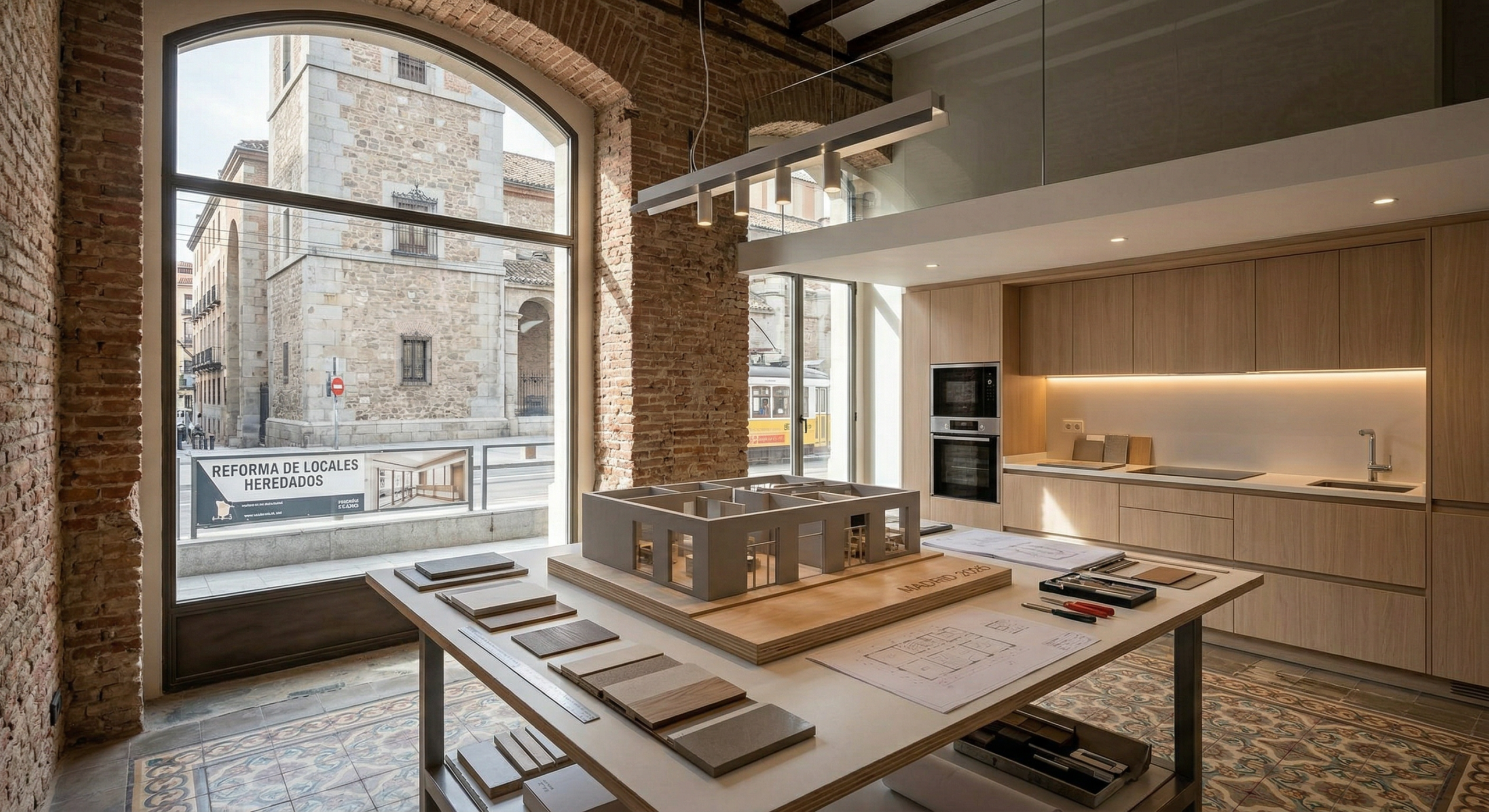
There's a type of project that comes to us with a very specific complexity: the second- or third-generation owner who inherits a family business and wants to modernize it, but is afraid of losing long-time customers. It's a legitimate fear. There are bars, restaurants, and shops in Madrid that have renovated and lost in weeks a clientele that took decades to build. And there are others that have renovated well and multiplied their business without losing any key customers. The difference lies in how the renovation is done and, before that, in what is decided to be renovated and what is left unrenovated.
First: understand what really works
Before touching anything, you have to understand why the business has the customers it does. Sometimes it's the product that works. Sometimes it's the person serving. Sometimes it's a tradition or a specific ritual of the establishment (the usual appetizer, the dessert that never changes, the spot where the same person always sits). And sometimes, incredibly, what works is a part of the physical space that seems outdated but that customers feel is theirs. A smart renovation preserves this element of identity and modernizes everything else.
What can almost always be modernized without impacting the clientele
Lighting: A loyal customer at a neighborhood bar didn't develop a fondness for it because of the fluorescent ceiling lights. Changing them to something warmer improves the space without affecting anything that matters to anyone. Restrooms: These are the element that receives the most criticism in reviews and the easiest to improve without affecting the bar's identity (an investment of €8,000-€15,000 measurably improves the average Google score). Organization and visible storage: Solving storage problems without changing the aesthetics is always a risk-free win. The menu: Redesigning the menu updates the business without affecting the physical space.
Things to handle with great care
The bar: In many Madrid bars, the bar is the heart of the establishment. If it needs to be renovated, the process must be meticulous: same dimensions, the same vantage point from the street if possible, and materials that complement what was there before. Unique elements with a history: the 1960s tiles, the original marble bar, the classic brass fixtures. Preserving these elements, as part of a broader renovation, yields better results than replacing them.
The renovation process with existing clients
Communicate beforehand: Loyal customers don't want to be surprised by a completely different space. Honest communication before starting the work generates understanding and sometimes even enthusiasm. Do the renovation in phases when possible: In hospitality establishments, a phased renovation allows you to continue operating with part of the premises open, maintaining customer routines during the construction. Include a visible element of continuity in the new space: Something from the old location that has a place in the new one. It's not nostalgia. It's preserving identity.
Actual budget: renovation of inherited premises in Madrid
- Partial renovation (bathrooms, lighting, carpentry): €20,000–€40,000
- Complete renovation while preserving elements of identity: €60,000–€140,000
- Complete renovation with new positioning: €100,000–€220,000
- In all cases, the initial assessment of what to preserve and what to change is the most critical part of the process. A diagnostic error in these types of projects costs far more than the cost of having done it correctly.
Are you going to inherit or have you already inherited a business in Madrid and want to modernize it?
Tell us the story of the place, what works and what you want to change. We'll start with an assessment and then tell you how we would approach the renovation to preserve its value.