
Guide
The reform that recovers a hospitality asset without killing what made it work
Subscribe to our newsletter!
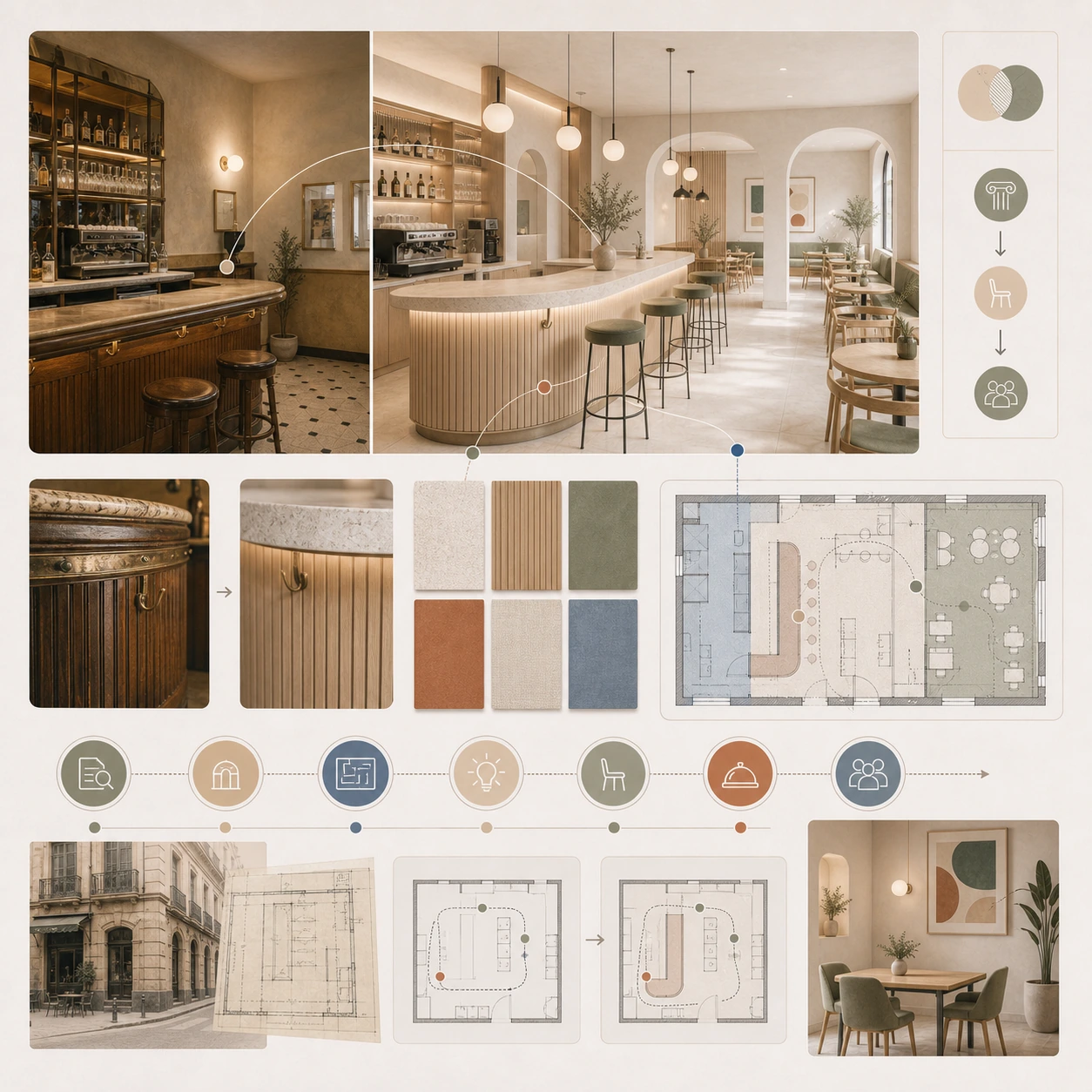
A neighborhood bar with 18 years of history. Worn out chairs, dark wood bar, lighting that doesn't quite work anymore. The owner knows he needs to renovate. He hires a studio, they present him with a nice project, and six months later the place looks like a different place. The problem: his usual customers no longer recognize themselves in it. And the new ones don't come because the change didn't respond to any real demand. The renovation cost 80,000 euros and turnover dropped by 30%.
This is not an isolated case. It is the most common pattern when a refurbishment of a hospitality asset is designed without understanding what makes the business work.
What makes a hospitality asset worth keeping?
Not all businesses with history have something to save. And the sign is not in the number of years they have been open, nor in the number of tables, nor in the decoration. It's in the behavior of the customers.
If there are tables that are always booked by the same customer, something is working. If there is a time slot that never fails, something is working. If suppliers have been coming through the same door for years and no one has ever had a problem, something is working.
That something is the real asset. Not the physical space, but the relationship that space has generated with the people who use it. And that relationship is not automatically transferred when you change the chairs.
The mistake made by the majority when proposing a hotel asset reform
The most common and most destructive decision: treat the reform as an opportunity to start from scratch.
It's understandable. The space looks old, things are broken, the image no longer represents what the operator wants to project. The temptation is to make a clean slate and build something new on top of it.
The problem is that “something new” does not inherit anything. It does not inherit the clientele, it does not inherit the informal positioning that the business has built up over the years, it does not inherit the logic of use that makes the service work. The new thing starts from scratch in terms of trust, and that has a real cost that does not appear in the construction budget.
A well-thought-out reform doesn't ask «what do we want space to look like?» before asking «what is space doing that we can't afford to lose?»
How to read what your space does (beyond what you think it does).
There is a difference between what an operator thinks makes his facility work and what actually makes it work. That difference is the biggest risk of any reform.
A restaurant owner may believe that it is the menu that builds loyalty. But if you look at actual behavior, you will see that most regulars arrive at the same time, sit at the same tables, and have had a relationship with the same waiter for years. The menu is almost irrelevant.
To renovate this restaurant without preserving this dynamic, the arrangement of tables that allows for this relationship, the acoustics that make conversation possible, the temperature of the space, is to dismantle what really generates loyalty.
The analysis prior to a refurbishment of a hotel asset must be ethnographic before being aesthetic. Who comes, when, with whom, what they do, where they sit, how long they stay, what they ask for. That pattern of use is the invisible architecture that the design has to respect or improve, never ignore.
What does a refurbishment that reactivates a hospitality asset without erasing its identity look like?
In practice, a refurbishment that recovers a hospitality asset without destroying what makes it work has some recognizable characteristics.
Intervene in what has a real operational or technical cost: facilities, regulatory compliance, kitchen, air conditioning, accessibility. Everything that affects the operation or has legal risk. This is not optional and must be done well.
Update the image without breaking the visual code that customers recognize. It may mean keeping the color palette but renewing materials. Maintain the layout but improve the lighting. Change the furniture but respect the proportions of the space.
Preserve or enhance the elements of the experience that customers identify as their own. If there is a terrace that is always full, the renovation does not touch the terrace. If there is a bar area that generates 40% of the average ticket, the renovation does not redistribute that space to add more tables.
In terms of costs: a well-planned reactivation renovation of a 150-200 m² hotel and catering business typically costs between 60,000 and 120,000 euros, with a lead time of 8 to 14 weeks depending on the condition of the premises. This is significantly less than opening from scratch, and much less than the cost of losing the clientele built up over the years.
If you want to understand which types of intervention make the most sense depending on the asset and the objective, the article on how interior design increases the value of a commercial asset gives a useful framework for thinking through the decision before making one.
When to call a studio before it's too late
The most common time to call a studio is when the decision to renovate has already been made and the operator has a rough budget in mind. That's fine, but it's not the optimal time.
The optimal time is before deciding the scope. When there is still room to define what to touch and what not to touch. When you can still design the process without having to conform to a work already contracted or a concept already sold internally.
A study with real hospitality experience doesn't just validate what you've already decided. It comes to help you understand what makes sense to do, what risks each option has, and how to sequence the intervention so that the business does not stop more than necessary during the work.
If you have a location with years of operation, with regular customers, with something that works but with a space that already needs intervention, it's time for a conversation before hiring anything. The form is below.