Conversación con Dolores: por qué tu proyecto comercial no necesita tres agencias
Dolores explica por qué un proyecto comercial debe coordinar espacio, marca y web como un solo sistema, no como tres encargos separados.
Journal · EOLOS DESIGN LAB
Guía · EOLOS DESIGN LAB Journal
Dolores es CEO y Socia de EOLOS DESIGN LAB. Lidera el estudio con foco en estrategia, sostenibilidad y ejecución, conectando diseño comercial, espacios, marca y presencia digital. Esta conversación no trata sobre los servicios de EOLOS. Trata sobre por qué un proyecto comercial debería pensar en su espacio, su marca y su web como partes del mismo problema.
El problema de contratar a tres
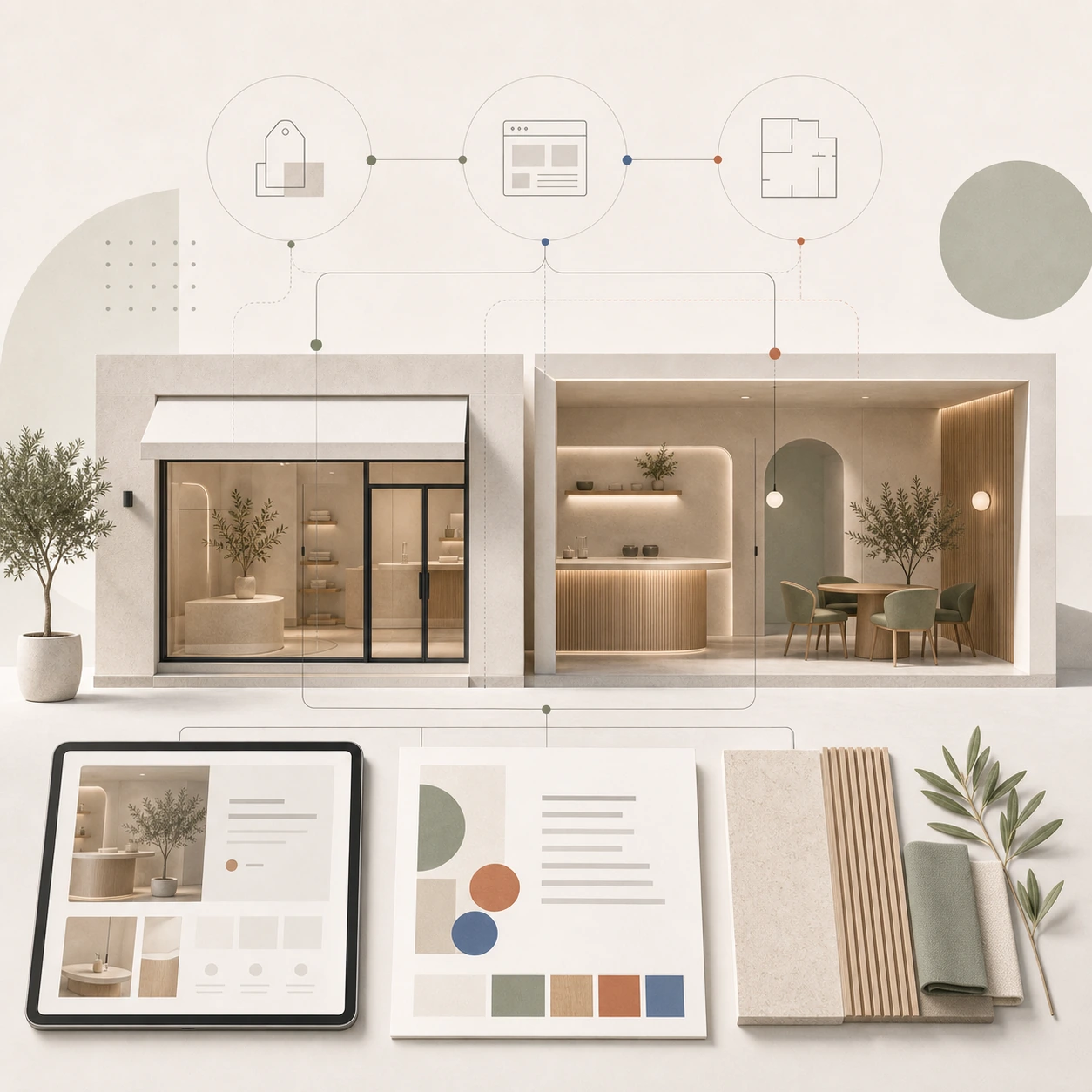
Lo vemos con frecuencia. Un proyecto comercial contrata un estudio de interiorismo para el espacio, una agencia de branding para la identidad y una agencia digital para la web. Tres equipos, tres briefings, tres procesos, tres facturas. Y al final, tres versiones distintas de lo que el negocio es.
El interiorista trabaja con su paleta. La agencia de branding crea una identidad visual con su propia lógica. El equipo web construye una experiencia digital que no ha visto el local. Cuando el cliente abre la puerta de su restaurante, el espacio dice una cosa, el logo dice otra y la web dice una tercera. No es culpa de nadie. Es un problema de estructura.
El cliente lo nota. No lo articula como "incoherencia de marca". Lo siente como algo que no encaja. Y cuando algo no encaja, el negocio empieza con desventaja.
El espacio es el primer acto de comunicación
Antes de que alguien visite tu web, antes de que vea tu logo, antes de que lea tu menú, entra en tu local. O pasa por delante. O ve una foto en Google Maps. La primera impresión de un negocio comercial es casi siempre espacial. No textual, no gráfica. Espacial.
Eso significa que el diseño del espacio no es una decisión estética. Es una decisión de posicionamiento. Un restaurante con mesas de madera maciza, luz cálida baja y acústica controlada está diciendo algo muy distinto a uno con mesas blancas, luz fluorescente y techos desnudos. Ambos pueden tener la misma carta. Pero el primero justifica un ticket de 40 euros por persona y el segundo no.
Si el espacio no comunica lo que la marca promete, ninguna campaña de marketing corrige esa distancia. El espacio siempre gana porque es experiencia, no argumento.
La marca no es un logo. Es una decisión sobre quién eres.
Muchos negocios encargan un "branding" pensando en un logo, una tipografía y una paleta de colores. Eso es la parte visible. La marca real es la posición: a quién te diriges, qué prometes, qué no eres, qué precio justificas, qué tono usas, qué sensación quieres que quede después de la visita.
Si esa posición no se define antes de diseñar el espacio, el interiorismo se convierte en decoración. Bonita, quizá. Pero sin dirección. Y si la posición se define en un documento que el interiorista nunca lee, el resultado es el mismo.
En EOLOS, la identidad de marca y el diseño del espacio nacen del mismo brief. No porque seamos una agencia de branding que también hace interiores. Somos un estudio de diseño donde la marca y el espacio son parte de la misma conversación. Eso cambia todo el proceso.
La web no es un folleto digital
Demasiados negocios tratan la web como lo último que se hace. El local está listo, la marca está definida, ahora "necesitamos una página". Esa secuencia produce webs que describen el negocio en vez de hacerlo funcionar.
Una web de restaurante que no facilita la reserva inmediata es un folleto. Una web de hotel que no muestra habitaciones con fotos coherentes con la experiencia real genera desconfianza. Una web de clínica que promete un ambiente "exclusivo" pero muestra un diseño genérico pierde pacientes antes de que llamen.
La presencia digital debería diseñarse al mismo tiempo que el espacio y la marca. Porque la web es donde el cliente decide si cruza tu puerta o no. Si la decisión de diseñar la web llega tres meses después de la apertura, el negocio ha perdido clientes que nunca sabrá que perdió.
No todo el mundo necesita las tres cosas
Hay que ser claros. No todos los proyectos necesitan interiorismo, branding y web de forma simultánea. Un inversor inmobiliario que va a alquilar un local puede necesitar solo un paquete de visualización y un staging digital. Un restaurante que ya tiene marca puede necesitar solo el espacio. Un negocio nuevo que abre su segundo local puede necesitar solo dirección creativa para mantener la coherencia.
Lo que no tiene sentido es contratar las tres cosas por separado a tres equipos que no se hablan. Porque el resultado es incoherencia. Y la incoherencia se paga en confianza del cliente, en ticket medio, en valoraciones, en repetición de visita.
Sobre por qué hacemos esto
EOLOS no nació para competir con estudios de interiorismo. Nació porque veíamos el mismo problema repetirse: negocios con buen producto, buen equipo y buen local que no terminaban de funcionar porque el espacio decía una cosa, la marca otra y la web una tercera.
No somos una agencia grande. No pretendemos serlo. Somos un estudio que piensa en el negocio del cliente como un sistema donde todo se conecta. Si el espacio funciona pero la marca no, el negocio cojea. Si la marca funciona pero la web no convierte, se pierden oportunidades. Si la web convierte pero el espacio decepciona, las reseñas lo destrozan.
La coherencia no es un lujo. Es la diferencia entre un negocio que arranca con fuerza y uno que empieza con fricción.
¿Estás preparando un proyecto comercial, hostelero, residencial o de desarrollo? Cuéntanoslo mediante las opciones de contacto que encontrarás a continuación.
Dolores is CEO and Partner of EOLOS DESIGN LAB. She leads the studio with a focus on strategy, sustainability and execution, connecting commercial design, spaces, branding and digital presence. This conversation is not about EOLOS' services. It's about why a commercial project should think of its space, its brand and its website as parts of the same problem.
The problem of hiring three
We see it all the time. A commercial project hires an interior design studio for the space, a branding agency for the identity and a digital agency for the website. Three teams, three briefs, three processes, three invoices. And in the end, three different versions of what the business is.
The interior designer works with their own palette. The branding agency creates a visual identity with its own logic. The web team builds a digital experience that the venue hasn't seen. When the customer opens the door to your restaurant, the space says one thing, the logo says another and the web says a third. It's no one's fault. It's a structure problem.
The customer notices it. They do not articulate it as "brand inconsistency." They feel it as something that does not fit. And when something doesn't fit, the business starts at a disadvantage.
Space is the first act of communication
Before someone visits your website, before they see your logo, before they read your menu, they walk into your venue. Or walk past it. Or sees a picture on Google Maps. The first impression of a commercial business is almost always spatial. Not textual, not graphic. Spatial.
That means that the design of the space is not an aesthetic decision. It's a positioning decision. A restaurant with solid wood tables, low warm light and controlled acoustics is saying something very different from one with white tables, fluorescent lighting and bare ceilings. Both may have the same menu. But the former justifies a ticket of 40 euros per person and the latter does not.
If the space does not communicate what the brand promises, no marketing campaign will correct that distance. Space always wins because it is experience, not argument.
Branding is not a logo. It's a decision about who you are.
Many businesses commission branding with a logo, typography and color palette in mind. That's the visible part. The real branding is the positioning: who you are addressing, what you promise, what you are not, what price you justify, what tone you use, what feeling you want to leave after the visit.
If this position is not defined before designing the space, the interior design becomes decoration. Beautiful, perhaps. But without direction. And if the position is defined in a document that the interior designer never reads, the result is the same.
At EOLOS, brand identity and space design are born from the same brief. Not because we are a branding agency that also does interiors. We are a design studio where brand and space are part of the same conversation. That changes the whole process.
The web is not a digital brochure
Too many businesses treat the web as the last thing to go. The store is ready, the brand is defined, now "we need a website". That sequence produces websites that describe the business instead of making it work.
A restaurant website that does not facilitate immediate booking is a brochure. A hotel website that does not show rooms with photos consistent with the actual experience generates distrust. A clinic website that promises an "exclusive" atmosphere but shows a generic design loses patients before they call.
The digital presence should be designed at the same time as the space and the brand. Because the website is where the customer decides whether to walk through your door or not. If the decision to design the website comes three months after opening, the business has lost customers it will never know it lost.
Not everyone needs all three
Let's be clear. Not all projects need interior design, branding and web simultaneously. A real estate investor who is going to rent premises may only need a visualization package and digital staging. A restaurant that already has a brand may only need the space. A new business opening its second location may only need creative direction to maintain consistency.
What does not make sense is to contract the three things separately to three teams that do not talk to each other. Because the result is inconsistency. And incoherence is paid for in customer confidence, in average spend, in ratings, in repeat visits.
Why we do this
EOLOS was not born to compete with interior design studios. It was born because we saw the same problem repeating itself: businesses with a good product, a good team and good premises that didn't work because the space said one thing, the brand said another and the website said a third.
We are not a large agency. We don't pretend to be. We are a studio that thinks of the client's business as a system where everything connects. If the space works but the brand doesn't, the business limps. If the brand works but the website doesn't convert, opportunities are lost. If the website converts but the space disappoints, the reviews destroy it.
Consistency is not a luxury. It is the difference between a business that starts strong and one that starts with friction.
Planning a commercial, hospitality, residential or development project? Tell us about it using the contact options below.
Siguiente paso
Cada buen proyecto empieza con una conversación clara.