
Guide
Psychology Practice Design that Reduces Patient Resistance
Subscribe to our newsletter!
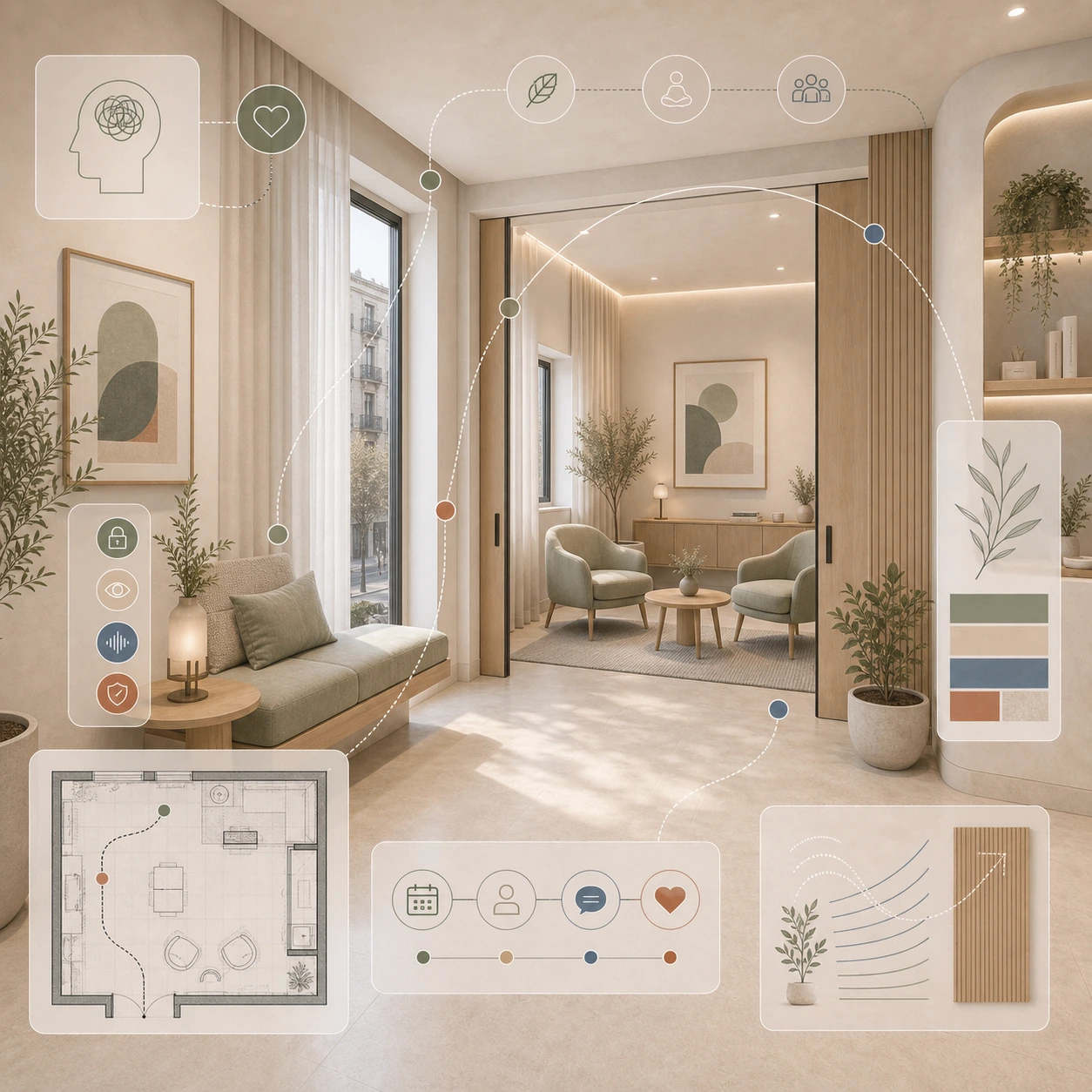
Patients arriving for their first psychology appointment often come with resistance. Many people take months to take that step. What they encounter when they walk through the door has a real impact on whether they decide to return.
A consultation room that conveys security, confidentiality, and warmth reduces that resistance. A consultation room that resembles a generic office or a cold clinical space increases it. Design in psychology is not decoration. It is part of the treatment.
What the space communicates to the patient before anyone speaks
The patient unconsciously evaluates the office with very specific questions: Is this place safe? Will no one hear what I say? Has the professional who works here taken their space seriously? Will I be able to relax enough to talk?
The design of the consulting room has to answer those questions with the space before the psychologist answers them with words.
The design elements that make a good doctor's office
Distribution: confidentiality first
A psychology practice waiting room should not be a space where patients can see each other. Ideally, there should be a small waiting area where those entering and leaving do not cross paths, and a door that acoustically isolates the consultation room from any common areas.
If the office is in a shared apartment with other professionals, soundproofing becomes even more critical. Patients who can hear conversations from outside won't be able to relax inside.
Furniture arrangement: without barriers or positions of power
The spatial relationship between the therapist's and patient's chairs is a design decision with clinical impact. Sitting face-to-face with a table between them creates a barrier that increases emotional distance. Positioning them at an angle, without a table, at a comfortable conversational distance, and at the same height facilitates communication and reduces the power imbalance.
The sofa or couch, if there is one, must be in a position that allows the therapist to maintain eye contact without the patient feeling directly observed.
Colors and materials: warmth without stimulation
The colors in a psychology office should be warm and neutral. Nothing bright, nothing distracting, nothing stimulating. Earth tones, beige, soft green, off-white. Materials that provide tactile warmth: wood, soft textiles, and a sound-absorbing rug that creates a more intimate space.
Indoor plants in a psychology office are not decoration. They are an element that measurably reduces cortisol levels. That's not a design detail. It's a clinical fact.
Lighting: never fluorescent, always dimmable
Warm, indirect lighting whenever possible, with a dimmer. The lighting in a consulting room must be able to adapt to the type of session and the time of day without the change being abrupt or noticeable.
Actual budget: Psychology office 40-80m² in Madrid
- Soundproofing (walls, door, ceiling): 8,000-14,000 euros
- Custom-made consulting room furniture: 6,000-12,000 euros
- Waiting area (2-3 people): 3,000-6,000 euros
- Adjustable warm lighting: 3,500-6,500 euros
- Wall coverings, textiles and finishes: 4,000-8,000 euros
- Project and management: 3,500-6,500 euros
- Total: 28,000-53,000 euros
A psychologist in Madrid who sees 25 patients weekly at €90 per session bills €9,000 per month. The difference between the €70 and €90 fee, partly justified by the level of the space, amounts to an additional €2,000 per month. The investment in the design is recouped in 15-25 months.
Are you designing or renovating a psychology practice in Madrid?
Tell us about the available space and the type of practice. We design consulting rooms that make the patient feel safe from the very first second.