
Guide
Store and Retail Design in Barcelona: Showcase, Flow and Conversion
Subscribe to our newsletter!
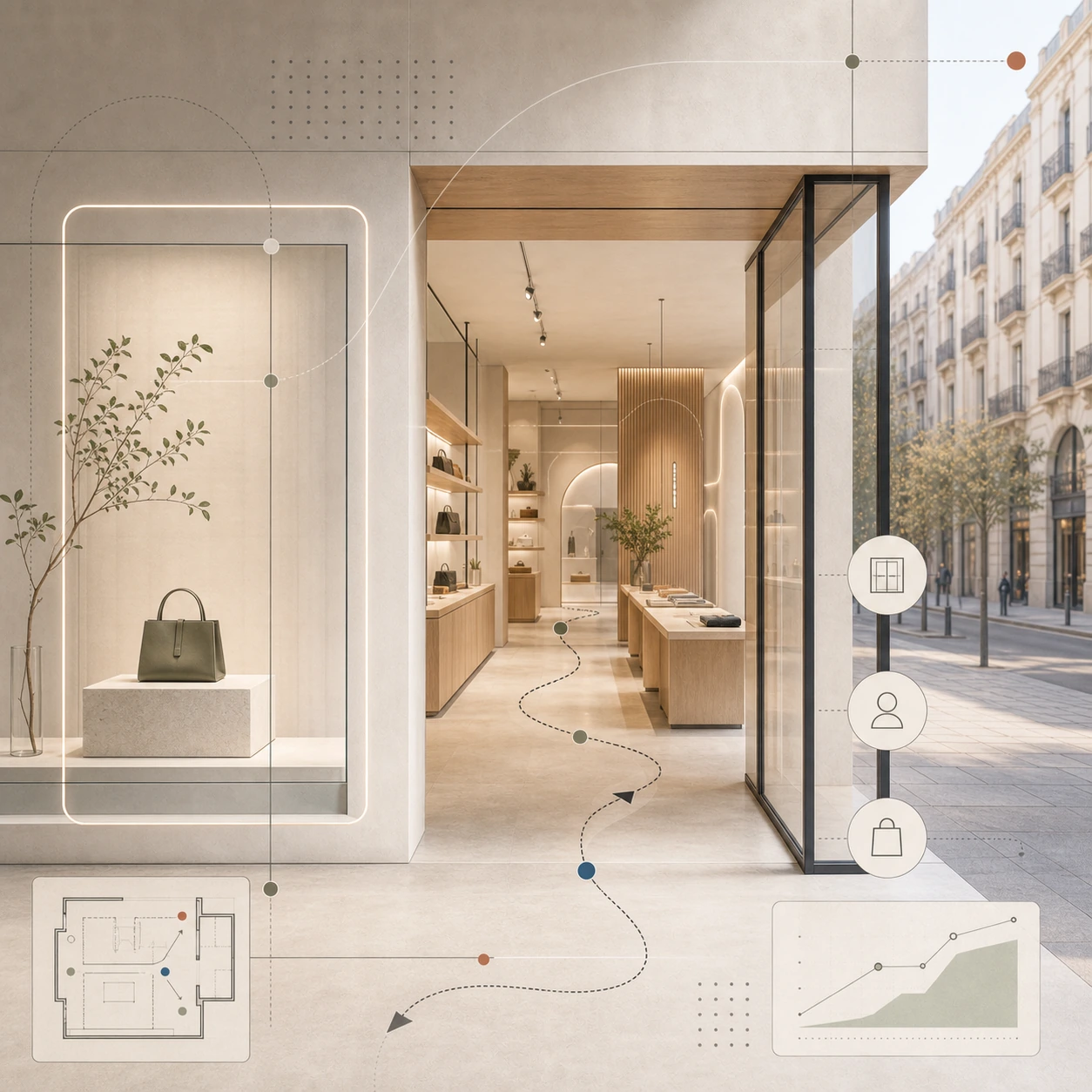
A store in Barcelona does not compete only with other stores. It competes with an entire city that already offers stimulus, window displays, cafés, tourism, local commerce, independent fashion and international brands. Retail interior design does not start with the furniture. It starts with a more uncomfortable question: why anyone should come in, stay and shop here.
The storefront brings the customer. The flow decides if he understands the store. The lighting decides whether the product looks expensive or flat. The cashier decides whether to buy something extra or leave the queue. In small stores, every meter has to work.
Barcelona is not a single market
El Born allows for concepts with more storytelling and discovery. Passeig de Gràcia demands premium clarity and error-free execution. Gràcia demands proximity and authenticity. Poblenou allows for more hybrid stores: showroom, workshop, community and physical e-commerce. In Sarrià or Zona Alta, the customer may shop less often, but expects more calm, attention and finish.
What a profitable store must solve
- Entrance: the customer must understand the product without reading a manifest.
- Route: a clear path prevents the store from being read in ten seconds and abandoned.
- Hero product: not everything can have the same visual importance.
- Testers or decision area: if they are uncomfortable, they lower conversion.
- Box: must close sales, not look like a makeshift counter.
- Materials: have to withstand traffic without losing brand awareness.
Reference costs
- Light intervention: 450 to 750 euros/m²
- Complete renovation with installations, fitting rooms and custom-made carpentry: 850 to 1,500 euros/m²
Frequent errors in stores in Barcelona
Mistake 1: Too many ideas, no hierarchy
A store with too many ideas looks like a marketplace. A store with too much emptiness looks like an inaccessible gallery. The design should help the customer to decide, not to orient himself indefinitely.
Mistake 2: Investing in beautiful parts and forgetting about flow
The most careful furnishing does not compensate for an entrance that confuses or a cash register that does not convert. Flow is the first budget. The finish comes later.
Mistake 3: Not thinking about how it will be photographed.
Most of the stores in Barcelona capture customers before through images on Google and networks than through direct pedestrian traffic. If the lighting does not allow product and ambient photography, the store loses an important part of its customer acquisition channel.
Mistake 4: Separating site design and web design
The customer compares the store with what they saw online before entering. If the web and the store don't speak the same visual language, one undermines the other.
Are you preparing a store in Barcelona?
Eolos works retail as a system: space, identity, storefront, web, photography, signage and shopping experience. Tell us about the area, meters, product and phase of the project.