
Guide
Design of Specialty Coffee Shops in Barcelona: Flow, Average Ticket and Queuing
Subscribe
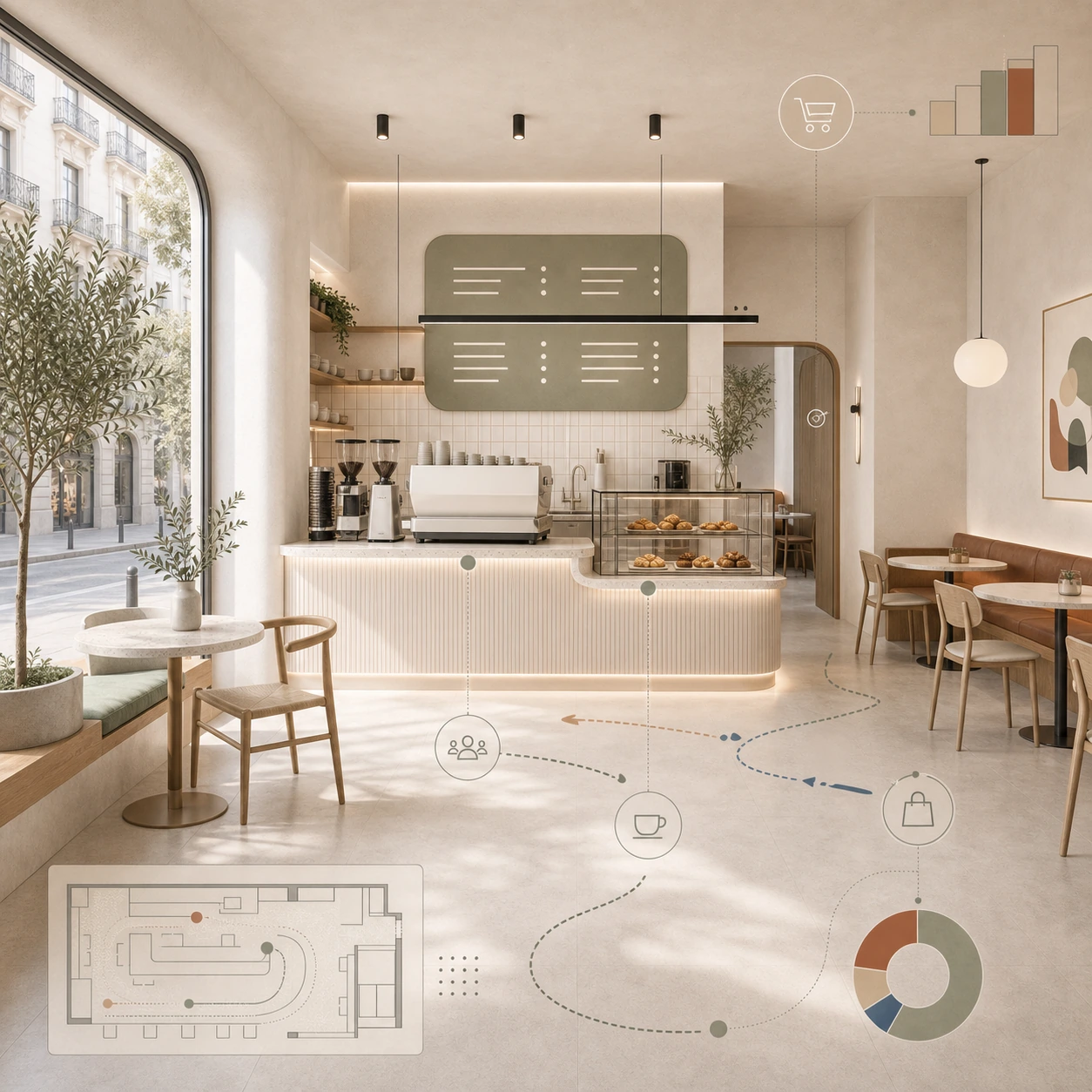
A specialty coffee shop in Barcelona can have good coffee and still sell below its potential. The problem is usually in the flow: a badly placed queue, a slow bar, an invisible display case or tables that look like many but do not rotate well.
In small cafés, the design decides whether the premises can withstand morning peaks, take-away, laptop work, neighborhood customers and tourists without becoming chaotic.
Barcelona and the neighborhood café
Eixample, Gràcia, Poblenou, Sant Antoni or Born do not ask for the same cafeteria. In office areas, speed and repetition weigh heavily. In residential areas, permanence and local treatment matter more. In tourist streets, frontage and immediate product readability are critical.
The bar rules
The bar is not a piece of furniture. It is the operating machine of the business. It must order, pay, prepare, prepare, deliver, display, water, waste, replenish and wait. When the bar is designed just for the photo, the equipment pays for the mistake every day.
A well-designed bar allows the barista to cross no more than three feet per order, the customer to understand where to pay and where to pick up, and the display case to be visible from the entrance. When those three things work together, the average ticket goes up without changing prices.
Average ticket and design
The average ticket does not go up with prices alone. It goes up when the secondary product is well positioned, when the display case is read quickly, when the customer understands what goes with the coffee and when the checkout area allows for an extra decision without pressure.
Reference costs
- Light cafeteria with controlled facilities and bar: 550 to 850 euros/m²
- Complete renovation of specialty cafeteria: 900 to 1,600 euros/m², with more weight on the bar, lighting, flooring, facade, bathrooms and carpentry.
Frequent errors in cafeterias in Barcelona
Mistake 1: Too many seats and not enough flow
A cafeteria that maximizes tables but has no room to move during rush hour generates stress for the team and a sense of discomfort for the customer. In Barcelona, where many cafeterias have tight surface areas, internal pedestrian flow is as important as the number of tables.
Mistake 2: Placing the queue where it blocks the entrance or tables.
A queue that goes all the way to the door or cuts off access to occupied tables makes seated customers feel overrun and keeps new customers from entering. Queue position is a design decision that affects sales every day.
Mistake 3: Hiding pastries and margin product
A display case that cannot be seen from the queue, with flat lighting and no height, does not sell. The product that leaves the most margin in a cafeteria is usually the one that has the least visibility in the design. The display case should be designed as a decision-making showcase, not as a storage unit.
Mistake 4: Ignoring take-away in design
In many cafeterias in Barcelona, take-away accounts for 30 to 50% of sales at peak times. If the bar does not have a separate area for take-away orders, the two flows intersect and slow down service for everyone.
Are you preparing a cafeteria in Barcelona?
Eolos designs coffee shops from operation and branding: bar, flow, average ticket, photography, local SEO and experience. Tell us about your neighborhood, meters and type of service.