
Guide
Design for Hospitality Spaces on the Costa del Sol that Work All Year Round, Not Just in August
Subscribe to our newsletter!
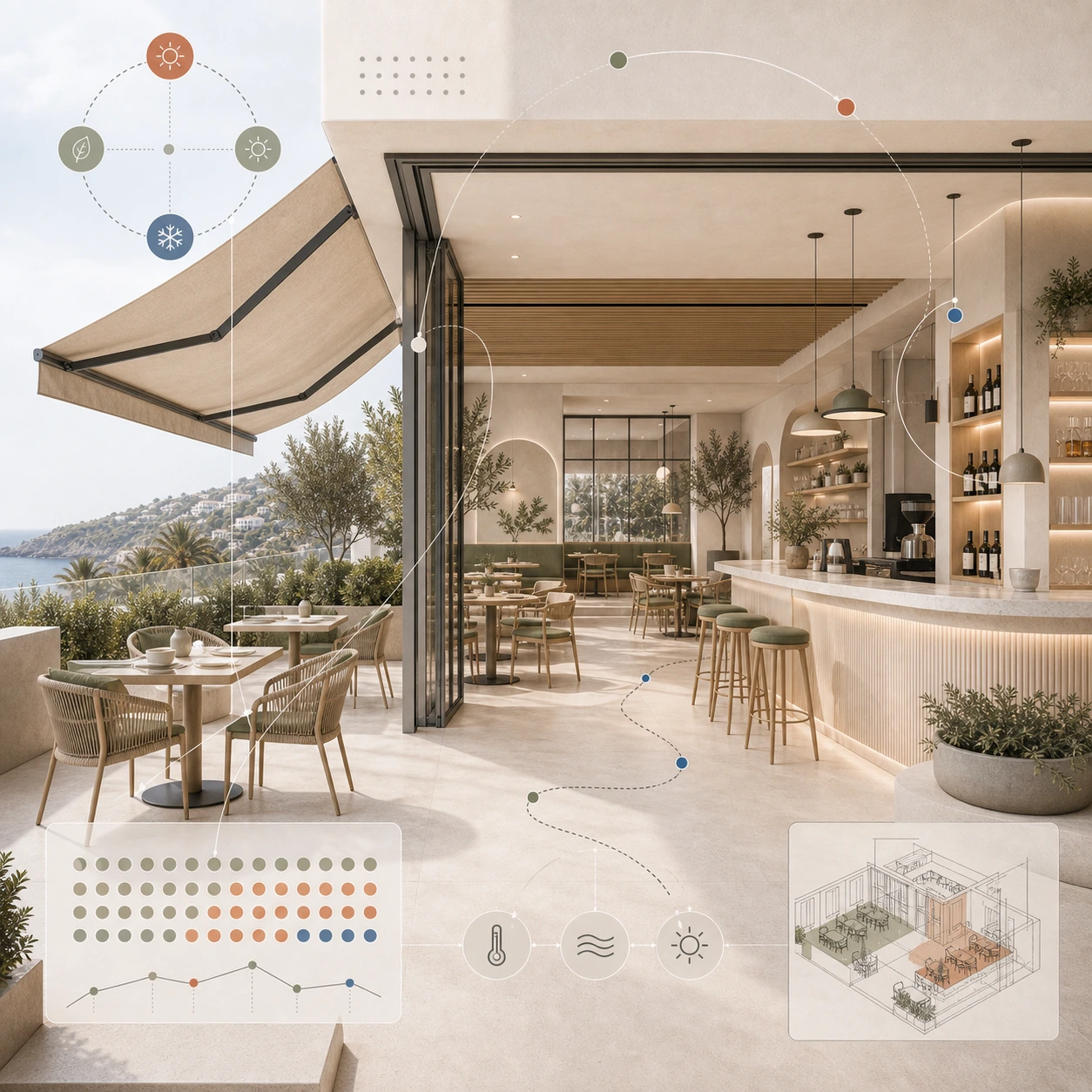
A restaurant in Marbella with a full terrace in August and empty tables in November does not have a demand problem. It has a design problem.
The Costa del Sol has summer tourism and winter tourism, but they are not the same client nor do they demand the same from the space. Most of the premises are designed for only one of these two moments. The result is predictable: four months working at the limit and eight months justifying why the numbers are not coming in.
The problem of designing only for the peak
In high season, a large, open space works alone. The atmosphere is set by the volume of people, the natural light, the background noise. The design almost doesn't have to work because the client arrives already predisposed.
In low season, that same large, open space becomes a problem. Fifteen people in a place designed for a hundred do not generate atmosphere: they generate discomfort. The client notices it, does not come back, and leaves a review that does not help.
The catch is that the operator tends to design with peak occupancy in mind. It's understandable: that's when they bill the most, when they have the most pressure, when they need everything to work the most. But this criterion produces spaces that are good in July and difficult the rest of the year.
What differentiates year-round locations from year-round locations
Hospitality spaces on the Costa del Sol that maintain real occupancy in the off-season have one thing in common: they can contract without looking empty.
This is achieved with zoning. A well-divided space in differentiated zones makes it possible to activate only a part of the premises in low season, maintaining the feeling of ambiance without needing the full capacity. A more intimate interior zone, a bar that functions as an independent space, a covered terrace that changes its character between summer and winter.
Lighting is the other tool. A space that works with natural light and open tones in summer needs to be able to close and heat in winter. That requires a lighting installation designed from the start for both registers, not a summer solution to which you then try to adapt a few floor lamps in October.
Acoustics also change. In a crowded room, the noise of the people fills the space. In a half-occupied room, every conversation is overheard. The materials that absorb or reflect sound are not neutral: they decide whether the space feels alive or empty with few people in it.
The winter customer on the Costa del Sol is not the same as in August.
Winter tourism on the Costa del Sol is predominantly Nordic, British and retirees with high purchasing power. They are not looking for volume or terraces. They are looking for comfort, conversation, and spaces that feel cared for.
A restaurant that in summer works with loud music, tables together and fast service needs to be able to offer something different in winter: more space between tables, less noise, more attention to detail in the finish. That winter customer is loyal, spends well, and comes back. But he does not tolerate a space that is clearly not designed for him.
Designing for that winter client doesn't mean giving up on the summer client. It means building a space that can be both, with design decisions that don't mortgage one of the two moments.
Which design decisions have the greatest impact on annual profitability
The decisions that most affect the ability of a hospitality establishment on the Costa del Sol to operate all year round are not the most expensive ones. They are the ones that are made before the work begins.
The distribution of the space in zones that can be activated independently. A terrace that can be covered and closed without losing character. An air conditioning system that does not make noise in winter when the premises are quiet. Interior materials that work with both summer light and artificial light in the evening in December.
None of these decisions makes the work significantly more expensive if they are taken from the beginning. They all become very expensive if they have to be added later, because then they imply intervening on something that is already finished.
If you want to understand how design impacts a hospitality asset's profitability beyond the season, the article on how to refurbish a hospitality asset without losing what made it work provides a useful framework for thinking through the intervention before committing to any concept.
How Eolos works on hospitality projects on the Costa del Sol
The starting point is always the same: understand the business before designing the space. On the Costa del Sol that means understanding the two clients, the two times of the year, and the two versions of the venue that have to exist within the same project.
Eolos is managed by COAM registered architects with more than 20 years of experience in commercial projects in Spain, Sweden and Greece. WELL AP accreditation from the International WELL Building Institute. We work with operators in Madrid, Marbella and the Costa del Sol who want spaces that work, not just look good in photos.
If you have a project on the Costa del Sol and you want it to work all year round, tell us the situation. The form is below.