
Guide
The Project That Lasted Twice as Long as Expected: Why It Happens and How to Avoid It
Subscribe to our newsletter!
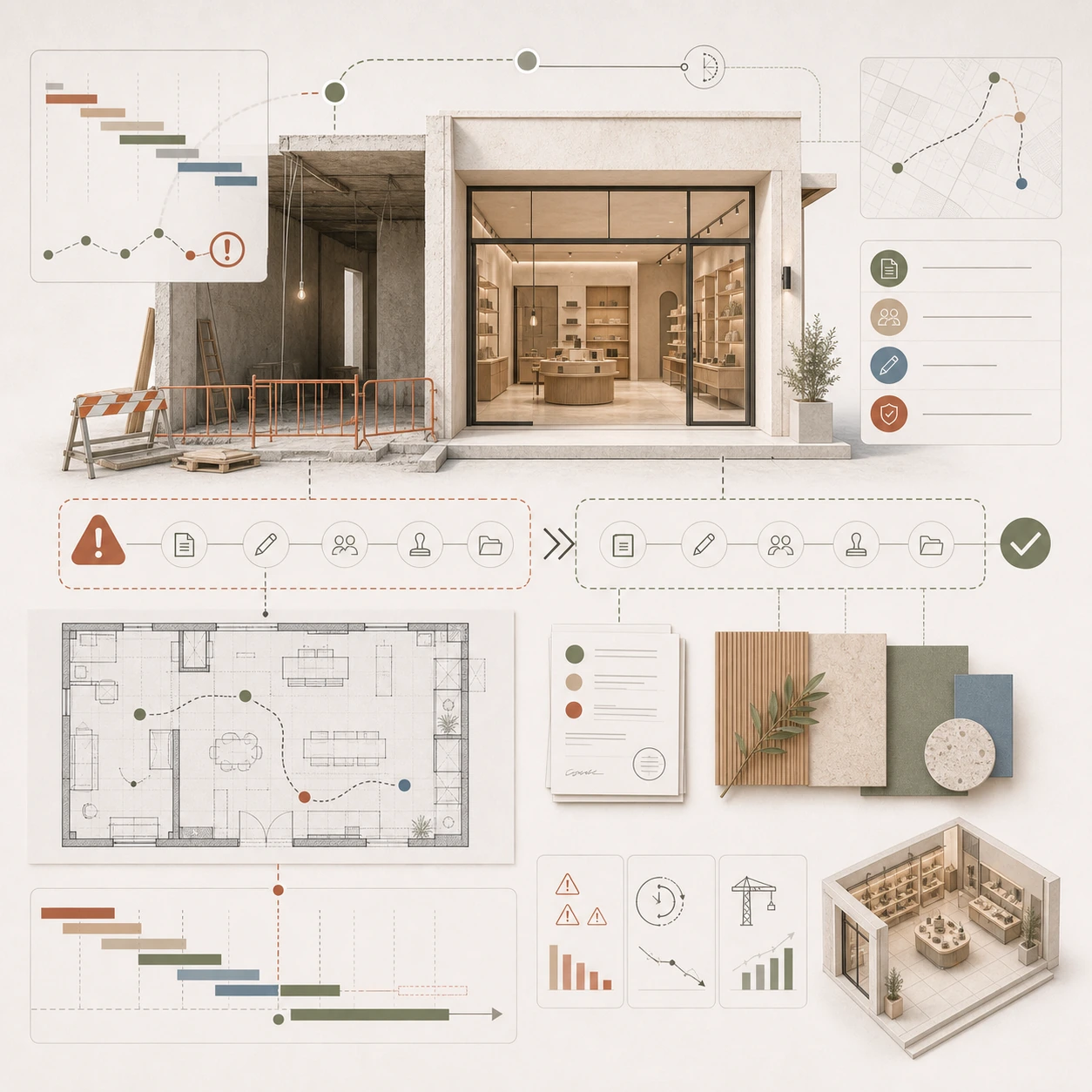
A restaurant that was supposed to open in October opens in February. Four months of closed premises, a hired team unable to work, a launch campaign launched prematurely, and a financial investment that continues to generate costs without generating income.
This is not an exceptional case. It is the most common pattern in poorly managed commercial interior design projects in Spain. And the most frustrating thing is that the delays don't come all at once: they come in small accumulations, each with its own reasonable justification, until the original schedule no longer makes any sense.
Why delays are not bad luck
Projects that are delayed are not delayed because of unforeseen events that were impossible to anticipate. They are delayed because critical decisions were made late, or were not made well, or were made by someone who did not have the authority to make them.
A contractor who starts the work without complete technical documentation will stop as soon as he needs a specification that he does not have. A studio that presents renderings without having closed the installation drawings will discover contradictions during the work that will require redesign. A client who makes decisions about materials while the work is still in progress will generate delays in orders that the original schedule did not contemplate.
All of this is predictable. And all of this can be prevented with the right sequence of work before the work begins.
Three most common causes of delay in commercial projects
The first one is to start the work before having the technical documentation closed. This is the most frequent and most expensive cause. The pressure to open leads many operators to approve the start of construction while the plans are still in process. The result is a construction site that is constantly waiting for decisions that should have been made earlier.
The second is not managing delivery times for materials and equipment well. In hospitality projects, industrial kitchens can have lead times of 8 to 12 weeks from the time the order is placed. If that order is placed when the work is already started, instead of before, the work is finished and there is no kitchen. The facility is ready but cannot operate.
The third is the processing of permits. In Madrid, a building permit for a hospitality business can take between 6 and 16 weeks depending on the type of intervention and the district. Many projects do not incorporate this timeframe into the initial schedule because the client did not know it existed, or because the studio did not communicate it clearly from the beginning.
What a delay costs in real terms
A month's delay in the opening of a restaurant in Madrid with a projected turnover of 80,000 euros per month is a loss of revenue of 80,000 euros. To that must be added the cost of the premises during that month, the salaries of the hired personnel who cannot work, and the cost of relaunching the opening communication.
In office or corporate space projects, the cost of delay is different but equally real: the team working in conditions that are not the final ones, the image that a temporary workspace projects to clients and candidates, and the cost of managing the transition twice instead of once.
The delay does not appear in the construction budget. But it has a real and measurable economic cost that in many cases exceeds the cost of having hired a more expensive but more rigorous study from the beginning.
What a rigorous study does before the work begins
Closes the brief with the client before producing any design. Submits a proposal that includes the estimated construction budget, not just the concept. Produces complete technical documentation before starting the work. Manages orders for materials and equipment well in advance. And communicate permitting deadlines from the first conversation, not when there is already a problem.
This does not guarantee that no unforeseen events will occur. Contingencies do exist. What it does guarantee is that foreseeable unforeseen events do not turn into delays, and that when something genuinely unexpected comes up, the project has enough margin to absorb it without derailing.
If you want to understand how the Eolos work process works phase by phase, the article on how we work at Eolos from the first coffee to the inauguration explains what happens at each step and what is requested from the customer at each moment.
If you have a project with an opening date in mind and you want to know if the schedule is realistic, tell us the situation. The form is below.