
Guide
Designing for a Second Location: What Changes When You Already Have One That Works
Subscribe to our newsletter!
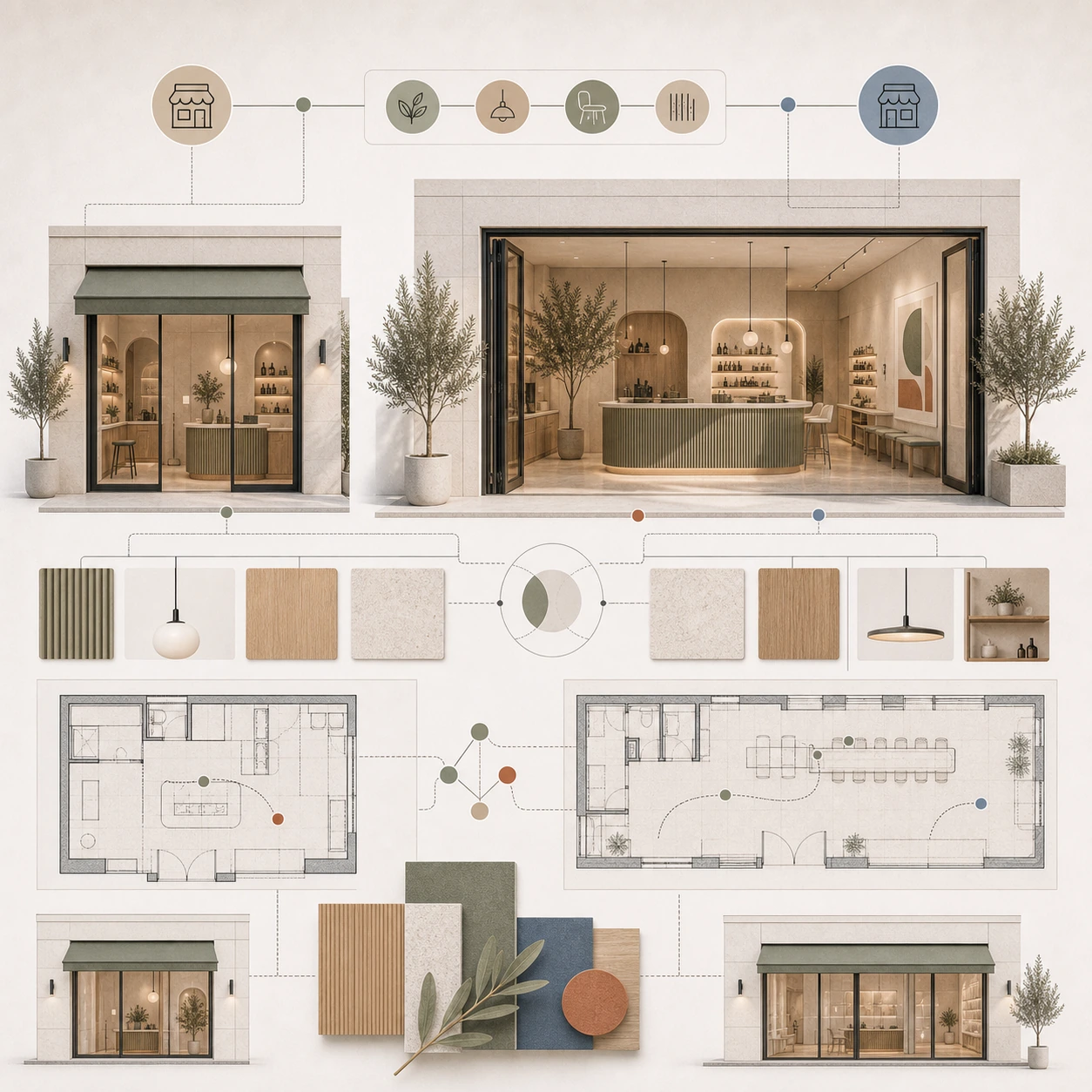
The first location was a process of discovery. You tried things, some worked and some didn't, and eventually you found the combination that makes the space work for the business. Now you have a second location. And the question no one prepares you to answer is: what part of what you have is replicable and what part is not?
Opening a second space is not the same as opening the first. The first location had nothing to protect. The second has to be recognizable as part of the same brand, operate in a different physical context, and not dilute what makes the first one special.
The most expensive mistake in the second opening
Copy the first location exactly.
It seems like the safest decision: you know it works, you have the suppliers, you have the plans. The problem is that what works in the first store is not the design itself: it is the combination of the design with the space, the neighborhood, the natural light, the proportions of the store. That combination is not replicated because the second location has other conditions.
A second location that is a copy of the first in a different space does not look like the first: it looks like a worse version of the first. And that hurts both.
What really makes a space recognizable?
Before designing the second location, a question that most operators have never explicitly asked themselves must be answered: what makes the first location what it is?
It's not the color palette or the specific materials or the typography of the menu. Those are the vehicles. What the client recognizes as his own is something more difficult to articulate: a sensation, a temperature of the space, a way of receiving, a relationship between light and surfaces.
Identifying that accurately is the work prior to the design of the second location. It can't be done by looking at photos of the first. It requires spending time in the space, observing how customers use it, and talking to the team that works there. What the staff at the first location knows about how the space works is design information that is typically not documented anywhere.
What can and cannot be systematized
There are elements that can and should be systematized between stores: the lighting system, the materials of the surfaces of greatest contact, the signage, the layout of the service area. These are the elements that the customer associates with the brand, even if he cannot say exactly why.
What cannot be systematized is the response to the specific space. The layout has to be adapted to the shape of the premises, the relationship with the street, the available light at different times of the day. A second store that has the same distribution as the first one because it was the one that was in the plans, and not because it responds to the conditions of the new space, will have areas that do not work well and will require intervention later on.
When does it make sense to create a space design manual?
If the plan is to open more than two locations, it makes sense to invest in documenting the brand's design system before the third opening. A space design manual captures the unchanging brand elements, standard materials and finishes, lighting criteria, and layout principles that apply to any location regardless of its shape or size.
Such a document does not eliminate design work at each new opening. It makes it more efficient: the design team does not start from scratch but from a system that is already proven, and can concentrate the creative work on adapting that system to the specific space rather than redefining the brand identity for each project.
If you want to understand how this process of brand identity replication works in commercial spaces, the article on what nobody tells you before hiring an interior design studio explains what to ask and what to expect from the process.
If you have a first location that works and are thinking about a second, start the conversation before you have the location signed. The form is below.