Diseño de cafeterías specialty rentables en Madrid
Cómo diseñar una cafetería specialty en Madrid que justifique precios de 4,50€ por café y tenga cola. Diseño de interiores para cafés premium y specialty coffee.
Journal · EOLOS DESIGN LAB
Guía · EOLOS DESIGN LAB Journal
La diferencia entre una cafetería que cobra €1.80 por café y una que cobra €4.50 (y tiene cola) no es solo el café. Es el diseño.
Las cafeterías specialty bien diseñadas en Madrid generan €280-€420 de ingresos por m²/mes vs €120-€180 de cafeterías commodity. Mismo m², triple facturación. El diseño es el 60% de esa diferencia.
Este artículo demuestra con Escenarios de planificación y números concretos cómo el diseño estratégico de cafeterías specialty impacta en pricing power, ticket medio, rotación, y rentabilidad. No es decoración hipster. Es arquitectura de márgenes.
La economía brutal del café commodity vs specialty
Escenario de planificación: Dos cafeterías en Malasaña, separadas por 200 metros
Cafetería A: "Cafetería de barrio" tradicional
Espaciales:
45m² totales
18 asientos interior + 4 terraza
Diseño: funcional, genérico, sin personalidad
Económicos:
Café solo: €1.80
Café con leche: €2.20
Ticket medio: €3.80
Clientes/día: 110
Facturación diaria: €418
Facturación mensual: €12,540
ingresos por m²/mes: €279
Márgenes:
Coste café/cliente: €0.45
Margen bruto: 76%
Pero: alquiler €2,400/mes (19% de ingresos)
Personal: €4,800/mes (38%)
Margen operativo: 18-22%
Cafetería B: Specialty third wave (a 200m de distancia)
Espaciales:
48m² totales (similar)
16 asientos interior + 6 terraza
Diseño: cuidado, identitario, instagrameable
Económicos:
Café solo (single origin): €3.80
Café con leche (latte art): €4.50
Ticket medio: €8.20 (incluye pastry/brunch)
Clientes/día: 95 (menos volumen)
Facturación diaria: €779
Facturación mensual: €23,370
ingresos por m²/mes: €487 (+74% vs A)
Márgenes:
Coste café/cliente: €0.85 (café mejor calidad)
Margen bruto: 73% (similar)
Alquiler: €2,600/mes (11% de ingresos, mejor ratio)
Personal: €6,200/mes (27% - puede permitirse mejor)
ROI del diseño premium: Beneficio adicional: €63k-€74k/año Payback sobrecost diseño: 6.8-8 meses
Por qué el diseño permite cobrar 2.5x más (sin resistencia del cliente)
La psicología del pricing en cafeterías:
1. Señales de calidad = justificación de precio
Cliente entra a cafetería commodity:
Ve: espacio funcional, máquina comercial, marca café estándar
Piensa: "Café normal de bar"
Expectativa precio: €1.50-€2.50
Si cobras €4.50 = "caro, no vuelvo"
Cliente entra a specialty bien diseñada:
Ve: barra statement, máquina La Marzocco, molinillo Mahlkonig, barista concentrado, tostador propio visible
Piensa: "Esto es serio, son expertos"
Expectativa precio: €3.50-€5.50
Si cobras €4.50 = "razonable para esta calidad"
El diseño comunica calidad ANTES de que el cliente pruebe el café.
2. Experiencia > transacción
Cafetería commodity:
Cliente entra, ordena, paga, espera de pie, toma café, sale
Tiempo: 6-8 minutos
Percepción: transacción funcional
Cafetería specialty bien diseñada:
Cliente entra, aprecia el espacio, elige asiento, ordena con conversación (origen del café, método), observa preparación, disfruta ambiente, toma fotos, se queda 25-45 minutos
Percepción: experiencia completa
Gente paga por experiencias, no por transacciones.
3. Instagrameability = marketing gratuito + justificación social
Matemática del contenido orgánico:
Cafetería specialty instagrameable con 180 clientes/día:
15-25% comparten en RRSS (27-45 posts/día)
810-1,350 posts/mes
Alcance promedio: 280 followers/post
Impresiones mensuales: 226k-378k
Valor en publicidad pagada equivalente: €1,800-€4,200/mes
Además: Cuando cliente comparte café de €4.50 en Instagram, no puede después quejarse que es caro. Justificación social = reducción de fricción de precio.
4. Diferenciación = pricing power
Madrid tiene 1,200+ cafeterías.
De esas:
950+ son commodity (compiten por precio)
180~ son specialty (compiten por experiencia)
40~ son specialty con diseño excepcional (pricing sin resistencia)
En commodity: Cliente elige por cercanía/precio En specialty con diseño: Cliente elige por experiencia, hace viaje específico, paga premium feliz
Los 9 elementos críticos del diseño de cafetería specialty rentable
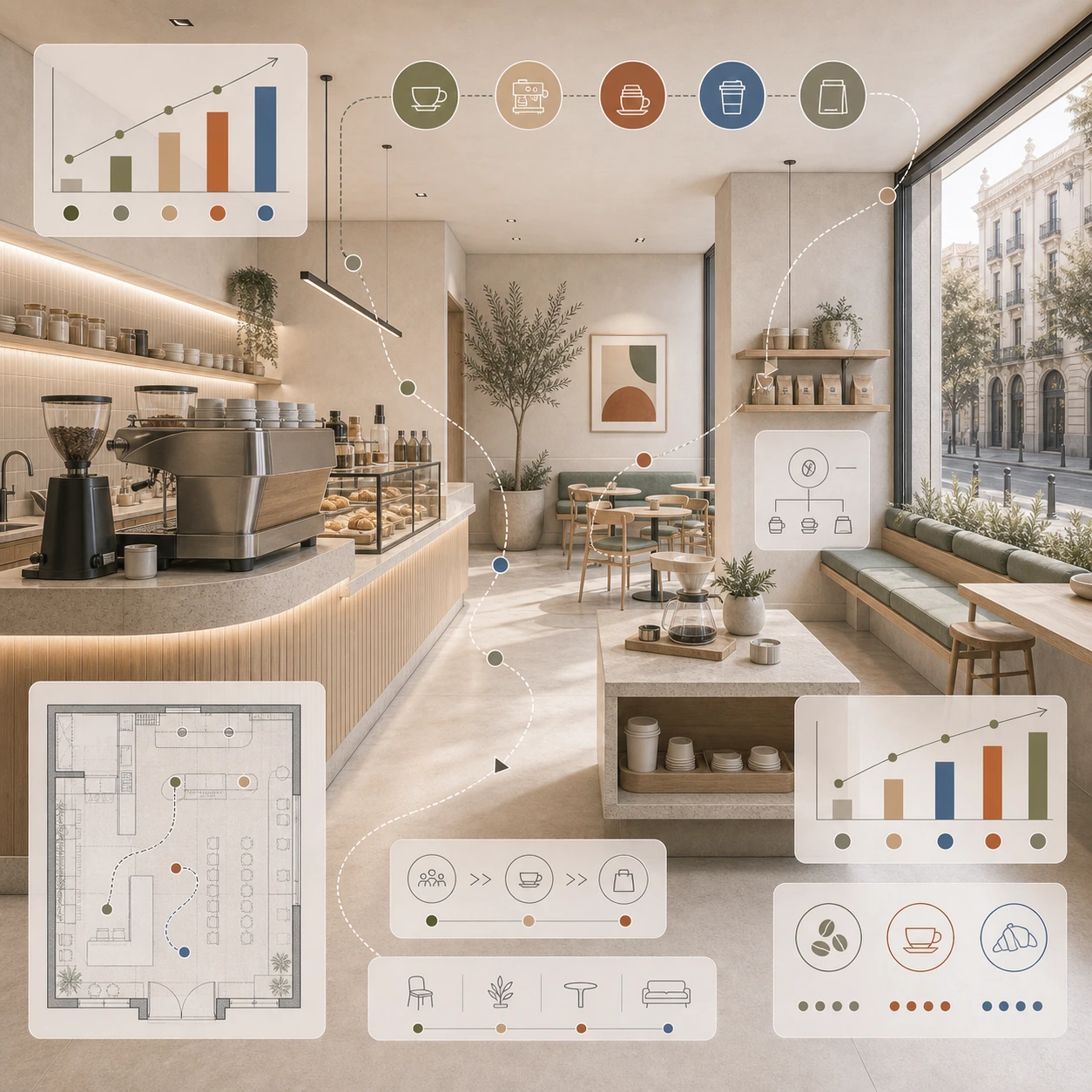
1. La barra: tu escenario, tu argumento de venta
La barra es el 40% del impacto visual de una cafetería specialty.
Error común: Barra funcional tipo bar de tapas. Cliente no ve preparación, no hay teatro.
Solución: barra statement diseñada como escenario
Elementos críticos:
A) Posicionamiento estratégico
Visible desde entrada (primer impacto)
Máquina de café como protagonista
Barista trabajando a la vista (show)
B) Altura y visibilidad
Altura trabajo: 90-95cm (barista cómodo)
Cliente puede ver preparación completa
Desde asientos se ve el ritual
C) Materiales que comunican calidad
Mármol/cuarzo/granito: premium, higiene visual
Madera maciza: calidez, artesanal
Acero inoxidable: profesional, técnico
Nunca: formica barata, melamina imitación
Presupuesto barra statement: €8,000-€18,000 (4-6 metros lineales)
D) Iluminación focal
Luz cenital sobre zona de preparación
Destaca ritual de preparación
Crea dramatismo
E) Display integrado
Tazas visibles (marca, diseño)
Granos de café en frascos de vidrio (visual + aroma)
Pastry/productos en vitrina diseñada
Merch (bolsas café, tazas) como decoración funcional
La solución: Menos asientos = más confort = estancia larga = ticket alto.
Óptimo specialty: 0.4-0.6 asientos/m²
Coste del error: ingresos por m² -30-40%
Error 3: Escatimar en iluminación
El síntoma: Iluminación funcional cenital fría.
Consecuencia: Ambiente poco acogedor, fotos malas, estancia corta.
La solución: Iluminación multicapa cálida. Es 15-18% de presupuesto pero 35% del ambiente.
Coste del error: Ocupación -25%, fotos UGC -60%
Error 4: No tener identidad visual clara
El síntoma: Mezcla de estilos sin coherencia.
Consecuencia: Parece cafetería "bonita" pero genérica. Cero memorabilidad.
La solución: Define identidad ANTES de diseñar. Todo debe ser coherente.
Coste del error: Diferenciación nula = competencia por precio
Error 5: Baño descuidado
El síntoma: Baño funcional pero feo/sucio.
Consecuencia: Reviews negativas, percepción de calidad se derrumba.
La solución: Baño debe mantener estándar del resto. Inversión €5k-€9k obligatoria.
Coste del error: Reputación dañada, recompra -40%
Error 6: Mala acústica
El síntoma: Espacio ruidoso, imposible conversar/trabajar.
Consecuencia: Estancia corta, trabajadores no vuelven, ticket bajo.
La solución: Tratamiento acústico €4k-€10k. No negociable.
Coste del error: Ticket medio -25%, ocupación tarde -50%
Casos de éxito completos
Caso 1: Cafetería micro-roastery, Malasaña
Perfil:
Proyecto nuevo, emprendedor con experiencia barista
Objetivo: Referencia specialty en zona saturada
Diferenciación: Tostado propio
Espacio:
72m²
Local diáfano (antigua tienda ropa)
Inversión:
Diseño + obra + equipamiento: €298,000
Elementos clave:
Tostador Giesen W6A visible desde calle
Barra central mármol Negro Marquina + nogal
28 asientos (0.39/m²) mix estilos
Iluminación dramática sobre tostador
Neón "Roasted With Love"
Mural artista local sobre proceso café
Acústica tratada (techo + paneles)
ingresos modelo:
Año 1:
Consumición cafetería: €38,400/mes
Retail bolsas café: €6,200/mes
Wholesale (8 cafeterías clientes): €9,400/mes
Total: €54,000/mes
Por m²/mes: €750
Márgenes:
Consumición: 74%
Retail: 71%
Wholesale: 52%
Margen ponderado: 68%
Resultados año 1:
Break-even mes 7
Beneficio año 1: €92,000
Payback inversión: 38 meses proyectado
Año 2 (actual):
Consumición: €42,800/mes
Retail: €8,900/mes
Wholesale (14 clientes): €16,200/mes
Total: €67,900/mes
Beneficio año 2: €168,000
Factores de éxito:
Diferenciación clara (uno de pocos con tostador propio Malasaña)
Calidad producto inquestionable
Diseño que comunica "esto es serio"
Marketing orgánico brutal (18-25 posts/día de clientes)
Wholesale creció orgánicamente (cafeterías buscan a ellos)
Quote propietario: "La inversión en diseño pareció loca al inicio. €298k para 72m² = €4,139/m². Pero el diseño es lo que permite cobrar €4.50 sin que nadie pestañee. Y lo que hace que otras cafeterías quieran comprar nuestro café. Se pagó solo en 3 años, y ahora genera €168k/año limpio."
Caso 2: Cafetería brunch specialty, Retiro
Perfil:
Pareja joven, uno chef uno barista
Concepto: Specialty coffee + brunch de verdad (no tostadas estándar)
Zona familias (kids corner) = padres vuelven semanalmente
Luz natural espectacular = fotos increíbles
Ubicación residencial leal
Challenge:
Capacidad máxima alcanzada (filas largas finde)
Considerando expansión o segundo local
Quote copropietaria: "El kids corner fue idea last-minute, €2,200 extra. Genera €8,000-€12,000 adicionales/mes en familias que vienen porque 'los niños están entretenidos'. ROI: inmediato."
Caso 3: Cafetería specialty minimal, Chamberí
Perfil:
Emprendedor ex-consultor, cambio de vida
Concepto: Minimalismo japonés, café como ceremonia
Target: Profesionales 30-45, buscan calma
Espacio:
48m²
Local estrecho pero profundo
Inversión:
Total: €118,000 (ajustado)
Concepto minimalista = menos elementos pero máxima calidad
Elementos clave:
Barra madera cedro japonés + mármol blanco
Máquina La Marzocco Linea PB (blanca)
18 asientos solo (0.375/m² - muy espacioso)
Iluminación difusa tipo wabi-sabi
Cerámica artesanal japonesa (tazas únicas)
Plantas tipo bonsai y kokedama
Ausencia de decoración superflua
ingresos modelo:
Clientes/día: 95 (volumen bajo pero intencional)
Ticket medio: €9.80 (alto)
ingresos/mes: €27,930
Por m²/mes: €582
Particularidades:
No tiene WiFi (decisión estratégica, busca desconexión)
Música solo ambiental japonesa
Barista explica origen de cada café (educativo)
Tiempo preparación más largo (ritual)
Perfil cliente:
78% son regulares (recompra altísima)
Edad promedio: 38 años
Estancia promedio: 25 min (corta pero intensa)
No es espacio para trabajar = rotación eficiente
Resultados año 1:
Beneficio: €94,000
Payback: 15 meses
Año 2:
ingresos estable (crecimiento lento intencional)
Beneficio: €108,000
Factores de éxito:
Diferenciación radical (único en Madrid con este concepto puro)
Público nicho pero leal y dispuesto a pagar
Costes operativos bajos (espacio pequeño, equipo 2-3 personas)
Márgenes altísimos (70%+)
Quote propietario: "Todos me dijeron que sin WiFi fracasaría. Pero esa es precisamente mi ventaja. La gente viene a desconectar, no a trabajar. 15 minutos de calma con buen café = vuelven toda la semana. Menos clientes, más margen, más felicidad."
Trabajar con EOLOS en tu cafetería specialty
Diseñamos cafeterías specialty en Madrid con ticket medio €7.80-€10.50 y ingresos €420-€750 por m²/mes.
Nuestro enfoque:
1. ingresos-driven design desde concepto
No diseñamos "cafeterías bonitas". Diseñamos máquinas de generar margen.
Modelamos P&L ANTES de diseñar:
ingresos proyectado por categoría
Break-even realista
Payback de inversión
Sensibilidad a variables clave
Diseño se optimiza para mejor ratio inversión/rentabilidad.
2. Identidad que justifica pricing
Trabajamos identidad de marca EN PARALELO a diseño espacial:
Recomendación: Elige estilo que refleje tu identidad auténtica, no tendencias.
Conclusión: El diseño no es decoración, es tu argumento de venta
En 2026, Madrid tiene más de 1,200 cafeterías compitiendo por el mismo cliente.
Tu ventaja competitiva no puede ser solo "tengo buen café" (muchos lo tienen).
Debe ser: "Tengo una experiencia completa que justifica €4.50 y genera una cola."
Los números son claros:
Cafetería specialty bien diseñada:
Ticket medio: €7.80-€10.50 vs €3.50-€4.80 commodity
ingresos por m²: €420-€750/mes vs €120-€280
Margen operativo: 28-38% vs 15-22%
Inversión diseño specialty vs commodity:
Commodity: €1,200-€1,800/m²
Specialty: €2,400-€3,800/m²
Diferencia: +€1,200-€2,000/m²
En 60m²: +€72k-€120k inversión inicial
Pero: Beneficio adicional anual: €95k-€180k Payback sobrecost: 5-15 meses
No diseñas specialty porque es "más bonito".
Lo haces porque es más rentable.
El diseño es lo que permite:
Cobrar 2.5x más sin resistencia
Generar €18k-€28k mensuales en marketing orgánico
Crear comunidad leal que vuelve diariamente
Competir por experiencia, no por precio
En Madrid, donde el alquiler te come 15-25% del ingresos, necesitas pricing power.
El diseño ES tu pricing power.
La decisión es tuya. Los números están claros.
¿Necesitas ayuda con tu proyecto?
En EOLOS diseñamos espacios comerciales que generan resultados medibles: más clientes, mejor experiencia, mayor rentabilidad.
¿Estás preparando un restaurante, un bar o un proyecto de hostelería? Cuéntanoslo mediante las opciones de contacto que encontrarás a continuación.
The difference between a coffee shop that charges €1.80 for a coffee and one that charges €4.50 (and has a queue) isn't just the coffee. It's the design.
Well-designed specialty coffee shops in Madrid generate €280-€420 in revenue per square meter per month, compared to €120-€180 for commodity coffee shops. Same square meterage, triple the revenue. Design is the key to that difference.
This article demonstrates, with real-world examples and concrete figures, how the strategic design of specialty coffee shops impacts pricing power, average transaction value, turnover, and profitability. It's not hipster decor. It's margin architecture.
The brutal economics of commodity vs specialty coffee
Planning scenario: Two cafes in Malasaña, separated by 200 meters
Cafeteria A: Traditional "neighborhood cafeteria"
Space:
45m² total
18 indoor seats + 4 terrace seats
Design: functional, generic, without personality
Economic:
Single coffee: €1.80
Coffee with milk: €2.20
average spend price: €3.80
Customers/day: 110
Daily revenue: €418
Monthly revenue: €12,540
Revenue per m²/month: €279
Margins:
Cost per coffee/customer: €0.45
Gross margin: 76%
But: rent €2,400/month (19% of revenue)
Personal: €4,800/month (38%)
Operating margin: 18-22%
Cafeteria B: Specialty third wave (200m away)
Space:
48m² total (similar)
16 indoor seats + 6 terrace seats
Design: careful, distinctive, Instagrammable
Economic:
Black coffee (single origin): €3.80
Coffee with milk (latte art): €4.50
Average price: €8.20 (includes pastry/brunch)
Customers/day: 95 (lower volume)
Daily revenue: €779
Monthly revenue: €23,370
Revenue per m²/month: €487 (+74% vs A)
Margins:
Cost per coffee customer: €0.85 (best quality coffee)
Gross margin: 73% (similar)
Rent: €2,600/month (11% revenue: best ratio)
Personal: €6,200/month (27%: can afford better)
Operating margin: 32-38%
Annual difference:
Cafeteria A: €150,480 revenue → €27k-€33k profit
Cafeteria B: €280,440 revenue → €90k-€107k profit
Difference in initial investment?
Cafeteria A: €52,000
Cafeteria B: €94,000
Difference: +€42,000
ROI of premium design: Additional profit: €63k-€74k/year. Payback on design surcharge: 6.8-8 months
Why design allows you to charge 2.5x more (without customer resistance)
The psychology of pricing in coffee shops:
1. Quality signals = price justification
Customer enters commodity cafe:
See: functional space, commercial machine, standard coffee brand
Think: "Regular bar coffee""
Expected price: €1.50-€2.50
If you charge €4.50 = "expensive, I won't be back""
Customer enters a well-designed specialty:
See: statement bar, La Marzocco machine, Mahlkonig grinder, concentrated barista, visible in-house roaster
Think: "This is serious, they're experts.""
Expected price: €3.50-€5.50
If you charge €4.50 = "reasonable for this quality""
The design communicates quality BEFORE the customer tastes the coffee.
2. Experience > transaction
Commodity cafeteria:
Customer enters, orders, pays, waits standing up, has coffee, leaves
Time: 6-8 minutes
Perception: functional transaction
A well-designed specialty coffee shop:
Customer enters, appreciates the space, chooses a seat, orders while conversing (coffee origin, brewing method), observes preparation, enjoys the atmosphere, takes photos, and stays for 25-45 minutes
Perception: complete experience
People pay for experiences, not transactions.
3. Instagramworthiness = free marketing + social justification
Mathematics of organic content:
Instagrammable specialty coffee shop with 180 customers/day:
Besides: When a customer shares a €4.50 coffee on Instagram, they can't later complain that it's expensive. Social justification = reduced price friction.
4. Differentiation = pricing power
Madrid has 1,200+ cafes.
Of those:
950+ are commodities (they compete on price)
180~ are specialty (they compete for experience)
40~ are specialty with exceptional design (price without resistance)
In commodity form: Customer chooses based on proximity/price Specialty with design: Customer chooses based on experience, takes a specific trip, and happily pays premium.
The 9 critical elements of a profitable specialty coffee shop design
1. The bar: your stage, your sales pitch
The bar is the 40% of a specialty coffee shop's visual impact.
Common mistake: Functional tapas bar style counter. Customer doesn't see preparation, there's no theatrics.
Solution: statement bar designed as a stage
Critical elements:
A) Strategic positioning
Visible from the entrance (first impact)
Coffee machine as the protagonist
Barista working in view (show)
B) Height and visibility
Working height: 90-95cm (comfortable barista)
Customer can view full preparation
The ritual can be seen from the seats.
C) Materials that communicate quality
Marble/quartz/granite: premium, visual hygiene
Solid wood: warmth, handcrafted
Stainless steel: professional, technical
Never: cheap Formica, imitation melamine
Statement bar budget: €8,000-€18,000 (4-6 linear meters)
D) Focused lighting
Overhead light over preparation area
preparation ritual stands out
Create drama
E) Integrated display
Visible cups (brand, design)
Coffee beans in glass jars (visual + aroma)
Pastry/products in a designed display case
Merch (coffee bags, mugs) as functional decoration
Total investment: €280,000-€380,000Per m²: €3,500-€4,200/m²
Includes all of the above PLUS:
Toaster 5-12kg: €28,000-€45,000
Specialized extraction toaster: €12,000-€18,000
Separate roasting area
Green coffee storage
Projected Revenue:
Coffee consumption: €42,000-€55,000/month
Retail toasted bags: €8,000-€15,000/month
Wholesale to other coffee shops: €12,000-€25,000/month
Total: €62,000-€95,000/month
Payback: 14-20 months (longer due to larger investment but multiple revenue streams)
Locations in Madrid: where Specialty operates
Prime areas for specialty (high success):
1. Malasaña / Triball
Young, conscious, digital audience
Willing to pay premium
High density of freelancers/creatives
Rent: €32-€48/m²/month
Profitability: High Competence: Very high (critical differentiation)
2. Chueca
Residents + LGBTQ+ tourism + international
High quality expectations
Local + tourist mix works
Rent: €35-€52/m²/month
3. Footbath
Artistic, multicultural, authentic
A slightly more affordable price is needed.
Strong, loyal community
Rent: €24-€36/m²/month
4. Chamberí / Trafalgar
Young families, professionals
High purchasing power
Less crowded than Malasaña
Rent: €28-€42/m²/month
5. Salamanca / List
Maximum purchasing power
Luxury/premium expectations
Requires a high level of finish.
Rent: €38-€58/m²/month
6. Retreat / Ibiza
Residential, quiet
Loyal local customers
Hearty brunch on weekends
Rent: €26-€38/m²/month
Emerging areas (opportunity):
7. Ambassadors / Arganzuela
Gentrification in progress
More affordable rents
High potential if you are a pioneer
Rent: €20-€30/m²/month
8. Prosperity / Chamartín
Corporate areas with offices
High demand on working days
Weak weekends
Rent: €22-€32/m²/month
Common mistakes that kill margins
Mistake 1: Investing in professional equipment but mediocre design
The symptom: La Marzocco machine €15k but generic space.
Consequence: You can't justify premium pricing. Customer sees professional equipment but a mediocre environment = confusion = resistance to €4.50.
The solution: Balance. Pro team + pro design. One without the other doesn't work.
Cost of error: Pricing limited to €2.80-€3.20 = insufficient margins
Error 2: Too many seats (commodity density)
The symptom: 50 seats in 55m² = overcrowding.
Consequence: Uncomfortable, noisy atmosphere, short stay, low price.
The solution: Fewer seats = more comfort = longer stay = higher ticket price.
Optimal specialty: 0.4-0.6 seats/m²
Cost of error: Revenue per m² -30-40%
Error 3: Skimping on lighting
The symptom: Cool overhead functional lighting.
Consequence: Unwelcoming atmosphere, bad photos, short stay.
The solution: Warm multi-layer lighting. It's 15-18% budget but 35% ambiance.
Cost of error: Occupancy -25%, photos UGC -60%
Error 4: Not having a clear visual identity
The symptom: A mix of styles without coherence.
Consequence: It looks like a "nice" but generic cafe. Zero memorability.
The solution: Define your identity BEFORE you design. Everything must be consistent.
Cost of error: Zero differentiation = price competition
Error 5: Neglected bathroom
The symptom: Functional but ugly/dirty bathroom.
Consequence: Negative reviews, perception of quality collapses.
The solution: Bathroom must maintain the standard of the rest of the bathroom. Investment of €5k-€9k is mandatory.
Cost of error: Damaged reputation, buyback -40%
Error 6: Poor acoustics
The symptom: Noisy space, impossible to talk/work.
Consequence: Short stay, workers don't return, low ticket price.
The solution: Acoustic treatment €4k-€10k. Non-negotiable.
Cost of error: average spend -25%, late occupancy -50%
Complete success stories
Case 1: Micro-roastery cafeteria, Malasaña
Profile:
New project, entrepreneur with barista experience
Objective: Specialty referral in a saturated area
Differentiation: Our own roasting
Space:
72m²
Open-plan space (former clothing store)
Investment:
Design + construction + equipment: €298,000
Key elements:
Giesen W6A toaster visible from street
Black Marquina marble central bar + walnut
28 seats (0.39/m²) mix styles
Dramatic lighting on toaster
Neon "Roasted With Love""
Mural by local artist depicting the coffee process
Treated acoustics (ceiling + panels)
Revenue model:
Year 1:
Cafeteria consumption: €38,400/month
Retail coffee bags: €6,200/month
Wholesale (8 client cafes): €9,400/month
Total: €54,000/month
Per m²/month: €750
Margins:
Consumption: 74%
Retail: 71%
Wholesale: 52%
Weighted margin: 68%
Year 1 Results:
Break-even month 7
Profit year 1: €92,000
Investment payback: Projected 38 months
Year 2 (current):
Consumption: €42,800/month
Retail: €8,900/month
Wholesale (14 clients): €16,200/month
Total: €67,900/month
Profit year 2: €168,000
Success factors:
Clear differentiation (one of the few with its own toaster in Malasaña)
Unquestionable product quality
Design that communicates "this is serious""
Brutal organic marketing (18-25 posts/day from clients)
Wholesale grew organically (coffee shops seek them out)
Quote owner: ""The investment in design seemed crazy at first. €298k for 72m² = €4,139/m². But the design is what allows us to charge €4.50 without anyone batting an eye. And it's what makes other cafes want to buy our coffee. It paid for itself in 3 years, and now it generates a net €168k/year.""
Case 2: specialty brunch Cafe, Retiro
Profile:
Young couple, one chef, one barista
Concept: Specialty coffee + real brunch (not standard toast)
Market: Families + digital nomads area
Space:
65m²
Corner unit with large windows (brutal natural light)
Co-Operating assumption: ""The kids' corner was a last-minute idea, an extra €2,200. It generates an additional €8,000-€12,000/month from families who come because 'the children are entertained'. ROI: immediate."‘
Case 3: Minimalist specialty coffee shop, Chamberí
Profile:
Entrepreneur, ex-consultant, life change
Concept: Japanese minimalism, coffee as a ceremony
Target: Professionals 30-45, seeking calm
Space:
48m²
Narrow but deep
Investment:
Total: €118,000 (adjusted)
Minimalist concept = fewer elements but maximum quality
Key elements:
Japanese cedar wood bar + white marble
La Marzocco Linea PB machine (white)
18 seats only (0,375/m²: very spacious)
Wabi-sabi style diffused lighting
Japanese handcrafted ceramics (unique mugs)
Bonsai and kokedama type plants
Absence of superfluous decoration
Revenue model:
Clients/day: 95 (low but intentional volume)
average spend: €9.80 (high)
Revenue/month: €27,930
Per m²/month: €582
Special features:
It doesn't have WiFi (strategic decision: seeks disconnection)
Japanese ambient music only
Barista explains the origin of each coffee (educational)
Longer preparation time (ritual)
Customer profile:
78% are regulars (very high rebuy)
Average age: 38 years
Average stay: 25 min (short but intense)
No workspace = efficient rotation
Year 1 Results:
Profit: €94,000
Payback: 15 months
Year 2:
Stable revenue (intentional slow growth)
Profit: €108,000
Success factors:
Radical differentiation (unique in Madrid with this pure concept)
A niche audience, but loyal and willing to pay
Low operating costs (small space, team of 2-3 people)
Very high margins (70%+)
Quote owner: ""Everyone told me I'd fail without WiFi. But that's precisely my advantage. People come to disconnect, not to work. 15 minutes of peace and quiet with good coffee = they come back all week. Fewer customers, higher profit margin, more happiness.""
Working with EOLOS in your specialty coffee shop
We design specialty coffee shops in Madrid with an average spend price of €7.80-€10.50 and a revenue of €420-€750 per m²/month.
Our approach:
1. Revenue-driven design from concept
We don't design "pretty cafes". We design profit-generating machines.
We model P&L BEFORE designing:
Projected revenue by category
Realistic break-even
Investment payback
Sensitivity to key variables
Design is optimized for a better investment/profitability ratio.
2. Identity that justifies pricing
We work on brand identity IN PARALLEL to spatial design: