Cómo diseñar un club de pádel o tenis boutique en Madrid que justifique cuotas premium y genere alta retención de socios. Interiorismo para instalaciones deportivas premium.
Journal · EOLOS DESIGN LAB
Guía · EOLOS DESIGN LAB Journal
El pádel en Madrid ha pasado de ser un deporte de barrio a ser el deporte de moda con uno de los mercados de instalaciones más activos de Europa. El problema es que la mayoría de los nuevos clubes se han construido pensando en la pista y olvidando todo lo demás.
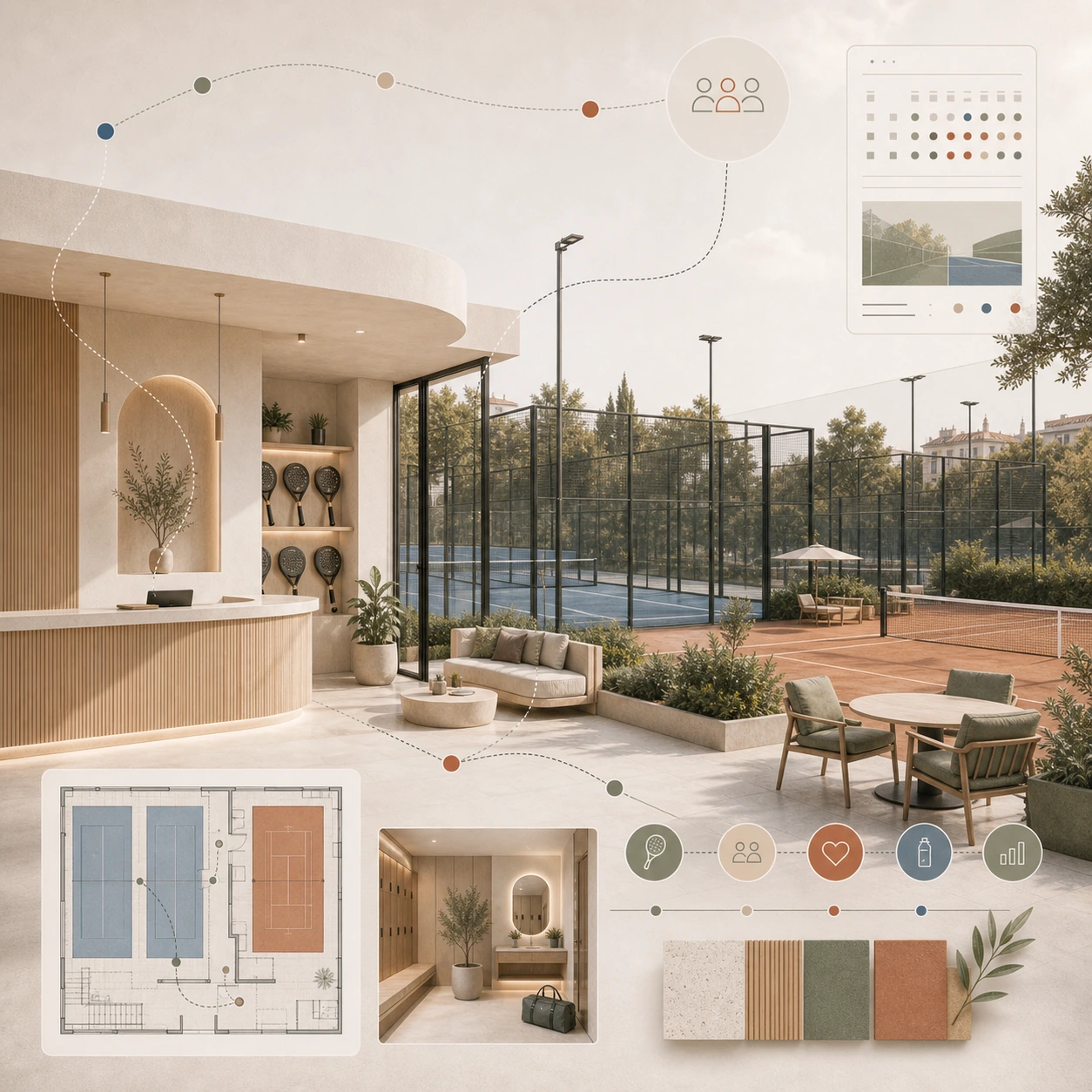
El club boutique que funciona en Madrid en 2026 no se diferencia solo por la calidad de sus pistas. Se diferencia por todo lo que rodea a las pistas: los vestuarios, la zona social, la cafetería, la recepción. Es el conjunto lo que justifica una cuota mensual de 120 euros frente a los 40 euros de un polideportivo municipal.
Los elementos que hacen un club deportivo de nivel
Los vestuarios: donde se decide la renovación de la membresía
Los vestuarios son el espacio más íntimo del club y el que más impacto tiene en la decisión de renovar la membresía. El socio que usa los vestuarios cuatro veces por semana hace esa evaluación inconscientemente en cada visita: ¿Este club cuida este espacio? ¿Está limpio? ¿Los materiales aguantan el uso diario? ¿Me siento bien aquí?
Un vestuario de club boutique necesita: taquillas de diseño con sistema de cierre moderno, ducha con buen caudal y temperatura estable, iluminación que no sea fluorescente fría, suelo antideslizante que no parezca un polideportivo, y un nivel de mantenimiento que se vea en los detalles.
La zona social: donde se construye la comunidad
Un club de pádel o tenis que tiene solo pistas es un lugar donde se juega. Un club que tiene una zona social bien diseñada es un lugar donde se quiere estar antes y después de jugar. Y el tiempo que el socio pasa en el club fuera de la pista es tiempo que genera consumo adicional y fidelización.
La zona social tiene que tener mobiliario cómodo, buena iluminación, acceso visual a las pistas si es posible, y un bar o cafetería que funcione bien. Es el corazón del club y el espacio que más peso tiene en la decisión de recomendar el club a otros.
La iluminación de pistas: rendimiento y estética
La iluminación de las pistas en un club de pádel o tenis interior tiene que cumplir dos funciones: que los jugadores puedan ver bien la pelota (requisito técnico de uniformidad y nivel de lux) y que el espacio se vea bien en fotos y en directo. La iluminación LED de calidad para pistas deportivas tiene un coste más alto que la iluminación estándar, pero el diferencial de consumo energético la amortiza en 3-4 años y el impacto visual es inmediato.
Escenario de presupuesto: club de pádel 4 pistas en Madrid
Pistas de pádel (4 unidades, estructura e instalación): 120.000-180.000 euros
Iluminación técnica de pistas LED: 20.000-35.000 euros
Un club de pádel con 4 pistas en Madrid, 200 socios a 95 euros mensuales y 80 alquileres semanales de no socios a 20 euros la hora factura en torno a 25.600 euros mensuales. La diferencia entre 60 y 95 euros de cuota mensual, en parte justificada por el nivel del espacio, son 7.000 euros mensuales adicionales con los mismos 200 socios.
¿Estás preparando un gimnasio, un centro de estética o un espacio de bienestar? Cuéntanoslo mediante las opciones de contacto que encontrarás a continuación.
Padel in Madrid has gone from being a neighborhood sport to the trendiest sport, boasting one of the most active facility markets in Europe. The problem is that most of the new clubs have been built focusing on the court itself and neglecting everything else.
The boutique club, which will be operating in Madrid in 2026, is distinguished not only by the quality of its courts. It's distinguished by everything surrounding the courts: the changing rooms, the social area, the cafeteria, the reception. It's the entire package that justifies a monthly fee of 120 euros compared to 40 euros for a municipal sports center.
The elements that make a top-level sports club
The changing rooms: where membership renewals are decided
The changing rooms are the most intimate space in the club and the one that has the greatest impact on the decision to renew a membership. Members who use the changing rooms four times a week subconsciously make this assessment on each visit: Does this club take care of this space? Is it clean? Can the materials withstand daily use? Do I feel comfortable here?
A boutique club changing room needs: designer lockers with a modern locking system, a shower with good flow and stable temperature, lighting that is not cold fluorescent, non-slip flooring that doesn't look like a sports center, and a level of maintenance that is evident in the details.
The social zone: where community is built
A padel or tennis club with just courts is a place to play. A club with a well-designed social area is a place where people want to be before and after playing. And the time members spend at the club off the court generates additional spending and fosters loyalty.
The social area needs comfortable furniture, good lighting, a view of the courts if possible, and a well-functioning bar or café. It's the heart of the club and the space that most influences the decision to recommend it to others.
Track lighting: performance and aesthetics
The lighting for courts in an indoor padel or tennis club must fulfill two functions: ensuring players can clearly see the ball (a technical requirement for uniformity and lux level) and making the space look good in photos and in person. High-quality LED lighting for sports courts costs more than standard lighting, but the energy savings pay for themselves in 3-4 years, and the visual impact is immediate.
Budget scenario: 4-court padel club in Madrid
Padel courts (4 units, structure and installation): 120,000-180,000 euros
Technical LED track lighting: 20,000-35,000 euros
Wardrobes (2 complete units): 30,000-50,000 euros
Social area and cafeteria: 25,000-45,000 euros
Reception and access: 10,000-18,000 euros
Project and management: 14,000-24,000 euros
Total: 219,000-352,000 euros
A padel club in Madrid with four courts, 200 members at €95 per month, and 80 weekly rentals by non-members at €20 per hour, generates around €25,600 in revenue per month. The difference between the €60 and €95 monthly membership fees, partly justified by the quality of the facilities, represents an additional €7,000 per month with the same 200 members.
Planning a gym, beauty studio or wellness space? Tell us about it using the contact options below.
Siguiente paso
Cada buen proyecto empieza con una conversación clara.