Cómo diseñar un estudio de tatuaje premium en Madrid que atraiga artistas de nivel y justifique precios altos. Interiorismo para estudios de tattoo.
Journal · EOLOS DESIGN LAB
Guía · EOLOS DESIGN LAB Journal
El sector del tatuaje en Madrid ha cambiado radicalmente. Ya no hay un solo perfil de cliente ni un solo tipo de estudio. Hay estudios que cobran 80 euros por pieza y estudios con artistas de lista de espera de seis meses que cobran 800 euros por sesión.
La diferencia entre los dos modelos incluye el talento del artista, la especialidad del estilo y la reputación construida. Pero también incluye el espacio. Un artista de nivel internacional que trabaja en un espacio genérico está limitando su capacidad de cobrar lo que su trabajo vale. El espacio es parte del argumento de precio.
Lo que distingue un tattoo studio de nivel
El cliente que paga 600 euros por una sesión de tatuaje ha investigado al artista, ha visto su portfolio, ha leído reseñas. Llega con expectativa alta. Si el espacio está a la altura de esa expectativa, el cliente sale con una experiencia completa que recomienda y que comparte. Si el espacio está por debajo, el trabajo puede ser excelente pero la experiencia queda incompleta.
Los elementos de diseño de un tattoo studio premium
Las estaciones de trabajo: privacidad y ergonomía
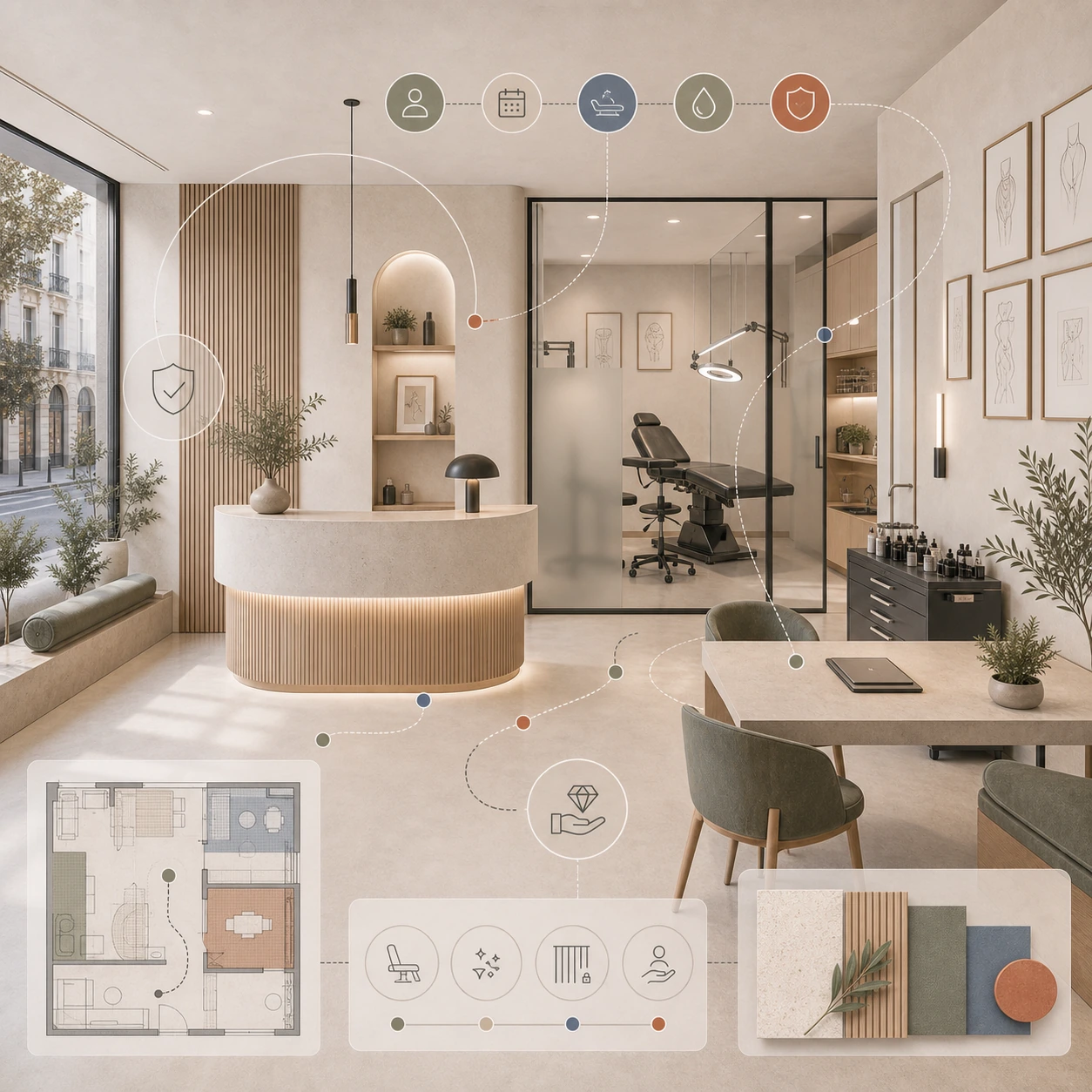
Cada artista necesita su espacio propio: suficiente para maniobrar alrededor del cliente en cualquier posición, con iluminación técnica de calidad para trabajar con precisión, y con privacidad visual suficiente para que el cliente se sienta cómodo en posiciones que a veces son incómodas.
La separación entre estaciones puede ser estructural (tabiques) o con elementos de diseño (estanterías, paneles, cortinas de calidad). Lo importante es que cada artista tenga un espacio que pueda personalizar y que el cliente sienta que es un espacio dedicado a él durante la sesión.
La iluminación técnica: donde no se puede escatimar
La iluminación de trabajo en tatuaje tiene que ser de espectro completo, regulable en intensidad y sin sombras. Un artista trabajando con luz insuficiente o con sombras comete errores que con buena luz no cometería. La inversión en iluminación técnica de calidad (entre 2.000 y 5.000 euros por estación) es la inversión con mejor retorno en un estudio de tatuaje.
La zona de recepción y portfolio: donde se convierte la visita
El cliente que visita un estudio antes de reservar está en proceso de decisión. La recepción y la zona donde puede ver el portfolio de los artistas es donde se toma esa decisión. Un espacio bien diseñado, con el trabajo expuesto en condiciones, y una persona que puede explicar los estilos de cada artista, convierte visitas en reservas.
La estética del estudio: coherente con el tipo de trabajo
El diseño de un estudio de tatuaje tiene que ser coherente con el estilo de trabajo que se hace. Un estudio especializado en tatuaje japonés tiene una estética diferente a uno especializado en realismo o en blackwork. El espacio tiene que comunicar la especialidad del artista antes de que nadie abra el portfolio.
Escenario de presupuesto: estudio de tatuaje 60-100m² en Madrid
Obra civil y distribución (estaciones + recepción): 10.000-16.000 euros
Estaciones de trabajo a medida (3-4 unidades): 12.000-20.000 euros
Iluminación técnica por estación: 8.000-16.000 euros
Zona de recepción y portfolio: 6.000-10.000 euros
Revestimientos y acabados con identidad: 7.000-13.000 euros
Proyecto y dirección: 4.500-8.000 euros
Total: 47.500-83.000 euros
Un estudio con 3 artistas facturando a 500 euros de ticket medio, 5 sesiones semanales cada uno, genera 30.000 euros mensuales. La diferencia entre 300 y 500 euros de sesión, en parte justificada por el nivel del espacio, son 18.000 euros mensuales adicionales con el mismo número de horas trabajadas.
¿Estás preparando un gimnasio, un centro de estética o un espacio de bienestar? Cuéntanoslo mediante las opciones de contacto que encontrarás a continuación.
The tattoo industry in Madrid has changed radically. There's no longer a single client profile or a single type of studio. Some studios charge 80 euros per piece, while others have artists with a six-month waiting list and charge 800 euros per session.
The difference between the two models includes the artist's talent, stylistic specialization, and established reputation. But it also includes the space. An internationally renowned artist working in a generic space is limiting their ability to charge what their work is worth. Space is part of the pricing argument.
What distinguishes a top-tier tattoo studio
A client who pays 600 euros for a tattoo session has researched the artist, viewed their portfolio profile, and read reviews. They arrive with high expectations. If the studio lives up to those expectations, the client leaves with a complete experience that they recommend and share. If the studio falls short, the work may be excellent, but the experience feels incomplete.
The design elements of a premium tattoo studio
Workstations: privacy and ergonomics
Each artist needs their own space: enough to maneuver around the client in any position, with quality technical lighting to work with precision, and with enough visual privacy for the client to feel comfortable in positions that are sometimes uncomfortable.
The separation between stations can be structural (partitions) or achieved through design elements (shelving, panels, quality curtains). The important thing is that each artist has a space they can personalize and that the client feels it's a space dedicated to them during the session.
Technical lighting: where no expense can be spared
Tattoo lighting must be full-spectrum, adjustable in intensity, and shadow-free. An artist working in insufficient or shadowy light makes mistakes that wouldn't be made with good lighting. Investing in quality technical lighting (between €2,000 and €5,000 per station) is the investment with the best return for a tattoo studio.
The reception area and portfolio: where the visit becomes
Clients visiting a studio before booking are in the decision-making process. The reception area and the space where they can view the artists' portfolios are where that decision is made. A well-designed space, with the work displayed in good condition, and a staff member who can explain each artist's style, converts visits into bookings.
The studio's aesthetic: consistent with the type of work
The design of a tattoo studio must be consistent with the style of work performed. A studio specializing in Japanese tattoos has a different aesthetic than one specializing in realism or blackwork. The space must communicate the artist's specialty before anyone even opens the portfolio.
Budget scenario: tattoo studio 60-100m² in Madrid
Civil works and distribution (stations + reception): 10,000-16,000 euros
Technical lighting per station: 8,000-16,000 euros
Reception area and portfolio: 6,000-10,000 euros
Cladding and finishes with identity: 7,000-13,000 euros
Project and management: 4,500-8,000 euros
Total: 47,500-83,000 euros
A studio with three artists, each charging an average of €500 per session and working five sessions per week, generates €30,000 per month. The difference between €300 and €500 per session, partly justified by the quality of the space, represents an additional €18,000 per month for the same number of hours worked.
Planning a gym, beauty studio or wellness space? Tell us about it using the contact options below.
Siguiente paso
Cada buen proyecto empieza con una conversación clara.