Cómo diseñar un local de comida rápida premium en Madrid que justifique tickets de 18€. Interiorismo para fast casual premium con experiencia de cliente diferenciada.
Journal · EOLOS DESIGN LAB
Guía · EOLOS DESIGN LAB Journal
McDonald's cobra 6€ por una hamburguesa. Shake Shack cobra 13€. Hay locales en Madrid que cobran 18-22€ y tienen cola en la puerta.
La diferencia no es solo el producto, aunque el producto también importa. Es el espacio. El local que justifica 18€ por una hamburguesa tiene que comunicar visualmente que eso tiene sentido. Si el espacio parece un local de comida rápida estándar, 18€ parece demasiado. Si el espacio tiene carácter, materiales de calidad y una atmósfera diferente, el precio se percibe coherente.
El fast casual: donde el diseño tiene más retorno por euro invertido
El fast casual es el segmento de restauración donde el diseño tiene más impacto relativo. Es informal pero aspiracional. Rápido pero con criterio. Asequible pero con identidad.
El cliente de fast casual premium en Madrid, entre 25 y 45 años con nivel adquisitivo medio-alto, está acostumbrado a espacios con personalidad. Si el local donde come su hamburguesa de 18€ podría ser cualquier franquicia, hay disonancia. Si tiene identidad propia y auténtica, el precio se percibe bien.
Los elementos que hacen funcionar un fast casual de nivel
Velocidad y comodidad pueden coexistir
El fast casual tiene que ser rápido, pero no tiene que sentirse una cadena de producción. El diseño tiene que permitir la rotación de mesas sin que el cliente se sienta empujado a salir.
El mobiliario duro (banquetas fijas, taburetes altos) acelera la rotación porque es menos cómodo para quedarse mucho tiempo. El mobiliario más cómodo (asientos con respaldo, cojines) la ralentiza. El equilibrio entre los dos tipos en el mismo local, con zonas diferenciadas, es la solución que funciona mejor.
Materiales: autenticidad por encima de perfección
El fast casual premium no necesita mármol. Necesita autenticidad. Madera industrial, acero visto, ladrillo, cemento, cuero sintético de buena calidad. Materiales que se ven genuinos y tienen carácter, no materiales de lujo que quedarían fuera de lugar en un contexto informal.
El error más frecuente es intentar hacer un fast casual que parece un restaurante de lujo. El resultado descoloca al cliente, que no sabe si está en el sitio correcto.
Iluminación cálida, no fría
La iluminación fría es el mayor enemigo del fast casual premium. Comunica cadena de franquicia y dificulta la foto del producto. La iluminación cálida, con puntos de luz focales sobre mesas y zona de pedido, crea un ambiente acogedor aunque el servicio sea rápido y en bandeja.
La zona de pedido: donde empieza la experiencia
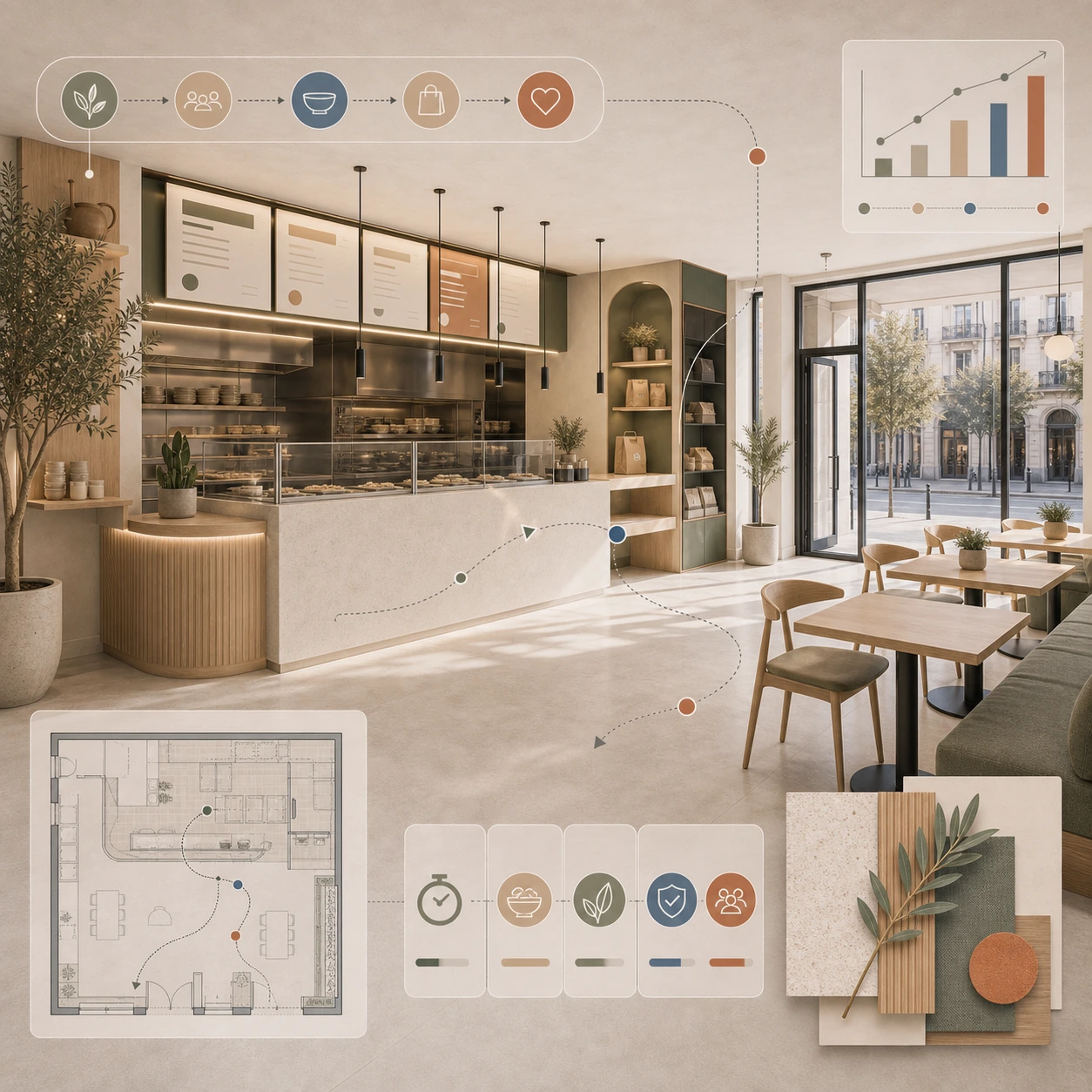
La zona de pedido en un fast casual es el equivalente de la cocina vista en un restaurante. Es donde el cliente ve el producto, hace el pedido y espera. Tiene que ser clara, visualmente atractiva y eficiente.
Un menú bien diseñado (no excesivamente largo, con fotografías apetitosas o sin fotos pero con descripciones que venden), una zona de espera donde el cliente puede ver la preparación, y una entrega con algún ritual propio elevan la percepción por encima del fast casual estándar.
Escenario de presupuesto: local fast casual 80-130m² en Madrid
Obra civil y distribución: 14.000-22.000 euros
Cocina (si es nueva apertura): 35.000-60.000 euros
Revestimientos y acabados con carácter: 12.000-20.000 euros
Zona de pedido y zona de espera: 6.000-10.000 euros
Señalética y menú diseñado: 4.000-7.000 euros
Proyecto y dirección: 7.000-12.000 euros
Total sin cocina: 67.000-114.000 euros
Un local de fast casual de 100m² con 60 cubiertos y rotación de 2,5 veces al mediodía y 2 por la noche a 17€ de ticket puede facturar 20.000-28.000 euros mensuales. La diferencia de 4€ por ticket frente a la competencia más barata son 9.600 euros mensuales adicionales en un local con 2.400 clientes al mes.
¿Estás preparando un proyecto comercial, hostelero, residencial o de desarrollo? Cuéntanoslo mediante las opciones de contacto que encontrarás a continuación.
McDonald's charges €6 for a hamburger. Shake Shack charges €13. There are locations in Madrid that charge €18-€22 and have queues outside.
The difference isn't just the product, although the product matters too. It's the space. A place that justifies €18 for a burger has to visually communicate that it makes sense. If the space looks like a standard fast-food joint, €18 seems excessive. If the space has character, quality materials, and a distinctive atmosphere, the price feels reasonable.
Fast casual: where design has a higher return per euro invested
Fast casual is the restaurant segment where design has the greatest relative impact. It's informal yet aspirational. Quick yet thoughtful. Affordable yet distinctive.
The Madrid fast-casual premium customer, aged between 25 and 45 with a medium-to-high income, is accustomed to spaces with personality. If the place where they eat their €18 burger could be any franchise, there's a disconnect. If it has its own unique and authentic identity, the price is perceived as justified.
The elements that make a top-tier fast casual restaurant work
Speed and comfort can coexist
Fast casual needs to be quick, but it shouldn't feel like an assembly line. The design must allow for table turnover without making customers feel pressured to leave.
Hard furniture (fixed benches, high stools) speeds up customer turnover because it's less comfortable for lingering. More comfortable furniture (seats with backrests, cushions) slows it down. A balance between the two types in the same space, with distinct areas, is the most effective solution.
Materials: authenticity over perfection
Premium fast casual doesn't need marble. It needs authenticity. Industrial wood, exposed steel, brick, cement, good-quality synthetic leather. Materials that look genuine and have character, not luxury materials that would be out of place in a casual setting.
The most common mistake is trying to create a fast-casual experience that resembles a luxury restaurant. The result is disorienting for the customer, who isn't sure if they're in the right place.
Warm lighting, not cold lighting
Cold lighting is the biggest enemy of premium fast casual. It suggests a chain restaurant and makes it difficult to photograph the product. Warm lighting, with spotlights on tables and the ordering area, creates a welcoming atmosphere even with fast, tray service.
The ordering area: where the experience begins
The ordering area in a fast-casual restaurant is the equivalent of the open kitchen in a restaurant. It's where the customer sees the product, places their order, and waits. It needs to be clear, visually appealing, and efficient.
A well-designed menu (not overly long, with appetizing photographs or no photos but with descriptions that sell), a waiting area where the customer can see the preparation, and a delivery with some ritual of its own elevate the perception above the standard fast casual.
Budget scenario: 80-130m² fast casual restaurant in Madrid
Civil works and distribution: 14,000-22,000 euros
Kitchen (if it's a new opening): 35,000-60,000 euros
Claddings and finishes with character: 12,000-20,000 euros
Ordering area and waiting area: 6,000-10,000 euros
Signage and menu design: 4,000-7,000 euros
Project and management: 7,000-12,000 euros
Total without kitchen: 67,000-114,000 euros
A 100m² fast-casual restaurant with seating for 60 and a turnover of 2.5 times at lunchtime and 2 times in the evening, with an average spend price of €17, can generate €20,000-€28,000 in monthly revenue. The €4 difference per ticket price compared to the cheapest competitors translates to an additional €9,600 per month for a restaurant serving 2,400 customers.
Planning a commercial, hospitality, residential or development project? Tell us about it using the contact options below.
Siguiente paso
Cada buen proyecto empieza con una conversación clara.