Cómo diseñar una librería independiente en Madrid que haga que la gente quiera quedarse. Interiorismo para librerías que compiten con Amazon por experiencia.
Journal · EOLOS DESIGN LAB
Guía · EOLOS DESIGN LAB Journal
La librería independiente que compite solo en precio con Amazon ha perdido esa batalla hace años. La que compite en experiencia, comunidad y selección curada tiene una ventaja que ninguna plataforma puede replicar: el espacio físico.
Madrid tiene algunas de las mejores librerías independientes de Europa. Las que funcionan no son las más grandes ni las que tienen más referencias. Son las que tienen más carácter, las que hacen que entrar sea un placer aunque no vayas a comprar nada, y las que han construido una comunidad de lectores que las elige semana a semana.
El espacio como argumento de existencia
Una librería independiente bien diseñada justifica su existencia con el espacio. Es un lugar donde te apetece estar aunque no tengas nada concreto que buscar. Donde los libros están ordenados con un criterio que no es el de los grandes distribuidores. Donde el espacio te lleva de un libro al siguiente de forma natural.
Ese tipo de experiencia genera compras por descubrimiento, que son las más rentables para una librería independiente: el cliente que entra a buscar un título y sale con tres que no sabía que quería.
Los elementos de diseño que hacen funcionar una librería boutique
Las estanterías: el elemento más identitario
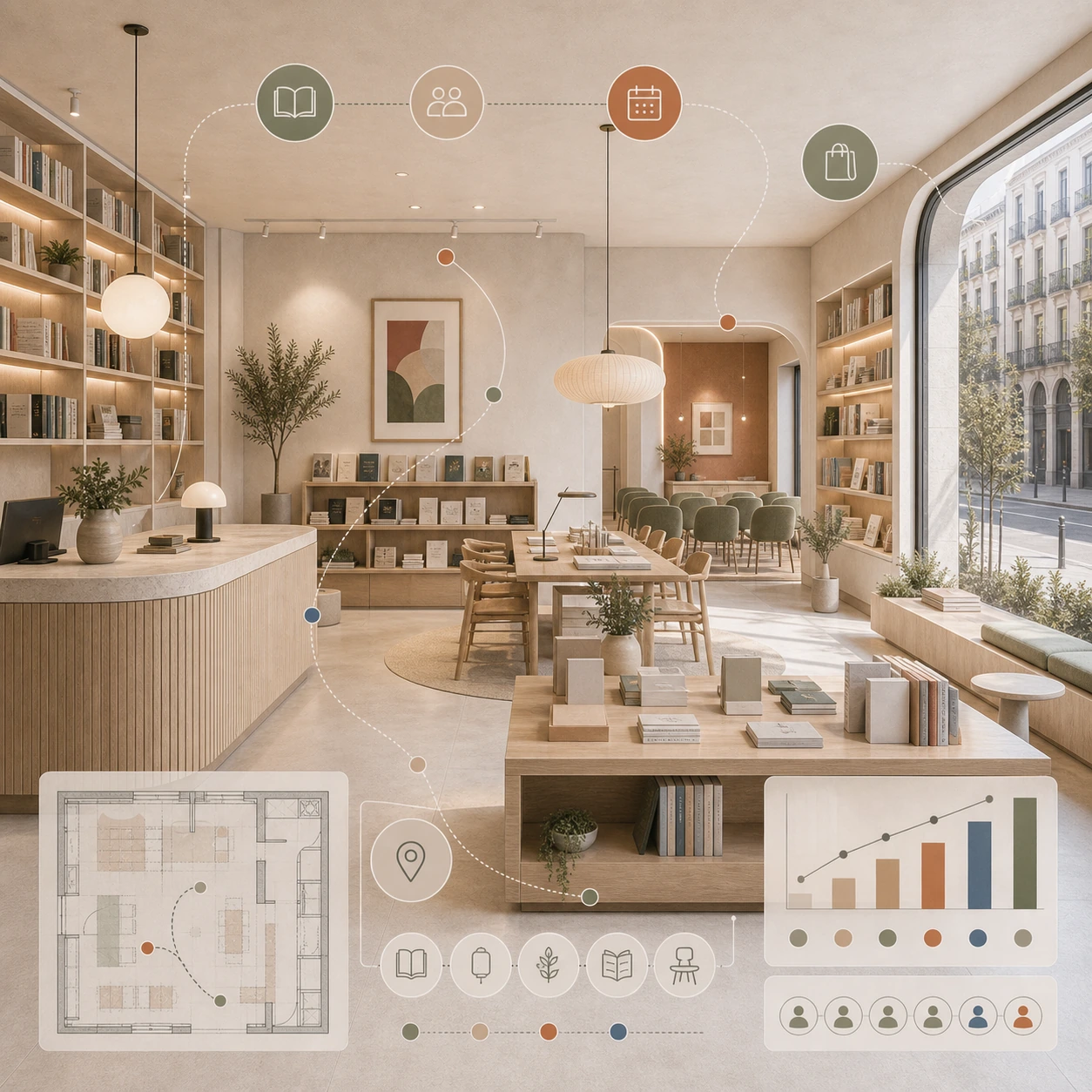
Las estanterías de una librería independiente son su arquitectura más visible. Tienen que ser suficientemente altas para generar la sensación de abundancia que caracteriza al espacio libresco, pero con escaleras o accesos que hagan que llegar a los libros más altos sea parte de la experiencia y no un obstáculo.
La combinación de estanterías fijas en perímetro con expositores de mesa centrales para novedades y recomendaciones es el esquema que mejor funciona: da estructura y al mismo tiempo permite la flexibilidad de cambiar la selección destacada con facilidad.
Los rincones: donde se deciden las compras
Un cliente que encuentra un rincón cómodo donde sentarse y hojear un libro tiene 3 veces más probabilidades de comprarlo. Los rincones de lectura en una librería no son un lujo. Son una herramienta de venta.
Un sillón, una silla con cojín, una pequeña mesa donde apoyar el café: espacios que invitan a quedarse son espacios que invitan a comprar. Y el cliente que se queda más tiempo, compra más.
La zona de eventos: el activo que genera comunidad y PR
Una librería con espacio para 20-30 personas donde se pueden hacer presentaciones, clubes de lectura, charlas y talleres tiene una ventaja competitiva que ninguna librería online puede tener. Los eventos generan tráfico en días habitualmente bajos, PR gratuito en redes sociales, y una comunidad de clientes que se sienten parte de algo.
El diseño del espacio de eventos tiene que ser flexible: sillas apilables, iluminación regulable, buena acústica para que se escuche bien aunque haya mucho ruido de fondo, y un sistema de audio básico para presentaciones con micrófono.
Escenario de presupuesto: librería independiente 80-150m² en Madrid
Estanterías a medida en perímetro: 14.000-24.000 euros
Expositores centrales y de novedades: 6.000-11.000 euros
Rincones de lectura (mobiliario + iluminación): 5.000-9.000 euros
Zona de eventos flexible: 7.000-13.000 euros
Iluminación cálida y focal: 6.000-11.000 euros
Mostrador y zona de caja: 4.000-7.000 euros
Revestimientos y acabados: 5.000-9.000 euros
Proyecto y dirección: 5.000-9.000 euros
Total: 52.000-93.000 euros
Una librería independiente en Madrid con 30 clientes diarios a 22 euros de ticket medio y 8 eventos mensuales a 15 euros por asistente con 25 personas por evento factura en torno a 22.800 euros mensuales. La diferencia entre 14€ y 22€ de ticket medio con ese volumen son 7.200 euros mensuales adicionales que el diseño del espacio puede generar.
¿Estás preparando un proyecto comercial, hostelero, residencial o de desarrollo? Cuéntanoslo mediante las opciones de contacto que encontrarás a continuación.
The independent bookstore that competes solely on price with Amazon lost that battle years ago. The one that competes on experience, community, and curated selection has an advantage no platform can replicate: physical space.
Madrid has some of the best independent bookstores in Europe. The ones that thrive aren't the biggest or the ones with the most titles. They're the ones with the most character, the ones that make walking in a pleasure even if you're not planning to buy anything, and the ones that have built a community of readers who choose them week after week.
Space as an argument for existence
A well-designed independent bookstore justifies its existence through its space. It's a place you want to be even if you don't have anything specific in mind. Where the books are arranged according to a different set of criteria than those of large retailers. Where the space naturally guides you from one book to the next.
That type of experience generates discovery purchases, which are the most profitable for an independent bookstore: the customer who comes in looking for one title and leaves with three that they didn't know they wanted.
The design elements that make a boutique bookstore work
The shelves: the most distinctive element
The bookshelves of an independent bookstore are its most visible architectural feature. They must be tall enough to create the sense of abundance that characterizes a bookish space, but with stairs or access points that make reaching the highest books part of the experience, not an obstacle.
The combination of fixed perimeter shelving with central table displays for new products and recommendations is the scheme that works best: it provides structure while also allowing the flexibility to easily change the featured selection.
The corners: where purchases are decided
A customer who finds a comfortable corner to sit and browse a book is three times more likely to buy it. Reading nooks in a bookstore aren't a luxury. They're a sales tool.
An armchair, a chair with a cushion, a small table to set your coffee on: spaces that invite you to linger are spaces that invite you to buy. And the customer who stays longer, buys more.
The events area: the asset that generates community and PR
A physical bookstore with space for 20-30 people, where presentations, book clubs, talks, and workshops can be held, has a competitive advantage that no online bookstore can match. These events generate traffic on typically slow days, free PR on social media, and a community of customers who feel like they belong.
The design of the event space needs to be flexible: stackable chairs, adjustable lighting, good acoustics so that you can hear well even with a lot of background noise, and a basic audio system for presentations with a microphone.
Budget scenario: independent bookstore 80-150m² in Madrid
An independent bookstore in Madrid with 30 daily customers at an average spend price of €22 and 8 monthly events at €15 per attendee (with 25 people per event) generates around €22,800 in revenue per month. The difference between an average spend price of €14 and €22 at that volume represents an additional €7,200 per month that the space design can generate.
Planning a commercial, hospitality, residential or development project? Tell us about it using the contact options below.
Siguiente paso
Cada buen proyecto empieza con una conversación clara.