Cómo diseñar un restaurante de autor o fine dining en Madrid que justifique precios de 120€ por comensal. Diseño de interiores para alta cocina y experiencias gastronómicas premium.
Journal · EOLOS DESIGN LAB
Guía · EOLOS DESIGN LAB Journal
En Madrid hay restaurantes con menú degustación de 95 euros que tienen lista de espera de dos meses. Y hay restaurantes con menú de 95 euros que cierran en el primer año.
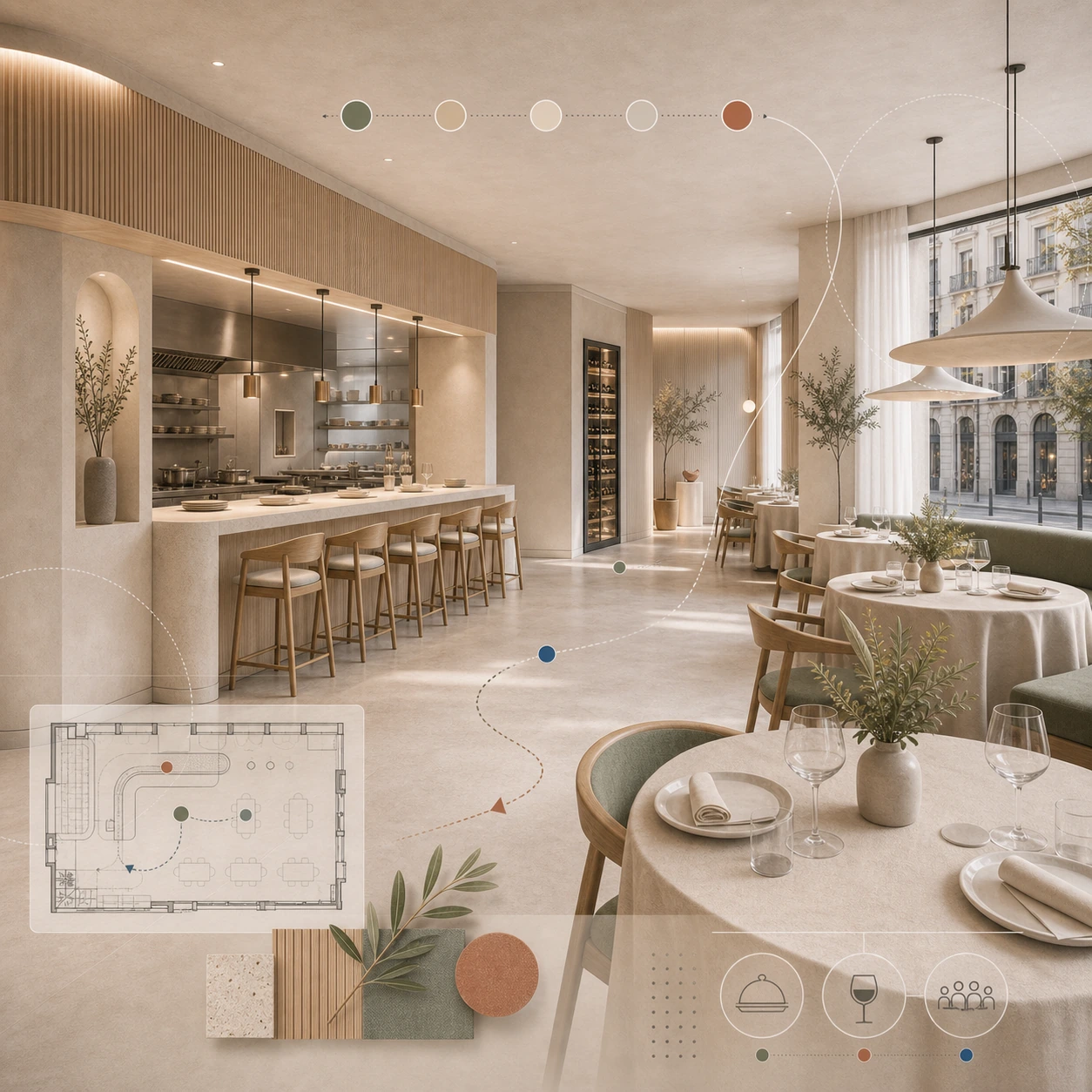
La cocina importa, claro. El chef importa. Pero el espacio también decide. Un restaurante de autor con un interiorismo genérico está limitando su capacidad de cobrar lo que su propuesta vale. Y al revés: un espacio bien diseñado eleva la percepción del producto antes de que llegue el primer plato.
Lo que el diseño aporta en fine dining que no aporta en ningún otro segmento
En restauración de precio bajo, el diseño ayuda pero no es determinante. En fine dining, el diseño es parte del producto. El cliente que paga 120-180 euros por persona no está comprando solo comida. Está comprando una experiencia que empieza cuando entra por la puerta y termina cuando sale.
Si la experiencia empieza con un espacio que no está a la altura del precio, hay una disonancia que el menú tiene que compensar. Y compensar disonancia es muy caro: requiere platos excepcionales, servicio impecable, y aun así el cliente puede irse con la sensación de que el precio era alto.
Si la experiencia empieza con un espacio que está diseñado para ese nivel, el cliente llega predispuesto a percibir calidad. Y esa predisposición hace que el mismo menú se perciba mejor, que el servicio se valore más, y que la cuenta final parezca coherente.
Los elementos de diseño que definen un fine dining de nivel
La acústica: el elemento más ignorado y más crítico
Un restaurante de alta gama donde no puedes mantener una conversación sin levantar la voz ha fallado en algo fundamental. La acústica en fine dining no es un lujo. Es una condición necesaria.
El tratamiento acústico en un espacio de restauración de nivel implica techo absorbente, paneles integrados en el diseño de las paredes, y una elección de materiales y tapizados que no reflejen el sonido. El objetivo es que en una sala llena, el nivel sonoro permita hablar con normalidad en la mesa sin escuchar la conversación de la mesa de al lado.
Una inversión de 15.000-25.000 euros en acústica bien diseñada cambia radicalmente la experiencia. Y ese coste se recupera en reseñas: la acústica es uno de los factores más mencionados en valoraciones negativas de restaurantes de precio alto.
La iluminación: cada mesa tiene que ser un escenario
La iluminación en fine dining tiene una función específica: hacer que el plato sea protagonista y que la persona que está enfrente parezca bien iluminada. Esas dos cosas son difíciles de conseguir con la misma fuente de luz.
La solución es iluminación en capas: luz focal sobre la mesa (cenital, cálida, suficientemente intensa para que los colores del plato se vean bien), luz ambiental baja que crea atmósfera sin oscurecer, y luz de acento que define el espacio arquitectónicamente.
El regulador de intensidad es obligatorio. La luz del servicio de mediodía no puede ser la misma que la del servicio de noche. El mismo espacio tiene que sentirse diferente en cada franja horaria.
Las distancias entre mesas: la privacidad que el cliente paga
En restauración de volumen, la distancia entre mesas se minimiza para maximizar la capacidad. En fine dining, ocurre lo contrario: la distancia entre mesas es un argumento de precio.
Un cliente que paga 150 euros por persona no quiere escuchar la conversación de la mesa contigua. No quiere que el camarero tenga que pedir permiso para pasar entre mesas. Y no quiere sentir que está en un local lleno cuando hay pocas mesas.
La ratio correcta en fine dining es de 2,5 a 3 metros cuadrados por comensal (incluyendo circulaciones). Eso significa que un local de 120m² de sala tiene capacidad real para 40-48 comensales, no para 70. Esa reducción de capacidad tiene que estar compensada por un precio por comensal proporcionalmente más alto.
Los materiales: el lujo que no grita
El error más frecuente en interiorismo de restaurante de autor es confundir lujo con ostentación. El cliente de fine dining en Madrid en 2026 no quiere oro y terciopelo. Quiere materiales nobles con criterio: mármol que no sea de catálogo, madera que tenga historia, tejidos que den tacto y no solo color.
Lo que comunica nivel en un fine dining no es el precio de los materiales. Es la coherencia entre ellos y la precisión en los detalles: la costura del tapizado, el acabado del borde de la mesa, el peso de la servilleta, el diseño del menú. Cada elemento cuenta una historia y tienen que contar la misma.
La mesa: el producto principal del espacio
En fine dining, la mesa es el espacio donde ocurre todo. Su diseño tiene que contemplar: superficie suficiente para la mise en place sin que parezca llena antes de que llegue el primer plato, altura correcta para estar cómodo dos horas, y un material que dialogue con la vajilla, los cubiertos y el mantel si lo hay.
Una mesa bien diseñada, a medida, en un material noble, cuesta entre 800 y 2.500 euros por unidad. En un restaurante de 12 mesas, eso son entre 9.600 y 30.000 euros. Es una inversión que el cliente percibe desde el primer segundo en que se sienta.
El chef's table: el activo más rentable del restaurante
Si hay espacio y el concepto lo permite, el chef's table es la mesa más rentable de cualquier fine dining. Un espacio para 6-10 personas con acceso visual a la cocina, experiencia personalizada y menú exclusivo puede cobrar 50-80 euros más por comensal que el menú estándar.
Con 6 personas a 180 euros, tres servicios semanales, son 16.200 euros mensuales adicionales de un espacio de 15-20m². La inversión en diseñar bien ese espacio se recupera en 2-3 meses.
Escenario de presupuesto: restaurante de autor 120-180m² en Madrid
Iluminación en capas con regulación: 18.000-32.000 euros
Tratamiento acústico: 15.000-25.000 euros
Mobiliario de sala a medida (mesas, sillas, banquetas): 28.000-55.000 euros
Barra / zona de recepción: 10.000-18.000 euros
Revestimientos y acabados nobles: 20.000-38.000 euros
Chef's table (si aplica): 12.000-22.000 euros
Proyecto y dirección de obra: 14.000-24.000 euros
Total: 160.000-286.000 euros
Un restaurante de autor con 40 comensales, ticket medio de 130 euros y ocupación del 75% cuatro noches por semana factura en torno a 81.000 euros mensuales. El diseño se justifica en menos de cuatro meses de operación plena.
¿Estás preparando un restaurante, un bar o un proyecto de hostelería? Cuéntanoslo mediante las opciones de contacto que encontrarás a continuación.
In Madrid, there are restaurants with €95 tasting menus that have a two-month waiting list. And there are restaurants with €95 menus that close within their first year.
The cuisine matters, of course. The chef matters. But the space also makes a difference. A signature restaurant with a generic interior is limiting its ability to charge what its offering is worth. And vice versa: a well-designed space elevates the perception of the product even before the first course arrives.
What design brings to fine dining that it doesn't bring to any other segment
In budget restaurants, design helps but isn't the deciding factor. In fine dining, design is part of the product. The customer who pays 120-180 euros per person isn't just buying food. They're buying an experience that begins when they walk through the door and ends when they leave.
If the experience begins with a space that doesn't live up to the price, there's a dissonance that the menu has to compensate for. And compensating for dissonance is very expensive: it requires exceptional dishes, impeccable service, and even then the customer may leave feeling that the price was high.
If the experience begins with a space designed for that level of service, the customer arrives predisposed to perceive quality. And that predisposition makes the menu itself seem better, the service more highly valued, and the final bill seem reasonable.
The design elements that define a high-level fine dining experience
Acoustics: the most ignored and most critical element
A high-end restaurant where you can't have a conversation without raising your voice has failed in a fundamental way. Acoustics in fine dining are not a luxury. They are a necessity.
Acoustic treatment in a high-end restaurant involves sound-absorbing ceilings, panels integrated into the wall design, and a choice of materials and upholstery that do not reflect sound. The goal is that in a full room, the sound level allows for normal conversation at your table without overhearing the conversation at the next table.
An investment of €15,000-€25,000 in well-designed acoustics radically changes the experience. And that cost is recouped in reviews: acoustics are one of the most frequently mentioned factors in negative reviews of high-priced restaurants.
The lighting: each table has to be a stage.
Lighting in fine dining has a specific function: to make the dish the star and to ensure that the person sitting across from it appears well-lit. These two things are difficult to achieve with the same light source.
The solution is layered lighting: focused light over the table (overhead, warm, intense enough to make the colors of the dish look good), low ambient light that creates atmosphere without darkening, and accent light that defines the space architecturally.
A dimmer switch is mandatory. The lighting for the midday shift cannot be the same as that for the evening shift. The same space must feel different at each time of day.
The distances between tables: the privacy that the customer pays for
In high-volume restaurants, the distance between tables is minimized to maximize capacity. In fine dining, the opposite is true: the distance between tables is a price point.
A customer paying 150 euros per person doesn't want to hear the conversation at the next table. They don't want the waiter to have to ask permission to walk between tables. And they don't want to feel like they're in a crowded place when there are only a few tables.
The correct ratio in fine dining is 2.5 to 3 square meters per diner (including circulation areas). This means that a 120m² dining room has a realistic capacity for 40-48 diners, not 70. This reduction in capacity must be offset by a proportionally higher price per diner.
The materials: luxury that doesn't shout
The most common mistake in designer restaurants is confusing luxury with ostentation. The fine dining customer in Madrid in 2026 doesn't want gold and velvet. They want carefully chosen, high-quality materials: marble that isn't just off the shelf, wood with a story, and fabrics that offer texture, not just color.
What conveys sophistication in fine dining isn't the price of the materials. It's the consistency between them and the precision in the details: the upholstery stitching, the finish of the table edge, the weight of the napkin, the menu design. Each element tells a story, and they must tell the same story.
The table: the main product of the space
In fine dining, the table is the space where everything happens. Its design must consider: enough surface area for the mise en place without it looking crowded before the first course arrives, the right height to be comfortable for two hours, and a material that complements the tableware, cutlery, and tablecloth, if there is one.
A well-designed, custom-made table in a high-quality material costs between 800 and 2,500 euros per unit. In a restaurant with 12 tables, that's between 9,600 and 30,000 euros. It's an investment that the customer notices from the moment they sit down.
The chef's table: the restaurant's most profitable asset
If space allows and the concept permits, the chef's table is the most profitable option in any fine dining establishment. A space for 6-10 people with a view of the kitchen, a personalized experience, and an exclusive menu can charge 50-80 euros more per person than the standard menu.
With 6 people at €180 each, three services per week, that's an additional €16,200 per month for a 15-20m² space. The investment in designing that space well is recovered in 2-3 months.
Budget scenario: signature restaurant 120-180m² in Madrid
Civil works and distribution: 18,000-30,000 euros
Installations (electricity, air conditioning, extraction): 25,000-42,000 euros
Layered lighting with dimming: 18,000-32,000 euros
Acoustic treatment: 15,000-25,000 euros
Custom-made living room furniture (tables, chairs, benches): 28,000-55,000 euros
Bar / reception area: 10,000-18,000 euros
High-end wall coverings and finishes: 20,000-38,000 euros
Chef's table (if applicable): 12,000-22,000 euros
Project and construction management: 14,000-24,000 euros
Total: 160,000-286,000 euros
A signature restaurant with 40 diners, an average check of €130, and occupancy of the 75% four nights a week, generates around €81,000 in revenue per month. The design pays for itself in less than four months of full operation.
Planning a restaurant, bar or hospitality project? Tell us about it using the contact options below.
Siguiente paso
Cada buen proyecto empieza con una conversación clara.