Interiorismo para family offices e inversores institucionales: cómo diseñar activos que retienen valor
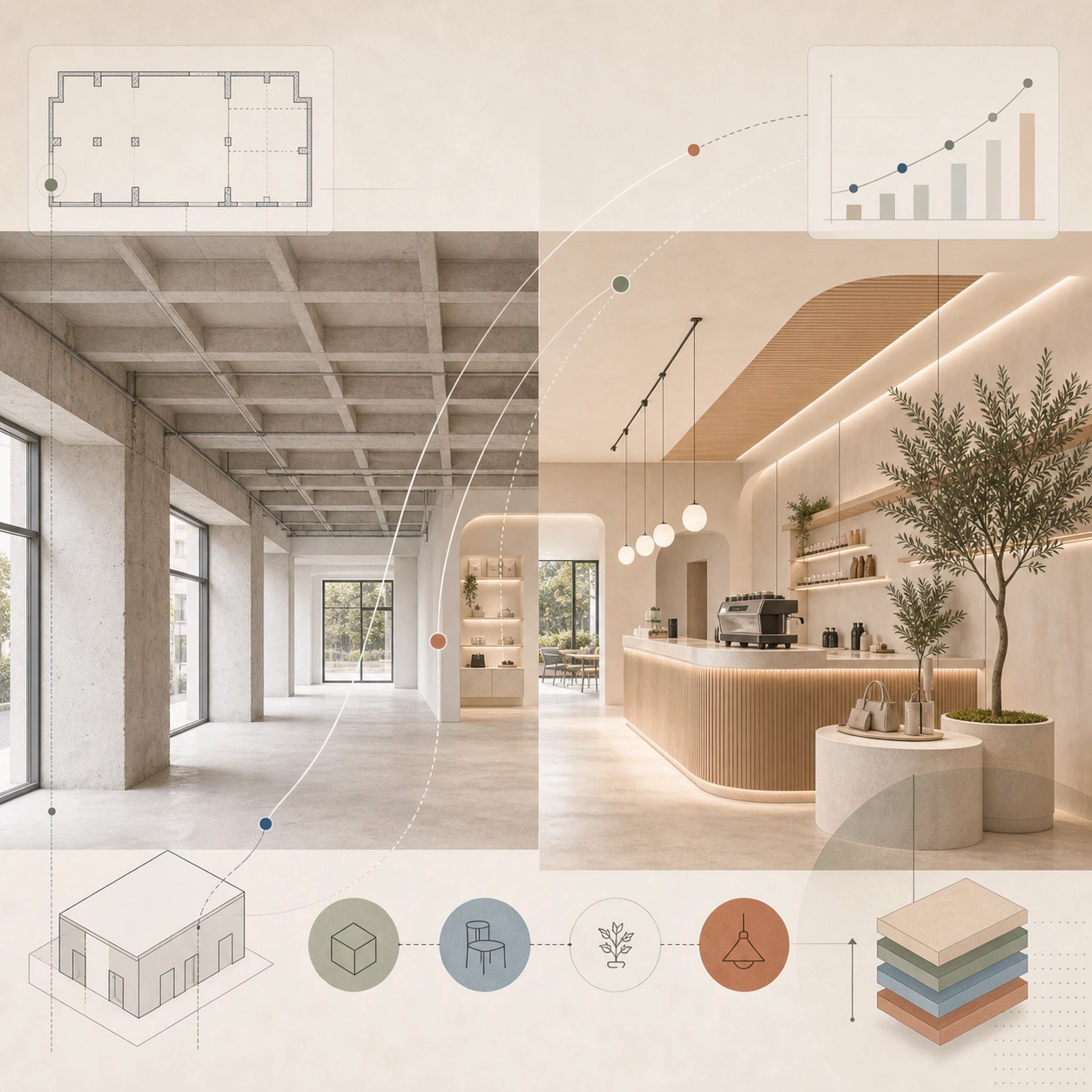
Cómo el interiorismo comercial impacta en el valor, la ocupación y la renta de activos para family offices e inversores institucionales. Diseño como herramienta de gestión de activos.
Journal · EOLOS DESIGN LAB
Guía · EOLOS DESIGN LAB Journal
Un gestor de activos que evalúa un local comercial en Madrid tiene una pregunta diferente a la del operador que va a abrir ahí su negocio. No es "¿me gusta este espacio?". Es "¿qué hace este espacio por el valor del activo en cinco años?".
El diseño de interiores comercial responde a esa pregunta. Pero la conversación entre inversores institucionales y estudios de diseño casi nunca empieza en ese punto. Suele llegar tarde, cuando el activo ya está en el mercado y el problema ya es visible.
El diseño como decisión de gestión de activos
Un activo comercial bien diseñado no es más bonito. Es más fácil de arrendar, se arrienda más rápido y justifica una renta superior sin necesidad de negociarla a la baja.
En el mercado español, un espacio comercial con interiorismo de nivel medio consigue rentas entre un 15% y un 35% superiores al mismo espacio sin intervención. En activos hosteleros o de oficinas premium, esa diferencia puede superar el 40%. El tiempo en mercado se reduce de forma relevante, lo que impacta directamente en la tasa de vacancia y en la rentabilidad de la cartera.
Para un family office o inversor con varios activos en cartera, esa diferencia no es marginal. Se acumula.
Lo que diferencia al inversor del operador
El operador que abre un restaurante o una clínica toma decisiones de diseño pensando en su cliente final. El inversor que gestiona el activo donde ese operador trabaja tiene un marco de decisión distinto.
Lo que importa para un gestor de activos es la capacidad de arrendamiento del espacio, la calidad del inquilino que atrae, la flexibilidad de uso si el inquilino cambia, y el estado del activo en el momento de una posible desinversión. Esas cuatro variables dependen, en gran parte, del diseño.
Un espacio diseñado con criterio retiene inquilinos de mayor calidad porque el entorno refuerza la percepción de valor de su propio negocio. Un inquilino que opera en un espacio que le ayuda tiene más motivos para renovar el contrato que uno que lleva años peleando con un local que no le funciona.
Qué tipo de intervención tiene sentido según el momento del activo
No todos los activos necesitan una reforma completa. La decisión depende del momento en el ciclo del activo y del objetivo de la operación.
Si el activo acaba de comprarse y está vacío, intervenir antes de salir al mercado es lo más rentable. El coste es el más bajo posible y el impacto en la primera impresión es máximo. Salir sin intervenir quema las primeras semanas, que son las más valiosas.
Entre contratos es el momento natural para reposicionar. El objetivo no es solo actualizar el espacio, sino elevar la categoría del activo para el siguiente arrendatario. Una intervención bien dirigida en ese momento puede cambiar el perfil de inquilino que atrae.
Si el activo lleva tiempo sin alcanzar las rentas objetivo o con alta rotación de inquilinos, el problema suele tener una dimensión de diseño. No siempre es el único factor, pero es el más fácil de corregir y el de impacto más inmediato en la percepción del mercado.
Y si el activo está próximo a una desinversión, prepararlo con una intervención de diseño antes del proceso de due diligence es una herramienta muy subutilizada en el mercado institucional. Un activo que llega con el interiorismo actualizado y un inquilino de calidad instalado se valora de forma diferente a uno que requiere inversión adicional por parte del comprador.
El error más habitual en gestión de activos comerciales
Tratar el diseño como una decisión del inquilino, no del propietario.
En muchas operaciones, el propietario entrega el espacio en bruto y deja que el inquilino decida qué hace con él. El problema es que eso traslada el control de la percepción del activo a quien menos interés tiene en proteger su valor a largo plazo. El inquilino diseña para su negocio, no para el activo. Cuando ese inquilino se va, lo que queda es un espacio que refleja una operativa anterior y que necesita intervención antes de poder arrendarse de nuevo.
Cómo trabaja EOLOS con inversores y gestores de activos
El punto de partida no es el diseño. Es el análisis del activo: qué perfil de inquilino se quiere atraer, qué renta objetivo se quiere justificar, y qué intervención tiene sentido dado el estado actual y el momento de la operación.
EOLOS está dirigido por arquitectos colegiados COAM con más de 20 años de experiencia en proyectos comerciales en España, Suecia y Grecia. Acreditación WELL AP del International WELL Building Institute. Experiencia directa en proyectos para promotores institucionales nórdicos, incluyendo Skanska, JM y Bonava.
¿Estás preparando un proyecto comercial, hostelero, residencial o de desarrollo? Cuéntanoslo mediante las opciones de contacto que encontrarás a continuación.
An asset manager evaluating a commercial property in Madrid has a different question than the operator who is going to open his business there. It's not "do I like this space?". It's "what does this space do for the value of the asset in five years?".
Commercial interior design answers that question. But the conversation between institutional investors and design studios almost never starts at that point. It usually comes late, when the asset is already on the market and the problem is already visible.
Design as an asset management decision
A well-designed commercial asset is not just prettier. It is easier to lease, leases faster and justifies a higher rent without the need to negotiate it down.
In the Spanish market, a commercial space with mid-level interior design achieves rents between 15% and 35% higher than the same space without intervention. In hospitality or premium office assets, this difference can exceed 40%. Time on market is significantly reduced, which directly impacts vacancy rate and portfolio profitability.
For a family office or investor with several assets in the portfolio, this difference is not marginal. It accumulates.
What differentiates the investor from the trader
The operator who opens a restaurant or a clinic makes design decisions with the end customer in mind. The investor who manages the asset where that operator works has a different decision-making framework.
What matters to an asset manager is the leasability of the space, the quality of the tenant it attracts, the flexibility of use if the tenant changes, and the condition of the asset at the time of a potential divestiture. Those four variables depend, in large part, on design.
A judiciously designed space retains higher quality tenants because the environment reinforces the perceived value of your own business. A tenant who operates in a space that helps him has more reason to renew his lease than one who has been struggling for years with a space that doesn't work for him.
What type of intervention makes sense depending on the timing of the asset
Not all assets need a complete overhaul. The decision depends on the point in the asset cycle and the objective of the operation.
If the asset has just been purchased and is empty, it is most cost-effective to intervene before going to market. The cost is the lowest possible and the impact on the first impression is maximized. Exiting without intervention burns the first few weeks, which are the most valuable.
Between leases is the natural time to reposition. The goal is not only to upgrade the space, but to elevate the asset's status for the next tenant. A well-targeted intervention at this time can change the tenant profile it attracts.
If the asset has been underperforming target rents for some time or with high tenant turnover, the problem usually has a design dimension. It is not always the only factor, but it is the easiest to correct and the one with the most immediate impact on market perception.
And if the asset is close to a divestiture, preparing it with a design intervention prior to the due diligence process is a very underutilized tool in the institutional market. An asset that arrives with updated interior design and a quality tenant in place is valued differently than one that requires additional investment by the buyer.
The most common mistake in commercial asset management
Treat design as a tenant decision, not an owner decision.
In many transactions, the landlord hands over the raw space and lets the tenant decide what to do with it. The problem is that this shifts control of the perception of the asset to the one who has the least interest in protecting its long-term value. The tenant designs for their business, not the asset. When that tenant leaves, what is left is a space that reflects a previous operation and needs intervention before it can be leased again.
The starting point is not the design. It is the analysis of the asset: what tenant profile you want to attract, what target rent you want to justify, and what intervention makes sense given the current state and timing of the transaction.
EOLOS is managed by COAM registered architects with more than 20 years of experience in commercial projects in Spain, Sweden and Greece. WELL AP accreditation from the International WELL Building Institute. Direct experience in projects for Nordic institutional developers, including Skanska, JM and Bonava.
Planning a commercial, hospitality, residential or development project? Tell us about it using the contact options below.
Siguiente paso
Cada buen proyecto empieza con una conversación clara.