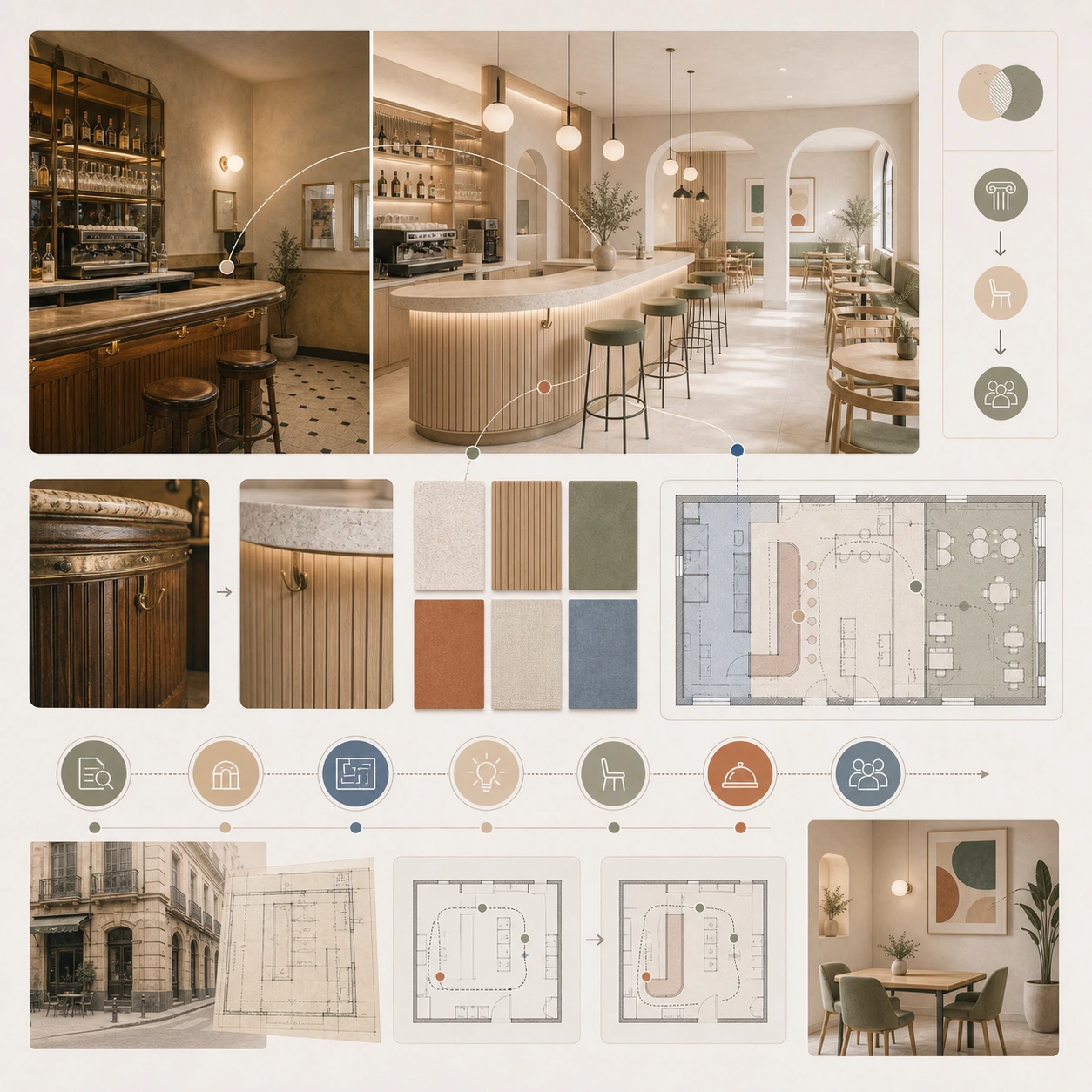
Reformar un activo hostelero con historia sin matar lo que lo hacía funcionar
Cómo reformar un activo hostelero con historia sin perder lo que lo hacía funcionar. Cuándo vale la pena renovar y cómo planear una reforma que reactive sin borrar la identidad.
Journal · EOLOS DESIGN LAB
Guía · EOLOS DESIGN LAB Journal
Un bar de barrio con 18 años de historia. Sillas desgastadas, barra de madera oscura, una iluminación que ya no funciona del todo bien. El dueño sabe que necesita reformar. Contrata a un estudio, le presentan un proyecto bonito, y seis meses después el local parece otro sitio. El problema: sus clientes de siempre ya no se reconocen en él. Y los nuevos no llegan porque el cambio no respondió a ninguna demanda real. La reforma costó 80.000 euros y la facturación bajó un 30%.
No es un caso aislado. Es el patrón más habitual cuando una reforma de un activo hostelero se diseña sin entender qué hace funcionar el negocio.
Qué hace que un activo hostelero tenga algo que vale la pena conservar
No todos los negocios con historia tienen algo que salvar. Pero muchos sí. Y la señal no está en los años que lleva abierto, ni en el número de mesas, ni en la decoración. Está en el comportamiento de los clientes.
Si hay mesas que reserva siempre el mismo cliente, hay algo que funciona. Si hay una franja horaria que nunca falla, hay algo que funciona. Si los proveedores llevan años entrando por la misma puerta y nadie ha dado problemas, hay algo que funciona.
Ese algo es el activo real. No el espacio físico, sino la relación que ese espacio ha generado con las personas que lo usan. Y esa relación no se transfiere automáticamente cuando cambias las sillas.
El error que comete la mayoría al plantear una reforma de activo hostelero
La decisión más común y más destructiva: tratar la reforma como una oportunidad para empezar de cero.
Es comprensible. El espacio se ve viejo, hay cosas rotas, la imagen ya no representa lo que el operador quiere proyectar. La tentación es hacer tabla rasa y construir algo nuevo encima.
El problema es que "algo nuevo" no hereda nada. No hereda la clientela, no hereda el posicionamiento informal que el negocio ha construido durante años, no hereda la lógica de uso que hace que el servicio funcione. Lo nuevo parte desde cero en términos de confianza, y eso tiene un coste real que no aparece en el presupuesto de obra.
Una reforma bien planteada no pregunta "¿cómo queremos que sea el espacio?" antes de preguntar "¿qué está haciendo el espacio que no podemos permitirnos perder?"
Cómo leer lo que hace tu espacio (más allá de lo que crees que hace)
Hay una diferencia entre lo que un operador cree que hace funcionar su local y lo que realmente lo hace funcionar. Esa diferencia es el mayor riesgo de cualquier reforma.
El dueño de un restaurante puede creer que lo que fideliza es la carta. Pero si observas el comportamiento real, verás que la mayoría de los habituales llegan a la misma hora, se sientan en las mismas mesas, y tienen relación con el mismo camarero desde hace años. La carta es casi irrelevante.
Reformar ese restaurante sin conservar esa dinámica, la disposición de mesas que permite esa relación, la acústica que hace posible la conversación, la temperatura del espacio, es desmantelar lo que en realidad genera la fidelidad.
El análisis previo a una reforma de activo hostelero tiene que ser etnográfico antes de ser estético. Quién viene, cuándo, con quién, qué hace, dónde se sienta, cuánto tiempo se queda, qué pide. Ese patrón de uso es la arquitectura invisible que el diseño tiene que respetar o mejorar, nunca ignorar.
Qué aspecto tiene una reforma que reactiva un activo hostelero sin borrar su identidad
En la práctica, una reforma que recupera un activo hostelero sin destruir lo que lo hace funcionar tiene algunas características reconocibles.
Interviene en lo que tiene coste operativo o técnico real: instalaciones, cumplimiento normativo, cocina, climatización, accesibilidad. Todo aquello que afecta al funcionamiento o que tiene riesgo legal. Eso no es opcional y hay que hacerlo bien.
Actualiza la imagen sin romper el código visual que los clientes reconocen. Puede significar mantener la paleta de colores pero renovar materiales. Mantener la distribución pero mejorar la iluminación. Cambiar el mobiliario pero respetar las proporciones del espacio.
Conserva o mejora los elementos de la experiencia que los clientes identifican como propios. Si hay una terraza que siempre está llena, la reforma no toca la terraza. Si hay una zona de barra que genera el 40% del ticket medio, la reforma no redistribuye ese espacio para meter más mesas.
En términos de costes: una reforma de reactivación bien planteada para un local hostelero de 150-200 m² se mueve normalmente entre 60.000 y 120.000 euros, con plazos de ejecución de 8 a 14 semanas según el estado del local. Es significativamente menos que abrir desde cero, y mucho menos que lo que cuesta perder la clientela construida durante años.
Cuándo llamar a un estudio antes de que sea demasiado tarde
El momento más habitual de llamar a un estudio es cuando la decisión de reformar ya está tomada y el operador tiene un presupuesto aproximado en mente. Eso está bien, pero no es el momento óptimo.
El momento óptimo es antes de decidir el alcance. Cuando todavía hay margen para definir qué se toca y qué no. Cuando todavía se puede diseñar el proceso sin tener que ajustarse a una obra ya contratada o a un concepto ya vendido internamente.
Un estudio con experiencia real en hostelería no llega a validar lo que ya has decidido. Llega a ayudarte a entender qué tiene sentido hacer, qué riesgos tiene cada opción, y cómo secuenciar la intervención para que el negocio no pare más de lo necesario durante la obra.
¿Estás preparando un restaurante, un bar o un proyecto de hostelería? Cuéntanoslo mediante las opciones de contacto que encontrarás a continuación.
A neighborhood bar with 18 years of history. Worn out chairs, dark wood bar, lighting that doesn't quite work anymore. The owner knows he needs to renovate. He hires a studio, they present him with a nice project, and six months later the place looks like a different place. The problem: his usual customers no longer recognize themselves in it. And the new ones don't come because the change didn't respond to any real demand. The renovation cost 80,000 euros and turnover dropped by 30%.
This is not an isolated case. It is the most common pattern when a refurbishment of a hospitality asset is designed without understanding what makes the business work.
What makes a hospitality asset worth keeping?
Not all businesses with history have something to save. And the sign is not in the number of years they have been open, nor in the number of tables, nor in the decoration. It's in the behavior of the customers.
If there are tables that are always booked by the same customer, something is working. If there is a time slot that never fails, something is working. If suppliers have been coming through the same door for years and no one has ever had a problem, something is working.
That something is the real asset. Not the physical space, but the relationship that space has generated with the people who use it. And that relationship is not automatically transferred when you change the chairs.
The mistake made by the majority when proposing a hotel asset refurbishment
The most common and most destructive decision: treat the refurbishment as an opportunity to start from scratch.
It's understandable. The space looks old, things are broken, the image no longer represents what the operator wants to project. The temptation is to make a clean slate and build something new on top of it.
The problem is that “something new” does not inherit anything. It does not inherit the clientele, it does not inherit the informal positioning that the business has built up over the years, it does not inherit the logic of use that makes the service work. The new thing starts from scratch in terms of trust, and that has a real cost that does not appear in the construction budget.
A well-considered refurbishment does not ask "what do we want space to look like?" before asking "what is space doing that we can't afford to lose?"
How to read what your space does (beyond what you think it does).
There is a difference between what an operator thinks makes his facility work and what actually makes it work. That difference is the biggest risk in any refurbishment.
A restaurant owner may believe that it is the menu that builds loyalty. But if you look at actual behavior, you will see that most regulars arrive at the same time, sit at the same tables, and have had a relationship with the same waiter for years. The menu is almost irrelevant.
To renovate this restaurant without preserving this dynamic, the arrangement of tables that allows for this relationship, the acoustics that make conversation possible, the temperature of the space, is to dismantle what really generates loyalty.
The analysis prior to a refurbishment of a hotel asset must be ethnographic before being aesthetic. Who comes, when, with whom, what they do, where they sit, how long they stay, what they ask for. That pattern of use is the invisible architecture that the design has to respect or improve, never ignore.
What does a refurbishment that reactivates a hospitality asset without erasing its identity look like?
In practice, a refurbishment that recovers a hospitality asset without destroying what makes it work has some recognizable characteristics.
Intervene in what has a real operational or technical cost: facilities, regulatory compliance, kitchen, air conditioning, accessibility. Everything that affects the operation or has legal risk. This is not optional and must be done well.
Update the image without breaking the visual code that customers recognize. It may mean keeping the color palette but renewing materials. Maintain the layout but improve the lighting. Change the furniture but respect the proportions of the space.
Preserve or enhance the elements of the experience that customers identify as their own. If there is a terrace that is always full, the renovation does not touch the terrace. If there is a bar area that generates 40% of the average spend, the renovation does not redistribute that space to add more tables.
In terms of costs: a well-planned reactivation renovation of a 150-200 m² hotel and catering business typically costs between 60,000 and 120,000 euros, with a lead time of 8 to 14 weeks depending on the condition of the premises. This is significantly less than opening from scratch, and much less than the cost of losing the clientele built up over the years.
If you want to understand which types of intervention make the most sense depending on the asset and the objective, the article on how interior design increases the value of a commercial asset gives a useful framework for thinking through the decision before making one.
When to call a studio before it's too late
The most common time to call a studio is when the decision to renovate has already been made and the operator has a rough budget in mind. That's fine, but it's not the optimal time.
The optimal time is before deciding the scope. When there is still room to define what to touch and what not to touch. When you can still design the process without having to conform to a work already contracted or a concept already sold internally.
A study with real hospitality experience doesn't just validate what you've already decided. It comes to help you understand what makes sense to do, what risks each option has, and how to sequence the intervention so that the business does not stop more than necessary during the work.
Planning a restaurant, bar or hospitality project? Tell us about it using the contact options below.
Siguiente paso
Cada buen proyecto empieza con una conversación clara.