
Guide
Change of Use of Premises to a Dwelling in Madrid: Legal Risks and Real Return
Subscribe to our newsletter!
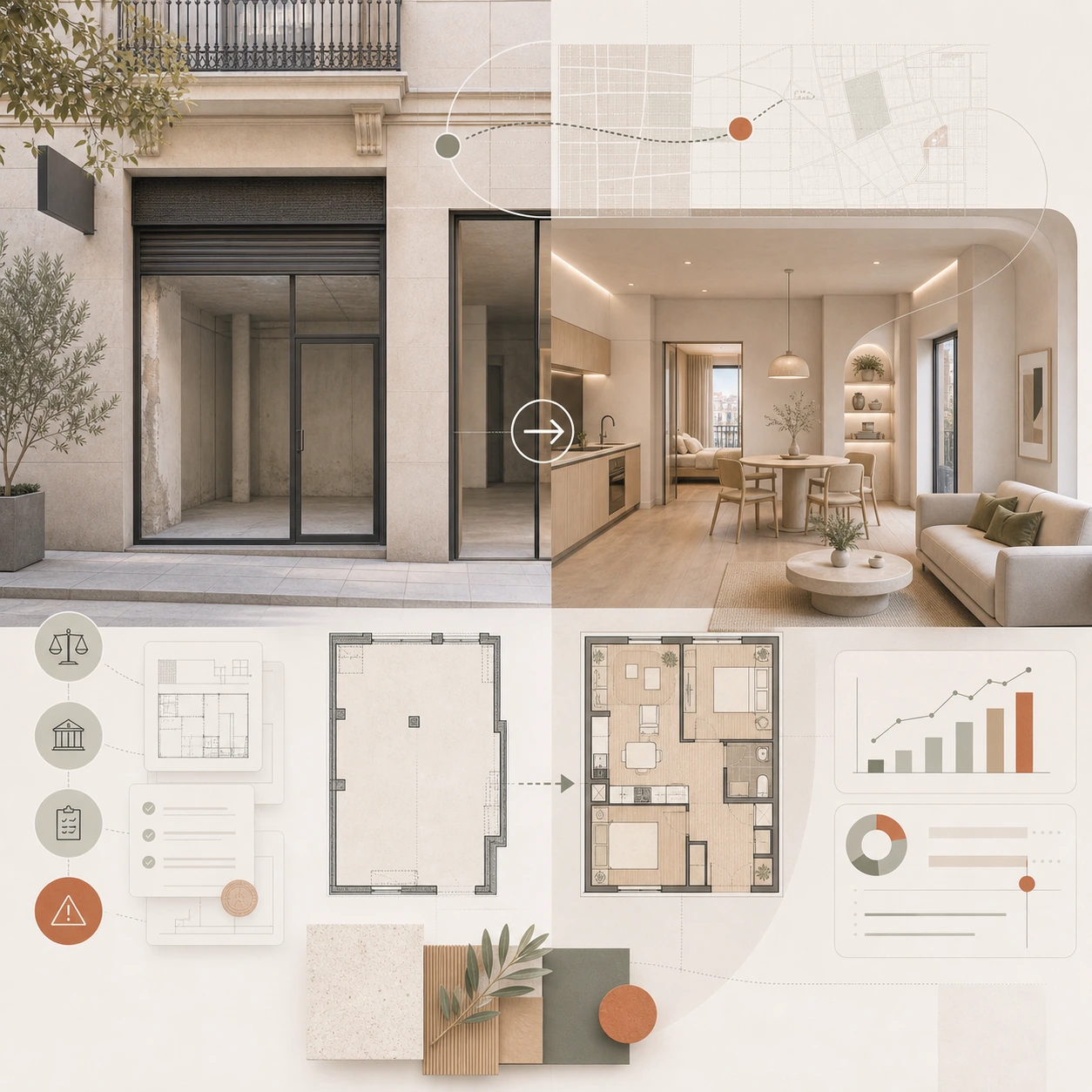
Converting a commercial space into housing in Madrid seems a simple operation from the outside. You buy a first floor unit cheaper than an equivalent property, renovate it, legalize it and sell or rent it with a margin. On paper, the logic is attractive. In practice, many premises are not an investment. They are a technical trap with street frontage.
The change of use does not consist of putting a kitchen, a bathroom and a bed. It consists of demonstrating that the property can be legally converted into a dwelling and that it meets the urban, technical, habitability, health, accessibility, safety and building relationship conditions. If this answer arrives after signing the earnest money deposit, the investor has already lost negotiating power.
At Eolos we analyze this type of operation from a clear premise: you do not buy premises by square meters. You buy viability.
The first question is not reform, it is planning.
Before talking about interior distribution, it is necessary to know if the residential use is compatible with the building, the plot and the applicable urban planning regulations. The General Urban Development Plan of Madrid and its urban development regulations are the basis for understanding whether the change of use can be considered. The modification of the Urban Development Standards finally approved in November 2023 and the subsequent compendium have made reviewing the current version mandatory, not a formality.
A good commercial location does not guarantee good housing. A location may have frontage, price and demand, but be conditioned by building protection, urban location, floor plan conditions, community limitations, lack of adequate ventilation or inability to meet the minimum housing program. Profitability does not start at the construction site. It starts in this reading.
That is why feasibility must be done before buying. After that, any finding becomes sunk cost.
Minimum housing is non-negotiable
The Madrid City Council has published technical documentation on the modification of the Urban Development Standards which clarifies that dwellings resulting from the transformation of premises for non-residential use must comply with the minimum housing condition of article 7.3.4. This implies a minimum useful surface area and a program with living-dining room, kitchen, bedroom and bathroom, in addition to the minimum surfaces required for each part.
This changes the way you look at a facility. It is not enough for it to have sufficient gross floor space. It is necessary to check how much is left as real usable area, which areas lose value due to height, structure, facilities, facade, courtyards or the need for compartmentalization. In many premises, the plan seems viable until you try to fit a legal, comfortable and saleable dwelling.
The resulting dwelling must function as a dwelling, not as a made-up room. This requires light, ventilation, sanitation, insulation, facilities and a reasonable relationship between parts. The market can tolerate an optimistic rendering. The City Council, the registry and the final buyer should not.
The three most expensive technical traps
The first is natural light and ventilation. A deep room, with little façade or with insufficient openings can force forced solutions that reduce useful surface or directly block the operation. The second is height. A room that seems high before construction may not be so when insulation, installations, false ceilings, flooring and technical passages enter. The third is smoke evacuation, sanitation and installations. Bringing a kitchen and a bathroom where the plan wants them does not always coincide with where the building allows to put them.
In addition to these three, there are homeowners' associations. Even if the urban feasibility is favorable, the bylaws, the common elements, the façade, the patios, the downspouts and the shared installations can condition the work. An investor who does not check the community is buying part of the risk blindly.
The usual financial mistake is to budget as if everything was interior renovation. In a change of use, the interior work is only part of it. The real question is how much it costs to convert that particular premises into a legal, habitable, registrable, financeable and saleable dwelling.
Responsible declaration does not mean absence of risk
Ordinance 6/2022 of the Madrid City Council regulates licenses and responsible urban planning declarations. The responsible declaration allows the initiation of actions when it is correctly presented and the compliance with the applicable regulations is declared, but it does not eliminate the subsequent municipal verification or the need to have sufficient technical documentation.
In changes of use, this is especially important. The apparent speed can create a false sense of security. If the documentation, the project, the urban planning justification or the material execution do not fit, the problem may appear later, when the investment is already inside the premises.
A serious operation does not only seek to present a dossier. It seeks to close the cycle: feasibility, project, work, verification, legalization, registration and financial exit.
How Eolos calculates the real return
The return is not calculated by comparing the price of the premises with the price of a renovated home. That is an incomplete account. The real return includes acquisition cost, taxes, technical fees, rates, construction work, installations, reinforcements, contingencies, financing, downtime, community, legalization, furnishing, marketing and possible loss of usable area.
It also includes the final quality of the product. A poorly designed first floor property may be legal, but difficult to rent or sell at a margin. A well-designed property may justify a better price because it corrects what the buyer fears about an old location: darkness, lack of privacy, noise, humidity, insecurity or residual sense of commercial use.
This is where architecture comes in as a financial tool. We do not design to make a place beautiful. We design to eliminate market objections: light, privacy, acoustics, storage, access, thermal comfort, materials, maintenance and perception of real housing.
What to check before signing arras
Before committing to a purchase, we review urban use, zoning regulations, building protection, probable usable area, facade, height, patios, ventilation, accessibility, structure, downspouts, chimneys, connections, community statutes, registry conditions and construction costs. We also analyze the final product: whether the resulting property will have sufficient demand for the target price.
Whether the objective is to rent, refurbish for own use, sell after change of use or prepare an asset for premium rental, the decisions change. The article on refurbishment for Airbnb and premium rentals in Madrid explains why a return-oriented home should not be designed in the same way as a home for living.
The best time to discover that a facility is not working is before you buy it. The second best time is before starting construction. After that, architecture is no longer optimizing an investment. It is trying to rescue it.
Official sources to start with
As a starting point, it is useful to review the Geoportal of the Madrid City Council on urban planning regulations., the transparency portal on urban planning, the Compendium of the PGOUM Urban Development Standards and the Ordinance 6/2022 on licenses and declarations of responsibility for urban development..
If you are considering buying a property in Madrid to convert it into a home, the form is below. We can help you decide if you have a real opportunity or a well presented problem.