
Guide
Design of Premium Dental Clinics and Medical Offices in Madrid
Subscribe to our newsletter!
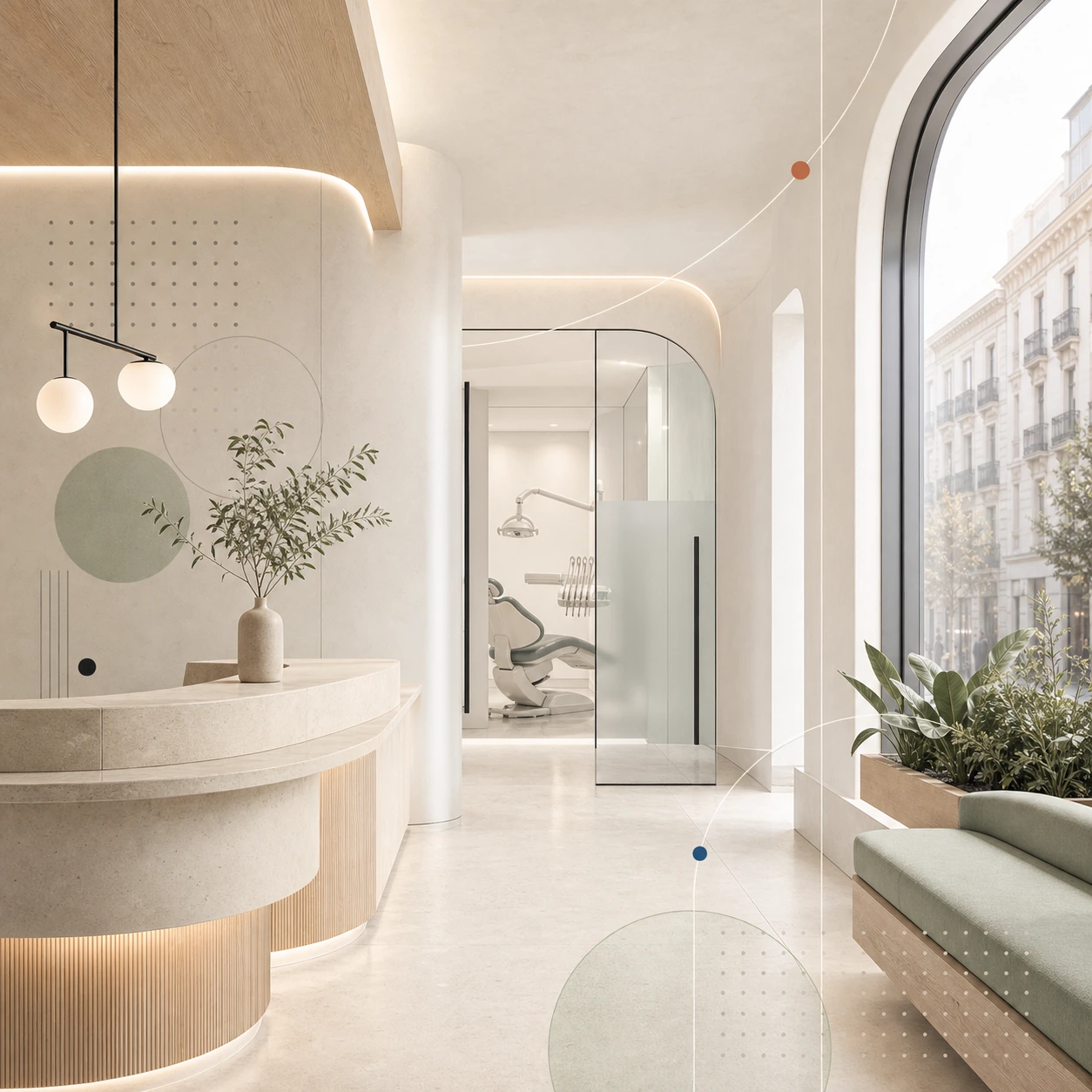
A premium dental clinic or medical practice in Madrid is not only judged by the treatment. It is judged by the confidence it conveys before the patient sits in the chair.
The patient arrives with a mixture of expectations, anxiety, comparison and price in mind. He has seen reviews, checked the web, compared locations and decided if the clinic looks serious before talking to the practitioner. The space either confirms or contradicts that decision.
In Madrid, where private clinics compete in neighborhoods such as Salamanca, Chamberí, Retiro, Chamartín, Centro, Pozuelo or La Moraleja, design is not a luxury. It is part of the conversion.
The premium clinic cannot appear to be improvised
When a patient pays for a private first visit, complex dental treatment, cosmetic medicine, dermatology, advanced physical therapy or a specialty practice, they expect consistency. If the price is premium, the experience should be too.
Inconsistency appears when the professional is excellent but the reception seems old, the lighting is cold, the waiting room generates tension and the patient's path is not clear. This inconsistency reduces the perception of value. Not because the patient is superficial, but because space is a sign of care, precision and control.
A premium clinic doesn't need to look like a hotel. It needs to look like a clinic that knows what it does, takes care of detail and understands how the patient feels.
Reception decides the first level of trust
The reception desk is the first point of control. If the patient does not know where to go, where to wait, if other patients are listening, or if the counter seems crowded, the clinic begins to lose authority.
A well-designed reception desk orders the flow from the first second. It protects privacy in sensitive conversations, integrates storage so that management does not invade the scene, positions the brand judiciously and allows the team to work without being exposed to operational clutter.
In a dental practice, that reception also prepares the patient to accept a quote. In a private medical practice, it prepares the patient to trust. In both cases, the space works before the speech.
The waiting room is not a dead zone
The waiting room is often the place where the patient thinks the most. If the space is cold, noisy or uncomfortable, the wait feels longer. If it is well resolved, the wait becomes a controlled transition.
The usual mistake is to design it as a row of chairs. That may work in a public administration, but not in a private clinic that wants to transmit attention, calm and quality. The waiting room needs distance between patients, good acoustics, friendly lighting, materials that do not look cheap and a clear relationship with reception and consultation.
In dentistry, where patient anxiety directly affects the decision to return, this point is especially important. The waiting room does not cure, but it can worsen or improve the condition with which the patient enters treatment.
The cabinet or consultation should be technical without being aggressive.
The dental office and the medical practice are technically demanding spaces. They require hygiene, clear circulation, equipment, storage, work lighting, facilities and ergonomics for the team. But they are also spaces where the patient feels vulnerable.
Design must solve both. The professional needs efficiency. The patient needs to understand that he or she is in the hands of someone competent. This is achieved with visual order, differentiated lighting, adequate materials, acoustic control, privacy and a layout that does not turn the equipment into a threat.
What the patient sees from the chair matters. The ceiling, the light fixtures, the front wall, the sound of the door, the path of the equipment and the feeling of exposure are all part of the experience. Many clinic projects forget this point because they design from the floor plan, not from the patient's body.
Madrid: location, licensing and technology to be reviewed before final design
Not all premises that seem good for a clinic are. A location on a street level with good visibility may have problems of ventilation, accessibility, evacuation, facilities, noise, distribution or compatible use. A location in a representative building may transmit prestige, but complicate access, machinery or patient flow.
Before finalizing the design, it is necessary to check what activity is going to be implemented, what the Madrid City Council requires, what technical documentation the project needs, what facilities exist and what limitations the property has. We have developed this part in more detail in the guide on licenses for premises in Madrid.
Clinic design cannot come before technical feasibility. If it does, the project becomes pretty before we know if it can work.
Materials, light and acoustics underpin price perception
A premium clinic needs materials that can withstand cleaning, traffic, intensive use and hygienic protocols. But resistance does not mean coldness. The right combination of technical surfaces, wood, controlled textiles, indirect lighting and well-executed details completely changes the perception of the space.
Light has a dual role: precision for clinical work and calm for the patient. Acoustics protect privacy and reduce stress. The right material reduces maintenance and prevents the clinic from aging badly in two years.
When these decisions are made late, the result is often expensive and weak. When they are made early, the clinic gains presence without losing functionality.
The clinic and its website are the same promise
A clinic can have an excellent space and lose patients because of a slow website, a confusing appointment system, poor photos or an outdated Google listing. It can also have good marketing and lose trust when the patient arrives at a space that does not live up to the digital promise.
That's why the project must connect space, branding, web, photography, local SEO, reservation system and physical experience. The patient does not separate these channels. They experience them as a single clinic.
At EOLOS we design clinics from this logic: local, brand, experience, technique and conversion as a single system.
Are you planning a dental clinic, medical practice or private health center in Madrid? Fill in the form with your name, email and a message about your premises, activity and objectives. We will get back to you.