
Guide
Interior Design for Family Offices and Institutional Investors: How to Design Assets that Retain Value
Subscribe to our newsletter!
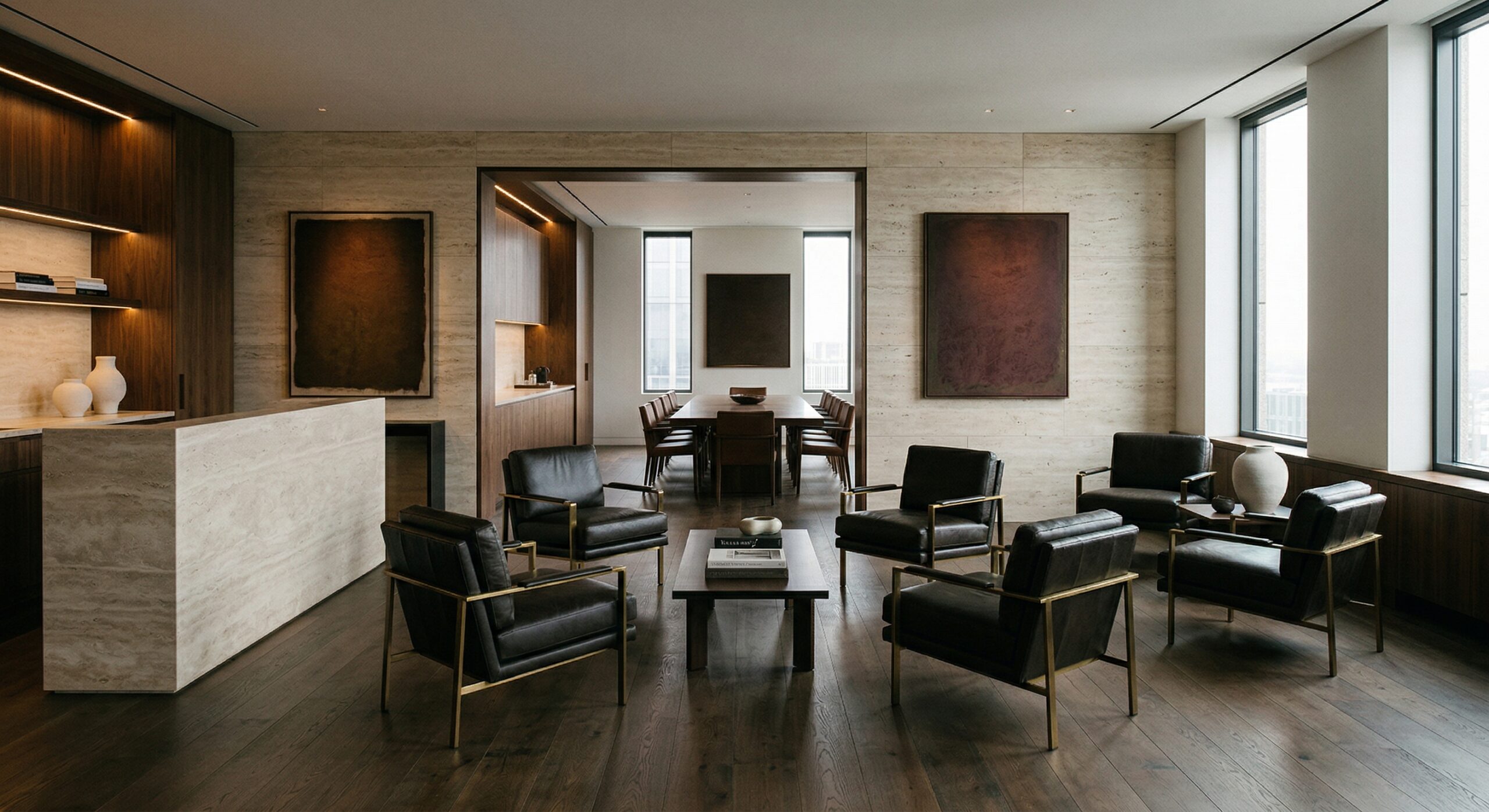
An asset manager evaluating a commercial property in Madrid has a different question than the operator who is going to open his business there. It's not “do I like this space?”. It's “what does this space do for the value of the asset in five years?”.
Commercial interior design answers that question. But the conversation between institutional investors and design studios almost never starts at that point. It usually comes late, when the asset is already on the market and the problem is already visible.
Design as an asset management decision
A well-designed commercial asset is not just prettier. It is easier to lease, leases faster and justifies a higher rent without the need to negotiate it down.
In the Spanish market, a commercial space with mid-level interior design achieves rents between 15% and 35% higher than the same space without intervention. In hospitality or premium office assets, this difference can exceed 40%. Time on market is significantly reduced, which directly impacts vacancy rate and portfolio profitability.
For a family office or investor with several assets in the portfolio, this difference is not marginal. It accumulates.
What differentiates the investor from the trader
The operator who opens a restaurant or a clinic makes design decisions with the end customer in mind. The investor who manages the asset where that operator works has a different decision-making framework.
What matters to an asset manager is the leasability of the space, the quality of the tenant it attracts, the flexibility of use if the tenant changes, and the condition of the asset at the time of a potential divestiture. Those four variables depend, in large part, on design.
A judiciously designed space retains higher quality tenants because the environment reinforces the perceived value of your own business. A tenant who operates in a space that helps him has more reason to renew his lease than one who has been struggling for years with a space that doesn't work for him.
What type of intervention makes sense depending on the timing of the asset
Not all assets need a complete overhaul. The decision depends on the point in the asset cycle and the objective of the operation.
If the asset has just been purchased and is empty, it is most cost-effective to intervene before going to market. The cost is the lowest possible and the impact on the first impression is maximized. Exiting without intervention burns the first few weeks, which are the most valuable.
Between leases is the natural time to reposition. The goal is not only to upgrade the space, but to elevate the asset's status for the next tenant. A well-targeted intervention at this time can change the tenant profile it attracts.
If the asset has been underperforming target rents for some time or with high tenant turnover, the problem usually has a design dimension. It is not always the only factor, but it is the easiest to correct and the one with the most immediate impact on market perception.
And if the asset is close to a divestiture, preparing it with a design intervention prior to the due diligence process is a very underutilized tool in the institutional market. An asset that arrives with updated interior design and a quality tenant in place is valued differently than one that requires additional investment by the buyer.
The most common mistake in commercial asset management
Treat design as a tenant decision, not an owner decision.
In many transactions, the landlord hands over the raw space and lets the tenant decide what to do with it. The problem is that this shifts control of the perception of the asset to the one who has the least interest in protecting its long-term value. The tenant designs for their business, not the asset. When that tenant leaves, what is left is a space that reflects a previous operation and needs intervention before it can be leased again.
Landlords who maintain control of the base design and negotiate with the tenant within that framework protect the residual value of the space and reduce repositioning costs between leases. You can see how that process works in the guide to how interior design increases the value of a commercial asset before selling or leasing it.
How Eolos works with investors and asset managers
The starting point is not the design. It is the analysis of the asset: what tenant profile you want to attract, what target rent you want to justify, and what intervention makes sense given the current state and timing of the transaction.
Eolos is managed by COAM registered architects with more than 20 years of experience in commercial projects in Spain, Sweden and Greece. WELL AP accreditation from the International WELL Building Institute. Direct experience in projects for Nordic institutional developers, including Skanska, JM and Bonava.
If you have a commercial asset that you want to reposition, prepare for the market or analyze before an investment decision, tell us the situation. We analyze the potential and tell you what makes sense to do.