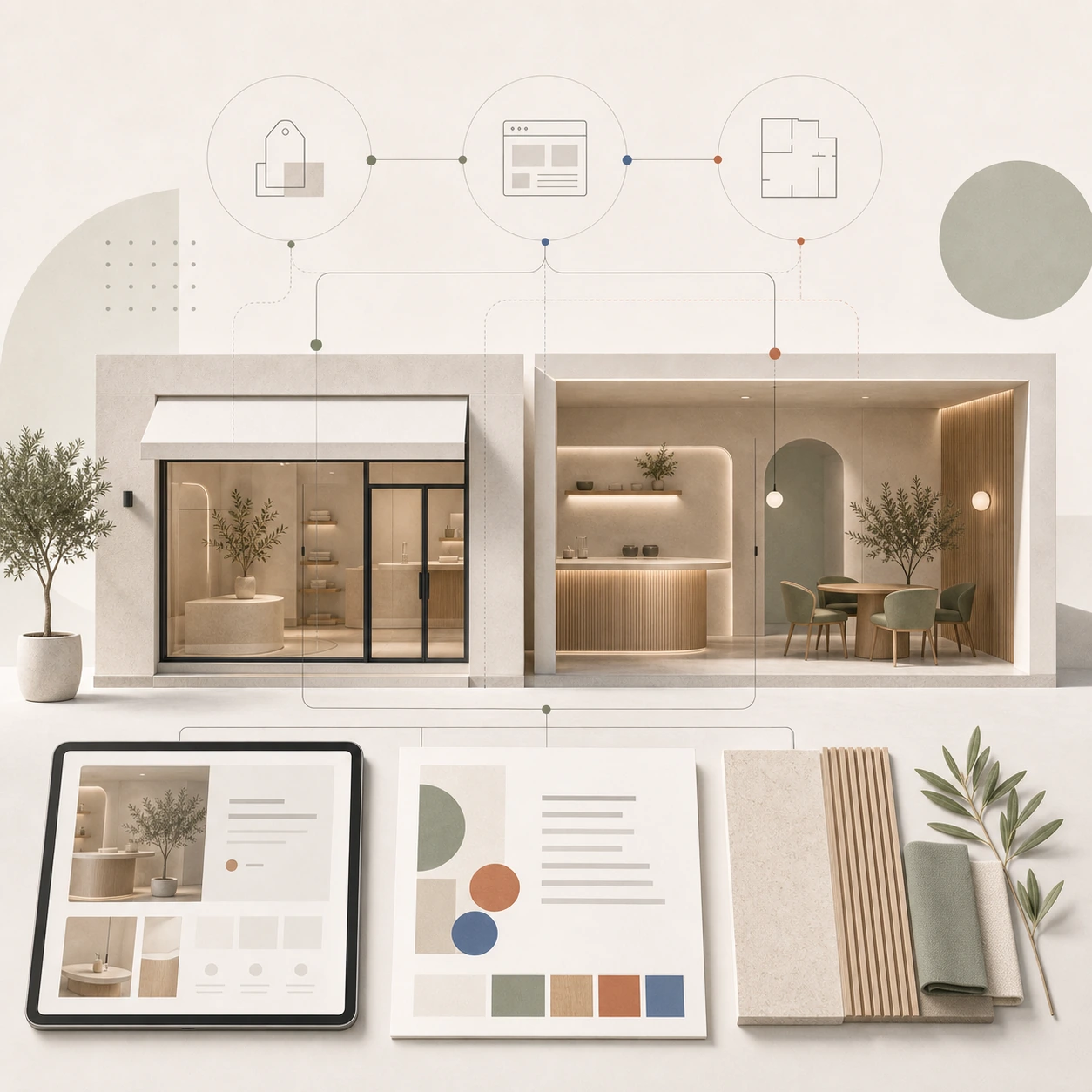
Un local comercial no fracasa porque una agencia hizo mal el logo y otra hizo mal la obra. Fracasa muchas veces porque nadie miró el conjunto. La fachada promete una cosa, el interior cuenta otra, la web no convierte, la carta no coincide con el ticket y la apertura llega tarde.
Por eso un restaurante, clínica, tienda, hotel boutique o espacio wellness no necesita tres discursos separados. Necesita un sistema: espacio, marca, web, señalética, contenido y operación.
El problema de dividir demasiado pronto
Cuando el branding se diseña sin conocer el local, puede quedar precioso pero imposible de aplicar. Cuando el interiorismo se diseña sin marca, el espacio puede parecer correcto pero sin posición. Cuando la web llega al final, termina contando un proyecto que ya no puede cambiar.
Qué debe estar alineado
- Nombre, identidad y tono.
- Fachada, entrada y primera impresión.
- Recorrido interior, zonas de venta y fotografía.
- Web, SEO local, reservas o captación de leads.
- Carta, servicios, precios y percepción de valor.
- Señalética, uniformes, packaging y contenido de apertura.
El coste invisible de coordinar agencias
Coordinar tres proveedores no es solo mandar más emails. Es traducir decisiones, corregir contradicciones y asumir zonas grises. Una agencia propone una marca que no cabe en fachada. Otra diseña un interior que no se puede fotografiar bien. Otra monta una web que no entiende el flujo real de reservas o consulta.
El resultado no siempre es malo. A veces simplemente es más lento, más caro y menos claro de lo que habría sido trabajando desde un criterio común desde el inicio.
Cuándo sí tiene sentido separar
Hay proyectos donde separar funciona: grandes cadenas con equipos internos, marcas ya maduras, arquitecturas muy técnicas o lanzamientos con proveedores especializados. Pero para muchos negocios comerciales en fase de apertura, reforma o reposicionamiento, separar demasiado pronto debilita el resultado.
Errores habituales al separar espacio, marca y web
Error 1: Empezar el interiorismo sin identidad visual definida
El color de las paredes, los materiales, el tipo de iluminación y la señalética deben hablar el mismo idioma que el logotipo y la web. Si la identidad visual llega cuando la obra ya está terminada, los ajustes cuestan más y el resultado es menos coherente.
Error 2: Hacer la web después de abrir
El cliente busca el local antes de ir. Si no hay web, o si la web está incompleta en el momento de la apertura, el negocio pierde reservas, visibilidad local y la oportunidad de generar expectativa antes del primer día.
Error 3: No planificar la fotografía
Las imágenes del local son el primer argumento de venta en Google, redes y prensa. Si se hacen deprisa, con el local a medio montar o con iluminación provisional, el proyecto lleva ese lastre durante meses o años.
Error 4: Lanzar sin contenido preparado
Una apertura sin contenido coherente, sin ficha de Google completa, sin fotos para prensa y sin descripción clara del concepto pierde el momento de mayor visibilidad orgánica que el negocio va a tener en mucho tiempo.
Quién dirige el conjunto
Un proyecto puede trabajar con especialistas distintos y seguir siendo coherente. Lo decisivo es que alguien sea responsable del sistema completo: briefing compartido, decisiones con propietario, interfaces entre disciplinas, calendario y control de cambios. Sin esa dirección, cada proveedor optimiza su parte y las contradicciones aparecen en los límites.
EOLOS no plantea la integración como una obligación de contratarlo todo a un único estudio. La plantea como una obligación de coordinar espacio, marca, web, operación y apertura desde el principio, con una matriz clara de responsabilidades.
EOLOS trabaja desde la experiencia completa.
¿Estás preparando un proyecto que necesita unir marca, espacio y presencia digital? Cuéntanoslo mediante las opciones de contacto que encontrarás a continuación.
A retail store does not fail because one agency did the logo wrong and another one did the work wrong. It often fails because no one looked at the whole picture. The facade promises one thing, the interior tells another, the website does not convert, the menu does not match the ticket and the opening is late.
That's why a restaurant, clinic, store, boutique hotel or wellness space doesn't need three separate discourses. It needs a system: space, brand, web, signage, content and operation.
The problem of dividing too early
When branding is designed without knowing the location, it can look beautiful but impossible to apply. When the interior design is designed without branding, the space may look correct but without position. When the website comes to the end, it ends up telling the story of a project that can no longer change.
What should be aligned
- Name, identity and tone.
- Facade, entrance and first impression.
- Interior tour, sales areas and photography.
- Web, local SEO, reservations or lead generation.
- Charter, services, prices and value perception.
- Signage, uniforms, packaging and opening content.
The invisible cost of coordinating agencies
Coordinating three suppliers is not just about sending more emails. It's about translating decisions, correcting contradictions and taking on gray areas. One agency proposes a brand that doesn't fit on the facade. Another designs an interior that cannot be photographed well. Another sets up a website that doesn't understand the real flow of bookings or queries.
The result is not always bad. Sometimes it is simply slower, more expensive and less clear than it would have been working from a common approach from the beginning.
When does it make sense to separate
There are projects where separating works: large chains with in-house teams, mature brands, highly technical architectures or launches with specialized suppliers. But for many commercial businesses in the opening, refurbishment or repositioning phase, separating too early weakens the outcome.
Common mistakes when separating space, brand and web
Mistake 1: Starting the interior design without a defined visual identity.
The color of the walls, the materials, the type of lighting and the signage must speak the same language as the logo and the website. If the visual identity arrives when the work is already finished, adjustments cost more and the result is less coherent.
Mistake 2: Making the web after opening
The customer looks for the store before going there. If there is no website, or if the website is incomplete at the time of opening, the business loses bookings, local visibility and the opportunity to generate expectation before the first day.
Mistake 3: Not planning the photograph
The images of the premises are the first sales argument in Google, networks and press. If they are done in a hurry, with the premises half-assembled or with provisional lighting, the project carries that ballast for months or years.
Mistake 4: Launching without prepared content
An opening without coherent content, without a complete Google listing, without press photos and without a clear description of the concept loses the moment of highest organic visibility that the business will have in a long time.
Who directs the whole system
A project can use different specialists and remain coherent. What matters is that someone is accountable for the complete system: a shared brief, owner decisions, interfaces between disciplines, programme and change control. Without that direction, each supplier optimises its own scope and contradictions appear at the boundaries.
EOLOS does not treat integration as an obligation to appoint one studio for every discipline. It treats it as an obligation to coordinate space, brand, web, operations and opening from the beginning, with a clear responsibility matrix.
EOLOS works from the complete experience.
Planning a project that needs to align brand, space and digital presence? Tell us about it using the contact options below.