Un restaurante en Marbella con terraza llena en agosto y mesas vacías en noviembre no tiene un problema de demanda. Tiene un problema de diseño.
La Costa del Sol tiene turismo de verano y turismo de invierno, pero no son el mismo cliente ni piden lo mismo del espacio. La mayoría de los locales están diseñados para uno solo de esos dos momentos. El resultado es previsible: cuatro meses trabajando al límite y ocho meses justificando por qué no llegan los números.
El problema de diseñar solo para el pico
En temporada alta, un espacio grande y abierto funciona solo. El ambiente lo pone el volumen de gente, la luz natural, el ruido de fondo. El diseño casi no tiene que trabajar porque el cliente ya llega predispuesto.
En temporada baja, ese mismo espacio grande y abierto se convierte en un problema. Quince personas en un local pensado para cien no generan ambiente: generan incomodidad. El cliente lo nota, no vuelve, y deja una reseña que no ayuda.
La trampa es que el operador suele diseñar pensando en el momento de máxima ocupación. Es comprensible: es cuando más factura, cuando más presión tiene, cuando más necesita que todo funcione. Pero ese criterio produce espacios que son buenos en julio y difíciles el resto del año.
Lo que diferencia a los locales que funcionan todo el año
Los espacios hosteleros en la Costa del Sol que mantienen ocupación real fuera de temporada tienen algo en común: pueden contraerse sin parecer vacíos.
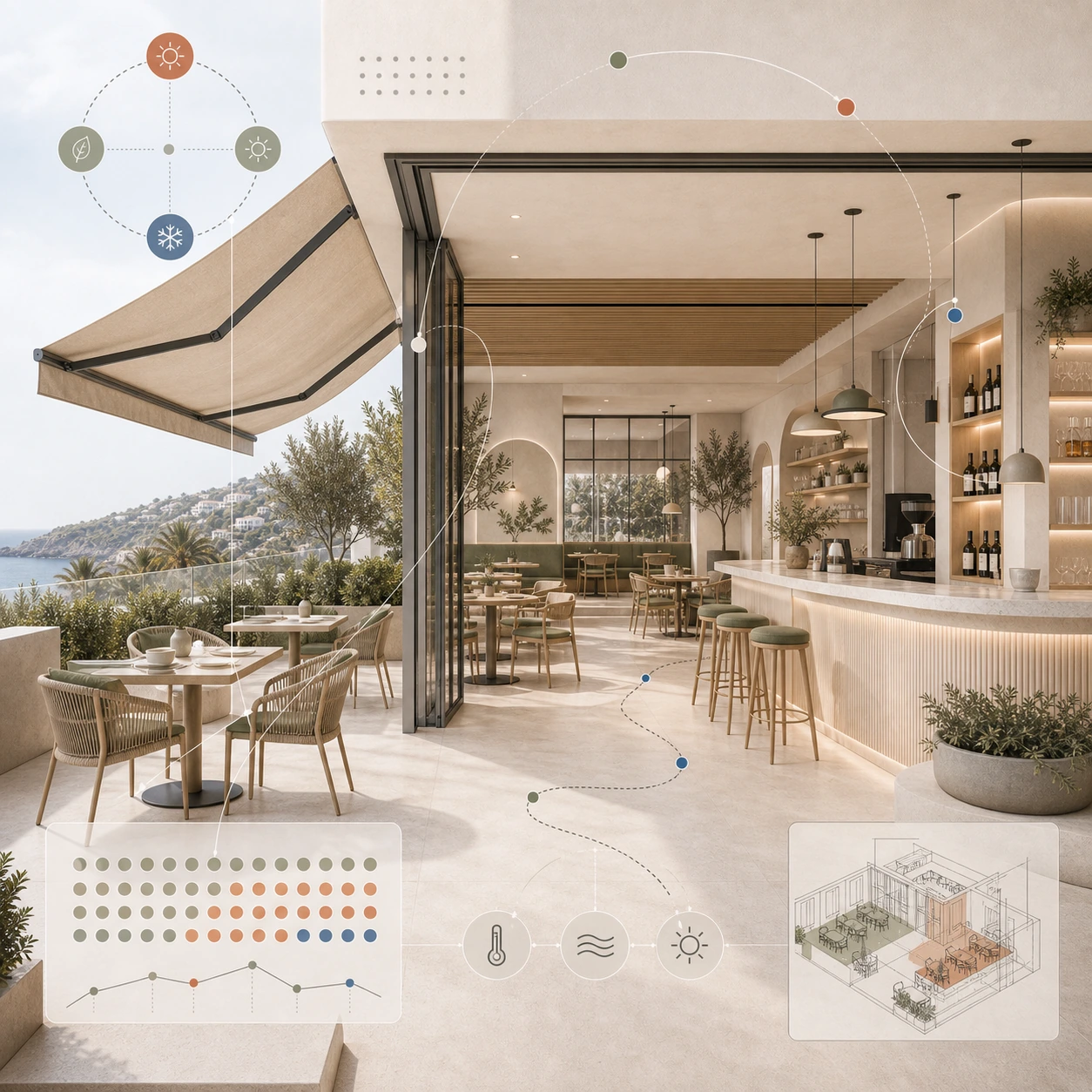
Eso se consigue con zonificación. Un espacio bien dividido en zonas diferenciadas permite activar solo una parte del local en temporada baja, manteniendo la sensación de ambiente sin necesitar el aforo completo. Una zona interior más íntima, una barra que funciona como espacio independiente, una terraza cubierta que cambia de carácter entre verano e invierno.
La iluminación es la otra herramienta. Un espacio que en verano funciona con luz natural y tonos abiertos necesita poder cerrar y calentar en invierno. Eso requiere una instalación de iluminación pensada desde el principio para los dos registros, no una solución de verano a la que luego se intenta adaptar unas lámparas de pie en octubre.
La acústica también cambia. En un local lleno, el ruido de la gente llena el espacio. En un local a media ocupación, cada conversación se oye demasiado. Los materiales que absorben o reflejan el sonido no son neutros: deciden si el espacio se siente vivo o vacío con poca gente dentro.
El cliente de invierno en la Costa del Sol no es el mismo que el de agosto
El turismo de invierno en la Costa del Sol es predominantemente nórdico, británico y de jubilados de alto poder adquisitivo. No busca volumen ni terraza. Busca confort, conversación, y espacios que se sientan cuidados.
Un local que en verano funciona con música alta, mesas juntas y servicio rápido necesita poder ofrecer algo diferente en invierno: más espacio entre mesas, menos ruido, más atención al detalle en el acabado. Ese cliente de invierno es fiel, gasta bien, y vuelve. Pero no tolera un espacio que claramente no está pensado para él.
Diseñar para ese cliente de invierno no significa renunciar al de verano. Significa construir un espacio que pueda ser las dos cosas, con decisiones de diseño que no hipotequen uno de los dos momentos.
Qué decisiones de diseño tienen más impacto en la rentabilidad anual
Las decisiones que más afectan a la capacidad de un local hostelero en la Costa del Sol para funcionar todo el año no son las más caras. Son las que se toman antes de empezar la obra.
La distribución del espacio en zonas activables de forma independiente. Una terraza que pueda cubrirse y cerrarse sin perder carácter. Una instalación de climatización que no haga ruido en invierno cuando el local está tranquilo. Materiales interiores que funcionen tanto con luz de verano como con luz artificial de tarde en diciembre.
Ninguna de estas decisiones encarece significativamente la obra si se toman desde el principio. Todas se vuelven muy caras si hay que añadirlas después, porque entonces implican intervenir sobre algo que ya está terminado.
Si quieres entender cómo el diseño impacta en la rentabilidad de un activo hostelero más allá de la temporada, el artículo sobre cómo reformar un activo hostelero sin perder lo que lo hacía funcionar da un marco útil para pensar la intervención antes de comprometerse con ningún concepto.
Cómo trabaja EOLOS en proyectos hosteleros en la Costa del Sol
El punto de partida siempre es el mismo: entender el negocio antes de diseñar el espacio. En la Costa del Sol eso significa entender los dos clientes, los dos momentos del año, y las dos versiones del local que tiene que existir dentro del mismo proyecto.
EOLOS está dirigido por arquitectos colegiados COAM con más de 20 años de experiencia en proyectos comerciales en España, Suecia y Grecia. Acreditación WELL AP del International WELL Building Institute. Trabajamos con operadores en Madrid, Marbella y la Costa del Sol que quieren espacios que funcionen, no solo que queden bien en fotos.
¿Estás preparando un restaurante, un bar o un proyecto de hostelería? Cuéntanoslo mediante las opciones de contacto que encontrarás a continuación.
A restaurant in Marbella with a full terrace in August and empty tables in November does not have a demand problem. It has a design problem.
The Costa del Sol has summer tourism and winter tourism, but they are not the same client nor do they demand the same from the space. Most of the premises are designed for only one of these two moments. The result is predictable: four months working at the limit and eight months justifying why the numbers are not coming in.
The problem of designing only for the peak
In high season, a large, open space works alone. The atmosphere is set by the volume of people, the natural light, the background noise. The design almost doesn't have to work because the client arrives already predisposed.
In low season, that same large, open space becomes a problem. Fifteen people in a place designed for a hundred do not generate atmosphere: they generate discomfort. The client notices it, does not come back, and leaves a review that does not help.
The catch is that the operator tends to design with peak occupancy in mind. It's understandable: that's when they bill the most, when they have the most pressure, when they need everything to work the most. But this criterion produces spaces that are good in July and difficult the rest of the year.
What differentiates year-round locations from year-round locations
Hospitality spaces on the Costa del Sol that maintain real occupancy in the off-season have one thing in common: they can contract without looking empty.
This is achieved with zoning. A well-divided space in differentiated zones makes it possible to activate only a part of the premises in low season, maintaining the feeling of ambiance without needing the full capacity. A more intimate interior zone, a bar that functions as an independent space, a covered terrace that changes its character between summer and winter.
Lighting is the other tool. A space that works with natural light and open tones in summer needs to be able to close and heat in winter. That requires a lighting installation designed from the start for both registers, not a summer solution to which you then try to adapt a few floor lamps in October.
Acoustics also change. In a crowded room, the noise of the people fills the space. In a half-occupied room, every conversation is overheard. The materials that absorb or reflect sound are not neutral: they decide whether the space feels alive or empty with few people in it.
The winter customer on the Costa del Sol is not the same as in August.
Winter tourism on the Costa del Sol is predominantly Nordic, British and retirees with high purchasing power. They are not looking for volume or terraces. They are looking for comfort, conversation, and spaces that feel cared for.
A restaurant that in summer works with loud music, tables together and fast service needs to be able to offer something different in winter: more space between tables, less noise, more attention to detail in the finish. That winter customer is loyal, spends well, and comes back. But he does not tolerate a space that is clearly not designed for him.
Designing for that winter client doesn't mean giving up on the summer client. It means building a space that can be both, with design decisions that don't mortgage one of the two moments.
Which design decisions have the greatest impact on annual profitability
The decisions that most affect the ability of a hospitality establishment on the Costa del Sol to operate all year round are not the most expensive ones. They are the ones that are made before the work begins.
The distribution of the space in zones that can be activated independently. A terrace that can be covered and closed without losing character. An air conditioning system that does not make noise in winter when the premises are quiet. Interior materials that work with both summer light and artificial light in the evening in December.
None of these decisions makes the work significantly more expensive if they are taken from the beginning. They all become very expensive if they have to be added later, because then they imply intervening on something that is already finished.
If you want to understand how design impacts a hospitality asset's profitability beyond the season, the article on how to refurbish a hospitality asset without losing what made it work provides a useful framework for thinking through the intervention before committing to any concept.
How EOLOS works on hospitality projects on the Costa del Sol
The starting point is always the same: understand the business before designing the space. On the Costa del Sol that means understanding the two clients, the two times of the year, and the two versions of the venue that have to exist within the same project.
EOLOS is managed by COAM registered architects with more than 20 years of experience in commercial projects in Spain, Sweden and Greece. WELL AP accreditation from the International WELL Building Institute. We work with operators in Madrid, Marbella and the Costa del Sol who want spaces that work, not just look good in photos.
Planning a restaurant, bar or hospitality project? Tell us about it using the contact options below.