Diseño interior para mejorar el valor de un activo comercial
Cómo el diseño de interiores puede mejorar el valor de un activo comercial antes de venderlo o alquilarlo. Estrategias de interiorismo para inversores inmobiliarios en Madrid.
Journal · EOLOS DESIGN LAB
Guía · EOLOS DESIGN LAB Journal
Si tienes un local, oficina o espacio comercial que quieres vender o alquilar, el diseño puede marcar la diferencia entre cerrarlo rápido a buen precio o tenerlo meses parado.
No es teoría. Pasa constantemente en el mercado inmobiliario comercial en España.
Por qué el estado del espacio afecta directamente al precio
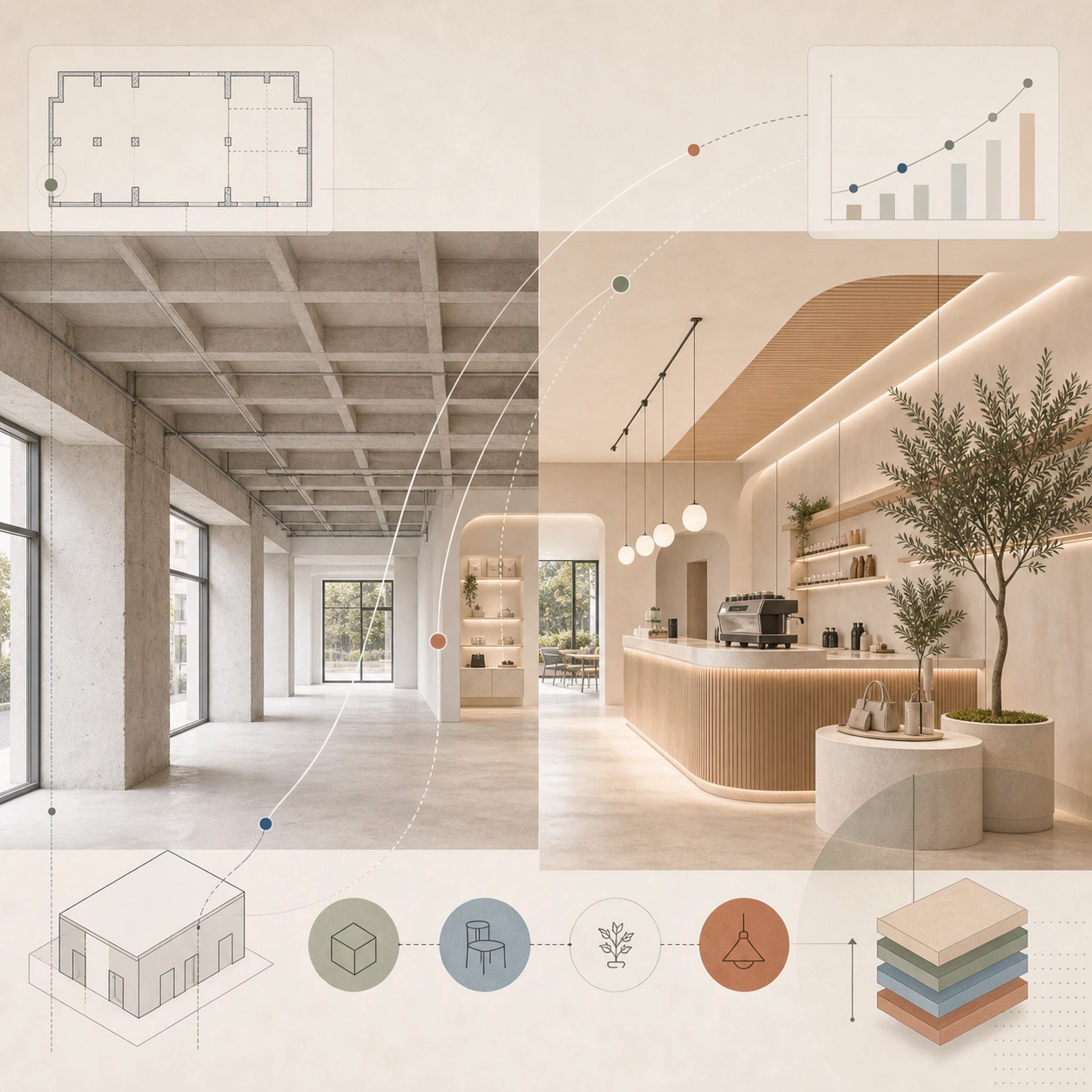
Un activo comercial vacío y sin acondicionar le pide al comprador o arrendatario que use su imaginación. La mayoría no lo hace. Ven un coste adicional, un problema, un riesgo.
Un espacio bien diseñado, o al menos bien presentado, hace exactamente lo contrario: reduce la fricción mental. El interesado puede verse operando ahí desde el primer minuto. Eso tiene un valor económico real y medible.
Qué impacto tiene en la valoración
Un local comercial acondicionado con diseño de nivel medio puede lograr rentas entre un 15% y un 35% superiores al mismo espacio sin intervención. En activos orientados a hostelería, retail premium u oficinas, esa diferencia puede ser aún mayor.
En venta, el impacto en precio de salida suele estar entre un 10% y un 25%, dependiendo de la zona, el uso previsto y la calidad de la intervención. Y lo más relevante para el propietario: el tiempo en mercado se reduce significativamente.
Qué tipo de intervención tiene más sentido
No siempre es necesaria una reforma completa. En muchos casos, una intervención estratégica bien dirigida es suficiente para cambiar la percepción del activo.
Acondicionamiento básico de presentación. Limpieza, pintura, iluminación funcional, eliminación de elementos deteriorados. Coste bajo, impacto visual alto.
Diseño de concepto y renders. Sin ejecutar ninguna obra, un buen estudio puede producir renders que muestran el potencial del espacio. Especialmente útil en locales en bruto o procesos de venta.
Intervención selectiva de alto impacto. Concentrar la inversión en las zonas que el comprador verá primero: fachada, entrada, zona de recepción.
Diseño completo con ejecución. Para activos que salen al mercado listos para operar, o para reposicionamiento de propiedades que llevan tiempo sin moverse.
Los activos que más se benefician
Locales hosteleros vacíos. Un antiguo bar o restaurante sin intervención transmite abandono. Con un diseño de concepto bien ejecutado, se convierte en una oportunidad clara para un operador.
Oficinas en edificios de segunda generación. El mercado de oficinas en España está muy polarizado: los espacios bien diseñados tienen ocupación alta, los mediocres compiten solo por precio.
Espacios de uso mixto o flexible. La flexibilidad es un valor, pero hay que comunicarla visualmente. Un espacio sin un uso claro necesita que el diseño cuente la historia de lo que podría ser.
Propiedades en reposicionamiento. Si un activo viene de un uso que ya no es el óptimo para su ubicación, el diseño es la herramienta para hacer visible el cambio de categoría.
El error más común
Poner el activo en el mercado antes de hacer cualquier intervención, para ver cómo responde. El problema: las primeras semanas son las más valiosas. Si el activo se presenta mal en ese momento, se quema rápido y luego cuesta el doble reactivarlo.
La secuencia correcta es intervención primero, salida al mercado después.
Presupuesto orientativo según tipo de intervención
Intervención selectiva de alto impacto (entrada, recepción, fachada): 12.000-25.000 euros
Diseño de concepto + renders (sin obra): 4.000-9.000 euros
Reforma completa de reposicionamiento: 40.000-150.000 euros según superficie y uso
La inversión previa a la salida al mercado se recupera normalmente en el primer mes de mayor renta o en la diferencia de precio de venta.
¿Tienes un activo que quieres posicionar mejor?
¿Estás preparando un proyecto comercial, hostelero, residencial o de desarrollo? Cuéntanoslo mediante las opciones de contacto que encontrarás a continuación.
If you have a shop, office or commercial space that you want to sell or rent, the design can make the difference between closing it quickly at a good price or having it sitting idle for months.
It's not just theory. It happens constantly in the commercial real estate market in Spain.
Why the state of space directly affects the price
An empty, unfurnished commercial property requires the buyer or tenant to use their imagination. Most don't. They see an added cost, a problem, a risk.
A well-designed, or at least well-presented, space does the exact opposite: it reduces mental friction. The user can envision themselves working there from the very first minute. That has real and measurable economic value.
What impact does it have on the valuation?
A commercial space fitted out with a mid-range design can achieve rents between 15% and 35% higher than the same space without intervention. In properties geared towards hospitality, premium retail, or offices, that difference can be even greater.
For sale, the impact on the asking price is typically between 10% and 25%, depending on the area, intended use, and the quality of the work. And most importantly for the owner: the time on the market is significantly reduced.
What type of intervention makes the most sense
A complete overhaul isn't always necessary. In many cases, a well-directed strategic intervention is enough to change the perception of the asset.
Basic presentation conditioning. Cleaning, painting, functional lighting, removal of deteriorated elements. Low cost, high visual impact.
Concept design and renderings. Without undertaking any construction work, a good studio can produce renderings that window display the potential of a space. This is especially useful for unfinished premises or sales processes.
Selective high-impact intervention. Focus investment on the areas the buyer will see first: facade, entrance, reception area.
Complete design with implementation. For assets that are coming onto the market ready to operate, or for repositioning properties that have been sitting idle for a while.
The assets that benefit the most
Empty restaurant premises. An old bar or restaurant left untouched conveys neglect. With a well-executed concept design, it becomes a clear opportunity for an operator.
Offices in second-generation buildings. The office market in Spain is highly polarized: well-designed spaces have high occupancy, while mediocre ones compete only on price.
Mixed or flexible use spaces. Flexibility is a value, but it needs to be communicated visually. A space without a clear use needs a design that tells the story of what it could be.
Properties in repositioning. If an asset comes from a use that is no longer optimal for its location, design is the tool to make the change of category visible.
The most common mistake
Put the asset on the market before making any intervention, to see how it responds. The problem: the first few weeks are the most valuable. If the asset performs poorly at that time, it quickly loses value and then it costs twice as much to revive it.
The correct sequence is intervention first, market entry later.
Indicative budget according to type of intervention