Cómo diseñar una tienda de cosmética natural y skincare en Madrid que justifique precios premium. Interiorismo para retail de belleza y cosmesi.
Journal · EOLOS DESIGN LAB
Guía · EOLOS DESIGN LAB Journal
La cosmética natural y el skincare consciente son dos de los segmentos de retail con mayor crecimiento en Madrid. Y también uno de los más competitivos: marcas online con distribución en 24 horas, grandes superficies con sección ecológica y tiendas multimarca compiten por el mismo cliente.
Lo que no pueden dar ninguna de esas opciones es la experiencia física: tocar la textura, oler el producto, recibir un diagnóstico de piel personalizado, y salir de la tienda con la sensación de haber hecho algo bueno por tu piel y por el planeta. Esa experiencia la construye el espacio.
La coherencia entre los valores de la marca y el espacio
Una tienda de cosmética natural que tiene sus valores de sostenibilidad muy bien comunicados online pero que tiene un interior de melamina blanca y fluorescente está en contradicción. El cliente que entra buscando autenticidad y coherencia lo percibe inmediatamente.
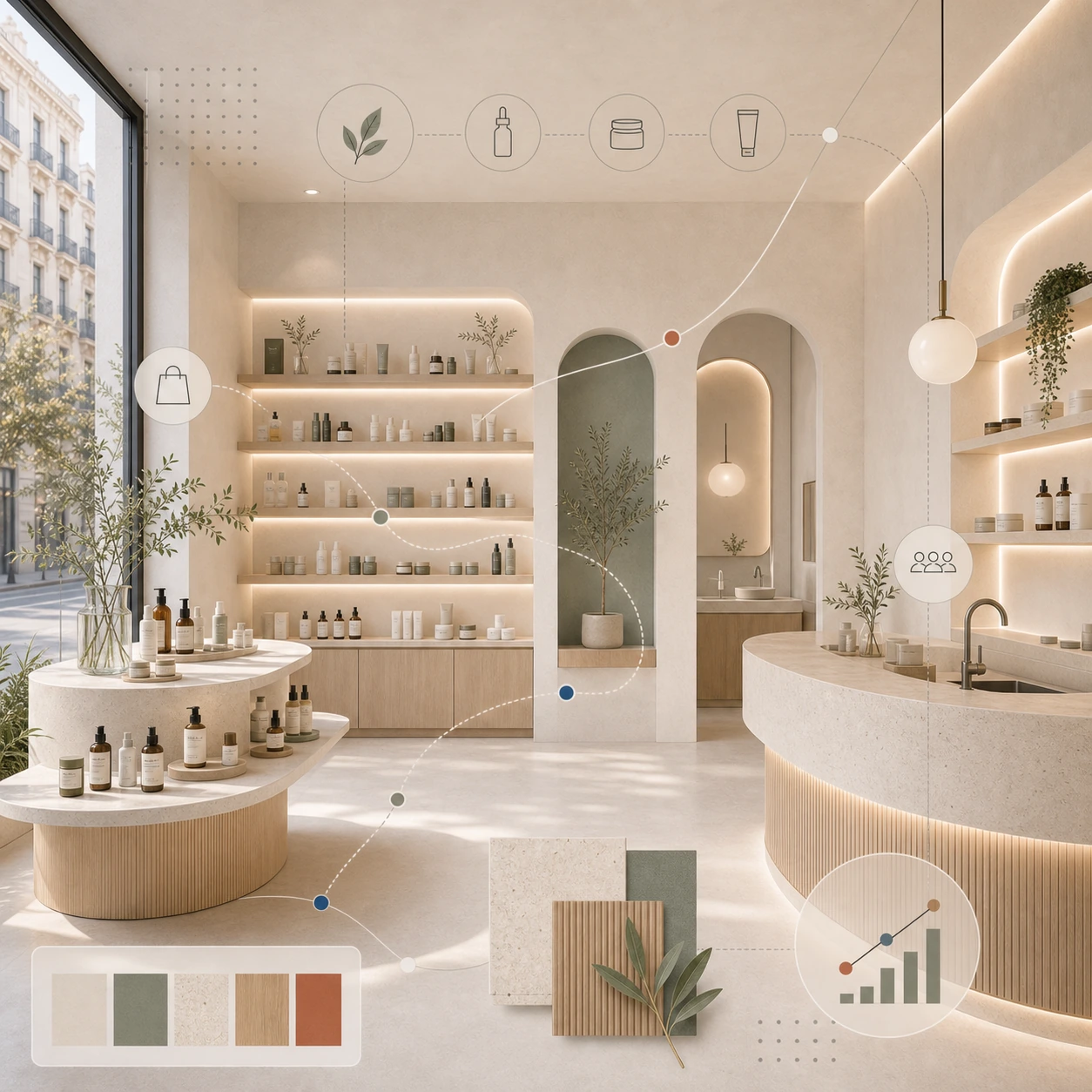
Los materiales del espacio tienen que ser coherentes con los valores del producto: madera sin tratar o con acabados naturales, algodón y lino en textiles, arcilla o yeso en paredes, plantas vivas abundantes. No por estética, sino porque esos materiales cuentan la misma historia que el producto que se vende.
Los elementos de diseño que venden en una beauty store natural
La zona de prueba: donde se toma la decisión de compra
En cosmética, la decisión de compra casi siempre ocurre cuando el cliente prueba el producto. Una zona de prueba bien diseñada, con buena iluminación (luz natural o LED que imite la luz natural para ver el color real de la piel), espacio limpio y organizado, y productos disponibles en formato tester, convierte visitas en compras.
La iluminación en la zona de prueba es particularmente crítica. Una luz que hace que la piel se vea bien hace que el producto parezca que funciona. Una luz que hace que la piel se vea mal hace lo contrario.
El olfato: el canal de venta más potente
En cosmética natural, el aroma del espacio es parte del producto. Un espacio que huele bien, con una mezcla de los productos más aromáticos de la tienda integrada de forma sutil, activa el deseo de compra antes de que el cliente haya tocado nada.
Diseñar el olfato del espacio no significa poner un difusor. Significa decidir qué productos tienen presencia olfativa desde la entrada y cómo el conjunto crea una experiencia sensorial coherente con la identidad de la marca.
El espacio de consulta: donde se genera el ticket alto
Las tiendas de skincare que tienen mayor ticket medio en Madrid no son las que tienen más producto. Son las que tienen una zona donde una persona puede sentarse con un asesor de piel y recibir un diagnóstico personalizado. Ese servicio, cuando el espacio lo facilita, puede generar tickets de 120-200 euros por visita frente a los 30-50 de una compra no asesorada.
Escenario de presupuesto: tienda cosmética natural 50-80m² en Madrid
Obra civil y distribución: 8.000-14.000 euros
Expositores y estanterías con materiales naturales: 10.000-18.000 euros
Zona de prueba y consulta: 6.000-11.000 euros
Iluminación natural o de espectro completo: 5.000-9.000 euros
Vegetación y elementos naturales: 2.500-5.000 euros
Proyecto y dirección: 4.500-8.000 euros
Total: 43.000-78.000 euros
Una tienda de skincare en Madrid con 20 clientes diarios, ticket medio de 65 euros y 4 consultas de piel semanales a 150 euros factura en torno a 40.000 euros mensuales. La diferencia entre 45€ y 65€ de ticket medio con ese volumen de clientes es 12.000 euros mensuales adicionales.
¿Estás preparando una tienda, un showroom o un espacio de retail? Cuéntanoslo mediante las opciones de contacto que encontrarás a continuación.
Natural cosmetics and conscious skincare are two of the fastest-growing retail segments in Madrid. They are also among the most competitive: online brands with 24-hour delivery, large department stores with organic sections, and multi-brand retailers all compete for the same customers.
What none of those options can offer is the physical experience: feeling the texture, smelling the product, receiving a personalized skin analysis, and leaving the store with the feeling of having done something good for your skin and the planet. That experience is created by the space itself.
The consistency between the brand values and the space
A natural cosmetics store that clearly communicates its sustainability values online but has a white and fluorescent melamine interior is contradictory. Customers who enter seeking authenticity and consistency immediately notice this.
The materials used in the space must be consistent with the product's values: untreated or naturally finished wood, cotton and linen textiles, clay or plaster walls, and plenty of live plants. This isn't just for aesthetics, but because these materials tell the same story as the product being sold.
The design elements they sell in a natural beauty store
The test area: where the purchase decision is made
In cosmetics, the purchase decision almost always occurs when the customer tries the product. A well-designed testing area, with good lighting (natural light or LEDs that mimic natural light to show the true skin tone), a clean and organized space, and products available in tester format, turns visits into sales.
Lighting in the testing area is particularly critical. Lighting that makes the skin look good makes the product seem to work. Lighting that makes the skin look bad has the opposite effect.
Smell: the most powerful sales channel
In natural cosmetics, the scent of the space is part of the product. A space that smells good, with a blend of the store's most aromatic products subtly integrated, sparks the desire to buy before the customer has even touched anything.
Designing the scent of a space doesn't mean simply placing a diffuser. It means deciding which products have a olfactory presence from the entrance and how the overall effect creates a sensory experience consistent with the brand's identity.
The consultation space: where the high ticket is generated
The skincare stores with the highest average spend in Madrid aren't necessarily the ones with the most products. They're the ones with an area where customers can sit down with a skin consultant and receive a personalized diagnosis. This service, when the space allows it, can generate spends of €120-€200 per visit, compared to €30-€50 for a purchase without consultation.
Budget scenario: 50-80m² natural cosmetics store in Madrid
Civil works and distribution: 8,000-14,000 euros
Display stands and shelves made with natural materials: 10,000-18,000 euros
Test and consultation area: 6,000-11,000 euros
Natural or full-spectrum lighting: 5,000-9,000 euros
Vegetation and natural elements: 2,500-5,000 euros
Project and management: 4,500-8,000 euros
Total: 43,000-78,000 euros
A skincare shop in Madrid with 20 daily customers, an average spend of €65, and four weekly skin consultations at €150 each, generates around €40,000 in revenue per month. The difference between an average spend of €45 and €65 with that customer volume represents an additional €12,000 per month.
Planning a shop, showroom or retail space? Tell us about it using the contact options below.
Siguiente paso
Cada buen proyecto empieza con una conversación clara.