Reformar una propiedad de inversión en Madrid: lo que renta, lo que retiene y la diferencia
Cómo reformar una propiedad de inversión en Madrid para mejorar la renta y retener buenos inquilinos. Guía de diseño para inversores inmobiliarios.
Journal · EOLOS DESIGN LAB
Guía · EOLOS DESIGN LAB Journal
Hay dos tipos de reforma en una propiedad de inversión en Madrid. La que minimiza el coste inicial para salir al mercado lo antes posible. Y la que piensa en quién va a vivir o trabajar ahí y por cuánto tiempo.
No son la misma reforma. Y la diferencia entre las dos no está solo en el presupuesto, sino en las decisiones que se toman: qué materiales se eligen, cómo se distribuye el espacio, qué nivel de acabado se busca en cada zona. Esas decisiones determinan si el activo atrae al inquilino que paga bien y se queda, o al que llega porque es lo más barato disponible y se va en cuanto puede.
El mercado de alquiler en Madrid en 2026
Madrid es el mercado de alquiler más competitivo de España. La demanda supera a la oferta en casi todos los distritos, lo que puede dar la sensación de que cualquier propiedad se alquila sola. En parte es verdad: una propiedad en mal estado en Malasaña o en Chamberí se alquila. El problema es a quién y a qué precio.
El inquilino de calidad, el que tiene estabilidad económica, cuida el espacio y renueva el contrato, no elige por necesidad. Elige por lo que el espacio le ofrece. Y tiene opciones. Si tu propiedad no está a la altura de lo que busca, no te lo dice: simplemente elige otra.
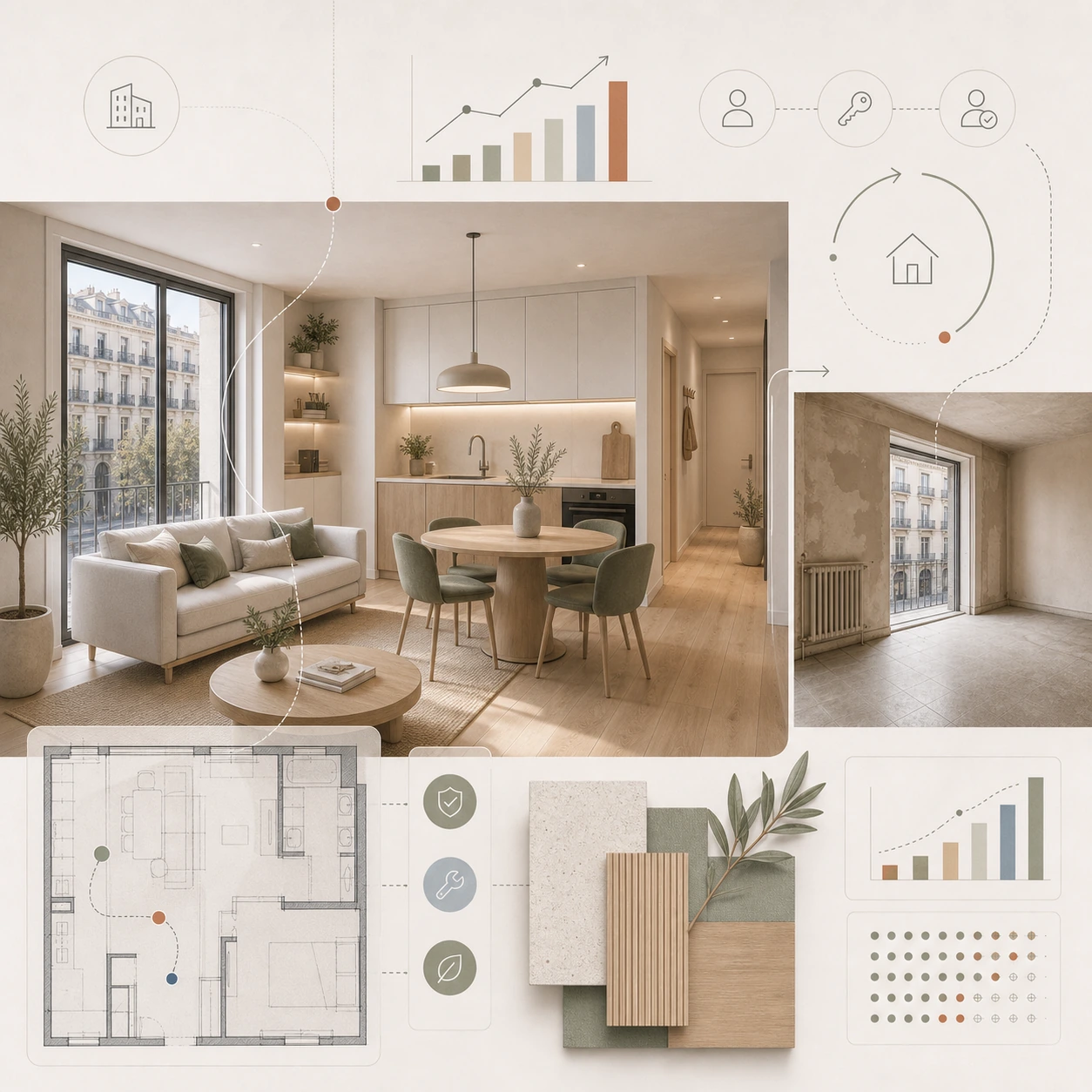
Una reforma bien planteada en Madrid puede justificar una renta entre un 20% y un 40% superior a la misma propiedad sin intervención, dependiendo de la zona y el tipo de inmueble. Esa diferencia se recupera normalmente en el primer año de mayor renta.
Lo que renta a corto plazo y lo que retiene a largo plazo
No siempre coinciden. Hay decisiones de diseño que hacen que una propiedad se vea bien en las fotos del anuncio y se alquile rápido, pero que generan problemas con el primer año de uso. Y hay decisiones que requieren una inversión algo mayor pero que producen un inquilino que renueva y un activo que no necesita intervención entre contratos.
Los suelos laminados de bajo coste fotografían bien y son baratos de instalar. Pero con un año de uso normal, especialmente en zonas de paso, se deterioran de forma visible. El siguiente inquilino lo ve, negocia a la baja, y la propiedad empieza a necesitar intervención cada vez que cambia el contrato.
Una cocina funcional con electrodomésticos de gama media-alta y encimera de material resistente tiene un coste inicial mayor, pero no genera incidencias, el inquilino la cuida porque la percibe como valiosa, y no necesita reposición en cinco años.
La diferencia entre las dos estrategias no está solo en el coste de la reforma. Está en el coste total del activo a cinco años: reforma, incidencias, rotación de inquilinos, tiempo en mercado entre contratos, y diferencial de renta.
Las zonas de la propiedad donde la inversión tiene más retorno
No hace falta reformar todo al mismo nivel. Hay zonas donde el impacto en la percepción del inquilino es alto y zonas donde una intervención básica es suficiente.
La cocina y el baño principal son las dos zonas que más influyen en la decisión de alquiler. Son también las que más se deterioran con el uso. Una inversión concentrada en estas dos zonas, con materiales resistentes y un diseño coherente, produce el mayor retorno por euro invertido.
La iluminación es la segunda palanca de mayor impacto por menor coste. Un espacio bien iluminado, con puntos de luz bien situados y temperatura de color adecuada, se percibe como más cuidado y más grande. Es una intervención relativamente barata que cambia la percepción del espacio por completo.
Los acabados de las zonas comunes, si se trata de un edificio compartido, están fuera del control del propietario individual. Pero dentro de la propiedad, la entrada y el salón son las primeras zonas que el inquilino ve. Una primera impresión buena hace que el resto del espacio se perciba mejor.
Airbnb y alquiler de corta estancia: un criterio de diseño diferente
Una propiedad pensada para alquiler turístico o de corta estancia necesita un diseño distinto al de una propiedad de alquiler residencial de larga duración. El desgaste es mayor y más rápido. Los materiales tienen que ser más resistentes, más fáciles de limpiar, y más neutros en términos de gusto para atraer al mayor rango posible de huéspedes.
También cambia la lógica de la distribución. Un apartamento de corta estancia que funciona bien es uno donde el huésped entiende cómo moverse sin instrucciones, donde todo está donde se espera que esté, y donde no hay elementos de diseño que requieran explicación. La funcionalidad prima sobre la originalidad.
Cómo trabaja EOLOS en proyectos de reforma para inversión en Madrid
El punto de partida es el objetivo del activo: si es para alquiler residencial de larga duración, para alquiler turístico, o para venta. Cada objetivo tiene una lógica de inversión diferente y produce decisiones de diseño distintas.
¿Estás preparando un proyecto residencial, patrimonial o de desarrollo? Cuéntanoslo mediante las opciones de contacto que encontrarás a continuación.
There are two types of refurbishment in an investment property in Madrid. The one that minimizes the initial cost to go on the market as soon as possible. And the one that thinks about who is going to live or work there and for how long.
They are not the same renovation. And the difference between the two is not only in the budget, but in the decisions that are made: what materials are chosen, how the space is distributed, what level of finish is sought in each area. These decisions determine whether the asset attracts the tenant who pays well and stays, or the one who comes because it is the cheapest available and leaves as soon as he can.
The rental market in Madrid in 2026
Madrid is the most competitive rental market in Spain. Demand outstrips supply in almost every district, which can give the impression that any property rents itself. This is partly true: a property in poor condition in Malasaña or Chamberí will rent. The problem is to whom and at what price.
The quality tenant, the one who has economic stability, takes care of the space and renews the lease, does not choose out of necessity. They choose because of what the space offers. And he has options. If your property is not up to what he is looking for, he doesn't tell you: he simply chooses another one.
A well planned renovation in Madrid can justify a rent between 20% and 40% higher than the same property without intervention, depending on the area and the type of property. This difference is normally recovered in the first year of higher rent.
What rents in the short term and what retains in the long term
They don't always match. There are design decisions that make a property look good in the listing photos and rent quickly, but create problems with the first year of use. And there are decisions that require a slightly larger investment but produce a tenant that renews and an asset that needs no intervention between leases.
Low-cost laminate floors photograph well and are inexpensive to install. But with a year of normal use, especially in walkways, they deteriorate visibly. The next tenant sees it, negotiates down, and the property starts needing intervention every time the lease changes.
A functional kitchen with medium-high-end appliances and a resistant material countertop has a higher initial cost, but it does not generate incidents, the tenant takes care of it because he perceives it as valuable, and it does not need to be replaced in five years.
The difference between the two strategies is not just in the cost of the renovation. It is in the total cost of the asset over five years: refurbishment, incidents, tenant turnover, time on market between leases, and rent differential.
The areas of the property where the investment has the highest return on investment
It is not necessary to renovate everything at the same level. There are areas where the impact on tenant perception is high and areas where a basic intervention is sufficient.
The kitchen and the main bathroom are the two areas that most influence the rental decision. They are also the ones that deteriorate the most with use. A concentrated investment in these two areas, with resistant materials and a consistent design, produces the highest return per euro invested.
Lighting is the second highest impact lever for the lowest cost. A well-lit space, with well-placed light points and appropriate color temperature, is perceived as more cared for and larger. It is a relatively inexpensive intervention that changes the perception of the space completely.
The finishes of the common areas, if it is a shared building, are outside the control of the individual owner. But inside the property, the entrance and living room are the first areas the tenant sees. A good first impression makes the rest of the space better perceived.
Airbnb and short-stay rentals: a different design criterion
A property intended for tourist or short term rental needs a different design than a long term residential rental property. Wear and tear is greater and faster. Materials need to be stronger, easier to clean, and more neutral in terms of taste to appeal to the widest possible range of guests.
It also changes the logic of the layout. A well-functioning short-stay apartment is one where the guest understands how to move around without instructions, where everything is where it is expected to be, and where there are no design elements that require explanation. Functionality takes precedence over originality.
If you want to understand how design impacts the value of a commercial or investment asset prior to selling or leasing it, the article on how interior design increases the value of a commercial asset provides a useful framework for thinking about intervention.
How EOLOS works on refurbishment projects for investment in Madrid
The starting point is the purpose of the asset: whether it is for long-term residential rental, for tourist rental, or for sale. Each objective has a different investment logic and produces different design decisions.
Planning a residential, property or development project? Tell us about it using the contact options below.
Siguiente paso
Cada buen proyecto empieza con una conversación clara.