Reposicionamiento de activos hosteleros: cuándo renovar, cuánto invertir y qué esperar
Cuándo renovar un activo hostelero, cuánto invertir y qué retorno esperar. Guía de reposicionamiento para propietarios e inversores hosteleros en Madrid y España.
Journal · EOLOS DESIGN LAB
Guía · EOLOS DESIGN LAB Journal
Hay hoteles, restaurantes y espacios hosteleros que llevan años funcionando pero que han dejado de competir bien. No por mala ubicación o mal servicio, sino porque el espacio ya no está a la altura de lo que el cliente espera.
Eso es un problema de reposicionamiento. Y tiene solución.
Qué significa reposicionar un activo hostelero
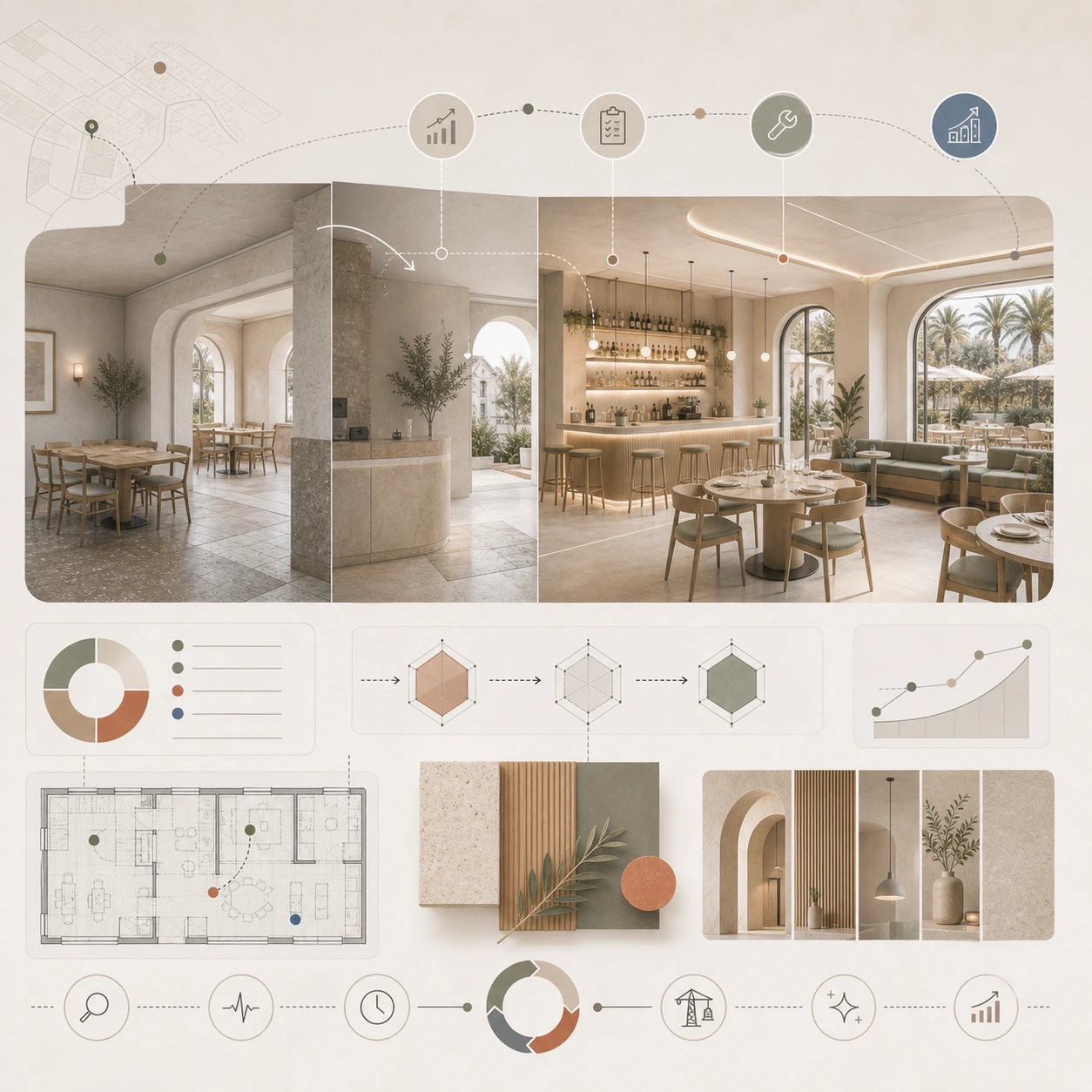
Reposicionar no es solo reformar. Es cambiar la categoría en la que compite el activo. Un hotel de 3 estrellas con potencial puede pasar a competir como boutique de 4 estrellas con una intervención de diseño bien dirigida. Un restaurante que lleva diez años sin tocar el espacio puede recuperar relevancia sin cambiar su concepto de cocina.
El diseño es la herramienta que hace visible ese cambio. Sin él, el reposicionamiento no existe en la mente del cliente.
Señales de que un activo necesita intervención
Caída de ocupación o ticket medio sin explicación por precio o competencia. Reviews negativas que mencionan el espacio de forma consistente. Dificultad para subir precios aunque el servicio haya mejorado.
Los menos evidentes: la competencia directa tiene fotos que se ven notablemente mejor que las tuyas, el personal tiene que compensar verbalmente lo que el espacio no comunica, los clientes habituales no traen a nadie nuevo.
Cuándo tiene sentido la inversión
El negocio tiene tracción real. Si el producto funciona y el problema es el espacio, la inversión tiene un suelo claro. Si el modelo de negocio tiene problemas estructurales, renovar no los resuelve.
Hay margen financiero. Una reforma mal financiada que deja el activo sin liquidez para operar durante la recuperación es peor que no hacerla.
El mercado del entorno lo justifica. Si la zona está en declive o hay sobreoferta estructural, el reposicionamiento mejora el activo individualmente pero no cambia las condiciones del mercado.
Qué hace que una intervención funcione o falle
Lo que funciona: tener claro desde el inicio qué perfil de cliente se quiere atraer después de la renovación y diseñar específicamente para ese perfil.
Lo que falla: una reforma estética sin estrategia detrás. Cambiar suelos, pintar y actualizar el mobiliario puede mejorar la percepción superficial pero no mueve el activo a una categoría diferente.
Presupuesto orientativo por tipo de activo
Hotel boutique 15-30 habitaciones (reposicionamiento completo): 150.000-350.000 euros
Restaurante de tamaño medio 80-150m²: 80.000-200.000 euros
Bar o café 50-100m²: 35.000-90.000 euros
Proyecto y dirección: 10-14% del coste de ejecución
Plazo de recuperación habitual: 12-24 meses vía aumento de ADR, ocupación o ticket medio.
¿Tienes un activo hostelero que quieres evaluar?
¿Estás preparando un restaurante, un bar o un proyecto de hostelería? Cuéntanoslo mediante las opciones de contacto que encontrarás a continuación.
There are hotels, restaurants, and other hospitality venues that have been operating for years but have stopped competing effectively. This isn't due to a bad location or poor service, but rather because the establishment no longer meets customer expectations.
That's a repositioning problem. And it has a solution.
What does it mean to reposition a hotel asset
Repositioning isn't just about renovations. It's about changing the category in which the asset competes. A 3-star hotel with potential can become a 4-star boutique hotel with a well-directed design intervention. A restaurant that hasn't touched its space in ten years can regain relevance without changing its culinary concept.
Design is the tool that makes that change visible. Without it, the repositioning doesn't exist in the customer's mind.
Signs that an asset needs intervention
Unexplained drop in occupancy or average spend price due to pricing or competition. Negative reviews consistently mentioning the space. Difficulty raising prices despite improved service.
The less obvious ones: direct competitors have photos that look noticeably better than yours, staff have to verbally compensate for what the space doesn't communicate, and regular customers don't bring in anyone new.
When does investment make sense?
The business has real traction. If the product works and the problem is space, the investment has a clear floor. If the business model has structural problems, renovation won't solve them.
There is financial leeway. A poorly funded refurbishment that leaves the asset without liquidity to operate during the recovery is worse than not doing it at all.
The surrounding market justifies it. If the area is in decline or there is a structural oversupply, repositioning improves the asset individually but does not change market conditions.
What makes an intervention work or fail?
What works: being clear from the beginning about what customer profile you want to attract after the renewal and designing specifically for that profile.
The problem: a cosmetic renovation without a strategy behind it. Changing floors, painting, and updating furniture might improve the superficial appearance, but it doesn't move the asset into a different category.
Indicative budget by asset type
Boutique hotel 15-30 rooms (complete repositioning): 150,000-350,000 euros