
Guide
Local SEO for Restaurants: Your Google Reviews Depend on Acoustics, Not Marketing.
Subscribe to our newsletter!
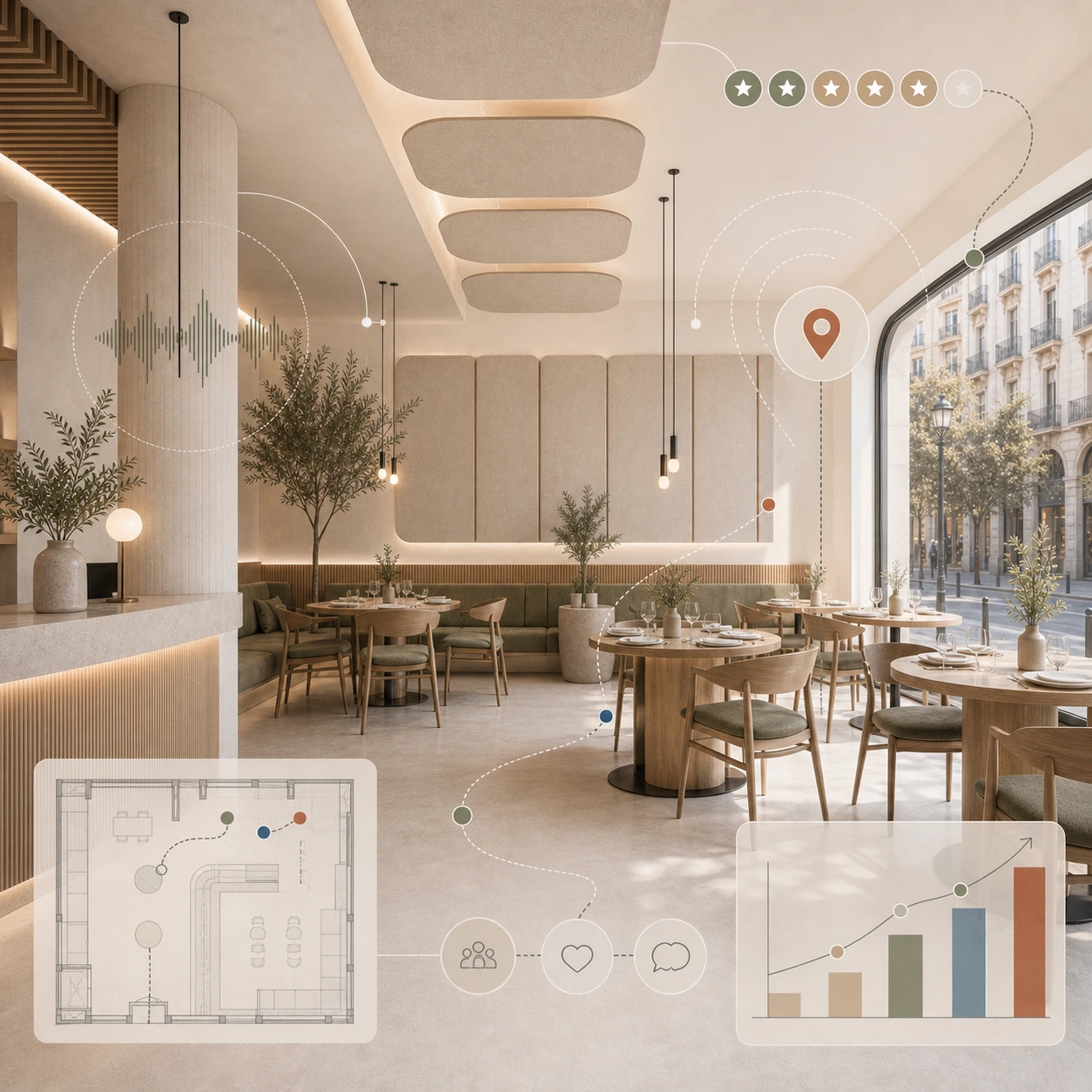
Marketing agencies often present local SEO for restaurants as a matter of Google profile, keywords, photos, posts and review management. All of that matters. But for a restaurant, the problem starts earlier: if the physical space produces a bad experience, marketing only accelerates the arrival of customers who will then leave negative signals.
Google explains that local results are based primarily on relevance, distance and prominence, and that prominence takes into account factors such as links, reviews and ratings. It also recommends responding to reviews and adding photos and videos to the business profile. The awkward question is this: what determines whether a customer wants to leave a good review or upload an attractive photo of your restaurant?
It's not just the community manager. It's the architecture.
The customer doesn't review the marketing. They review the experience.
A customer does not write “the content strategy was weak”. They write that the place was noisy, that the table was uncomfortable, that it was cold, that you couldn't talk, that the food looked worse in the photos, that the service was slow or that the ambiance didn't justify the price. Many of these phrases sound like operational problems. In reality, they often have a spatial root.
Acoustics affect dwell time, perception of service and equipment fatigue. Lighting affects how the dish looks, how it is photographed and how the customer feels at the table. Circulation affects room speed, staff stress and sense of control. Air conditioning affects comfort, but it rarely appears in a review as “air conditioning”; it appears as discomfort.
Local SEO is measured digitally, but it is earned physically.
Acoustics is a commercial metric
Madrid is full of visually appealing restaurants that sound bad. Hard surfaces, bare ceilings, glass, stone, micro-cement, metal and little textile create spaces that are photogenic in rendering but exhausting in actual service. When the noise level goes up, the customer speaks louder, the equipment becomes strained, orders are communicated worse and the experience no longer feels premium.
The customer rarely identifies the problem as reverberation. He translates it as “stressful environment,” “couldn't talk,” or “chaotic service.” That language ends up on Google Maps, TripAdvisor, Instagram and private recommendations. No agency can respond to reviews faster than bad acoustics generate them.
A restaurant that wants to protect its local reputation needs to integrate acoustic absorption, geometry, textiles, furniture and materials from the concept. Not as patches after opening, but as part of the business model.
Light decides whether the customer creates useful content
Google allows customers to add photos to the business profile, and those images influence how other users perceive the venue before booking. For restaurants, this is critical. Customer-generated photography can either reinforce desire or destroy it.
A poorly lit table turns a correct dish into a dull image. The wrong color temperature makes food look cold, greasy or artificial. Too much contrast forces the mobile to compensate and burns out light areas. Too much flat light removes texture. The result is not only aesthetic: it affects click, reservation and confidence.
That's why restaurant lighting should be designed with service, atmosphere and camera in mind. The experience lives in the room, but also on the next customer's screen.
Distribution affects the service overview
Many criticisms of service are born on the floor plan. If the waiter walks too much between kitchen and table, if the pass is poorly positioned, if customer and staff flows cross, if the waiting area encroaches on the dining area or if the restrooms interrupt the dining room, the restaurant operates with friction. The staff compensates for that friction with effort. The customer perceives it as slowness.
Good distribution not only improves the operation. It reduces the chances that the experience will deteriorate during rush hour. For local SEO, that matters because the most damaging reviews are often written after an emotionally intense experience: a wait, an inconvenience, an argument, excessive noise, a meal that was not enjoyed.
Restaurant interior design is not decoration. It is control of reputational variables.
Where marketing separate from architecture fails
An agency can optimize categories, copy, publications, campaigns and responses. But if it has no power over acoustics, lighting, layout, signage, façade, visibility, booking experience and photography, it is only working on the final layer of the problem. That explains why some restaurants invest in marketing and continue to rack up mediocre reviews.
At Eolos, the starting point is different. We design the physical space and the digital presence as parts of the same system. The room must produce an experience that can sustain positive reviews. The lighting must encourage real customer photography. The website and local profile must promise an experience that the restaurant can deliver. Architecture cannot contradict marketing.
If you want to learn more about how a commercial opening should coordinate regulations, construction and launch, read also our guide on licenses for premises in Madrid.
New local SEO starts on the roof
A restaurant that wants to gain local visibility needs more than just a digital presence. It needs a space that generates positive signals: customers who recommend, photos that convert, reviews that describe comfort, ambiance and service in words that other customers want to read.
The next time someone promises to improve your reviews with digital management alone, look at the ceiling, the light on the tables, the staff's walk and the room noise. That's where reputation starts.
Sources for understanding the digital context
Google explains its main local ranking factors in its official guide on how to improve local ranking, and also documents how the review ratings and the customer photo updates in company profiles.
If you are preparing a restaurant in Madrid and want the architecture to work for digital reputation from day one, the form is below.