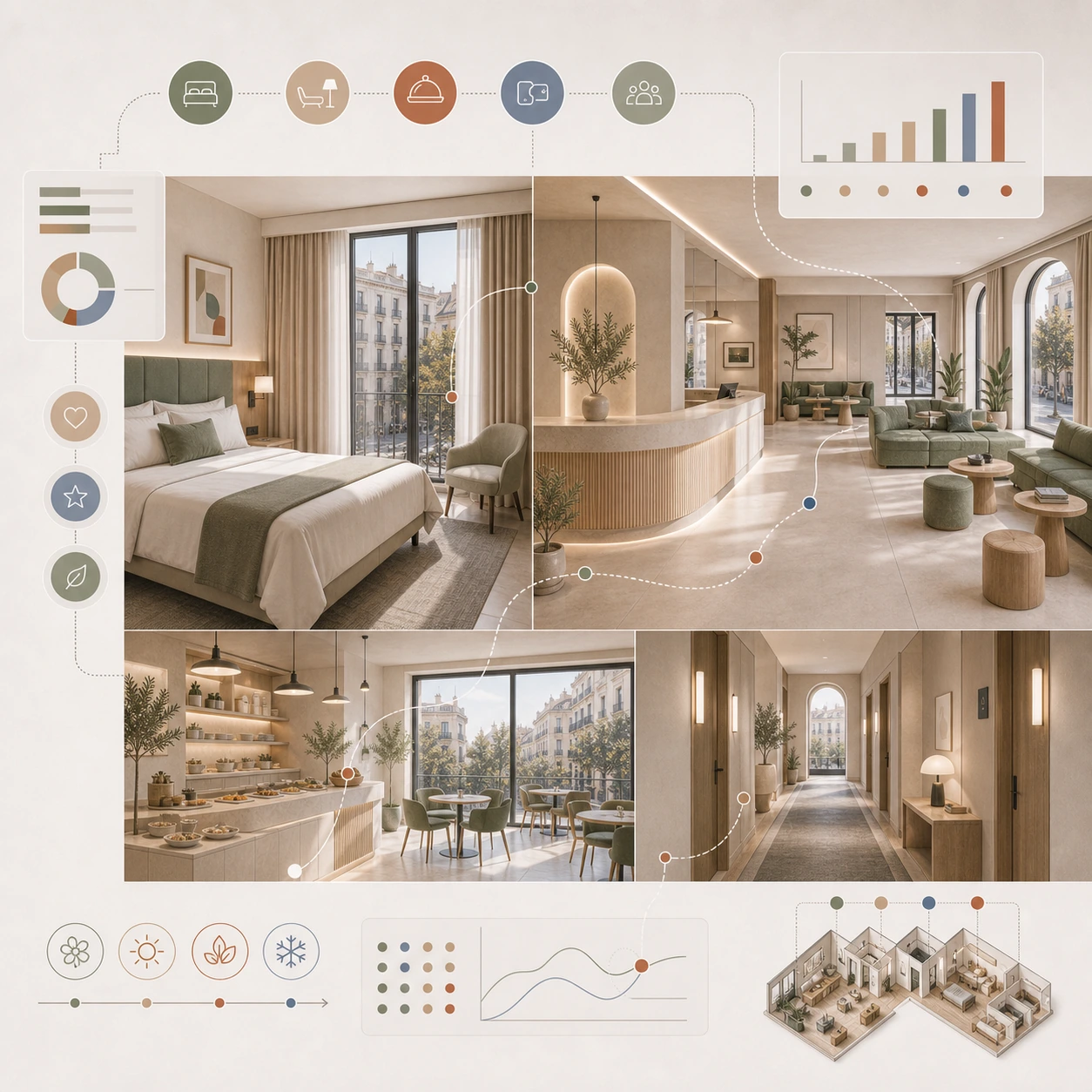
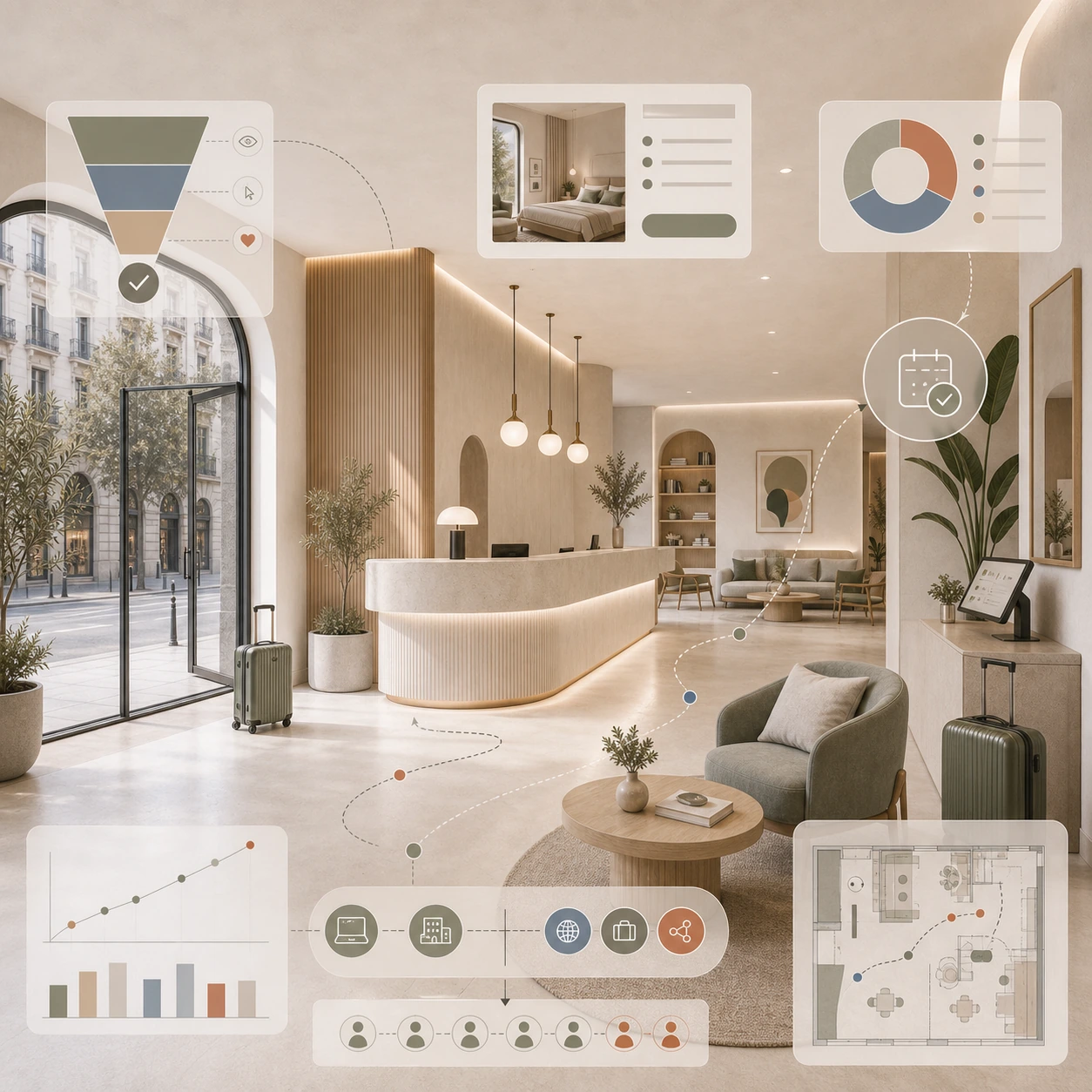
Cómo el diseño de interiores impacta en la ocupación hotelera en Madrid. Escenarios de planificación, datos y estrategias de interiorismo para hoteles boutique que pueden mejorar reservas directas.
Journal · EOLOS DESIGN LAB
Guía · EOLOS DESIGN LAB Journal
El mercado hotelero de Madrid está más competitivo que nunca. No basta con tener buena ubicación y precio ajustado: en 2026, los viajeros eligen hoteles basándose en la experiencia visual que prometen las fotos en booking y redes sociales.
Este artículo demuestra con datos reales cómo el diseño de interiores impacta directamente en tus KPIs: ocupación, RevPAR, ADR y valoraciones. No es teoría, es matemática aplicada a la rentabilidad hotelera.
Los números que importan: cómo el diseño afecta tu cuenta de resultados
Escenario de planificación: Hotel boutique 18 habitaciones, Malasaña
Antes del rediseño: 62% ocupación anual, ADR 95€, RevPAR 58.9€
Después del rediseño (inversión 120.000€): 84% ocupación, ADR 135€, RevPAR 113.4€
ROI: Inversión recuperada en 14 meses
¿Por qué funcionó? Tres palancas clave:
Aumento de conversión directa: Las fotos profesionales del nuevo diseño redujeron dependencia de OTAs del 78% al 52%
Precio premium justificado: El diseño permitió subir tarifas 42% sin resistencia de mercado
Valoraciones superiores: Pasaron de 7.8 a 9.2 en Booking, entrando en el top 15% de Madrid
Las 5 áreas de diseño que más impactan la ocupación
1. La zona de entrada/lobby (40% del impacto en conversión)
El lobby es tu foto de portada. El 73% de los potenciales huéspedes deciden en los primeros 8 segundos si tu hotel "les pega" basándose en esta imagen.
Elementos críticos:
Lighting statement: Una pieza de iluminación escultórica (no un plafón de centro comercial)
Textura en paredes: Papel pintado, panelados, microcemento, algo táctil
Mobiliario de escala: Piezas de tamaño medio-grande que den personalidad
Verde: Plantas grandes (mínimo 2 de 150cm+) o muro vegetal
Zona de espera fotogénica: Aunque sea pequeño, debe tener un rincón digno de Instagram
Presupuesto: 8.000-25.000€ | ROI: <6 meses en conversión directa
2. Habitaciones tipo (30% del impacto)
Aquí vive tu huésped. Un diseño mediocre aquí no se compensa con lobby espectacular.
Lo que diferencia:
Cabeceros custom: No estructura metálica de catálogo. Panel tapizado, madera, metal cortén...
Iluminación regulable: Mínimo 4 fuentes de luz independientes por habitación
Cortinas blackout invisibles: Que no parezcan persianas de oficina
Amenities con identidad: Packaging custom o marcas boutique (nada de monodosis genéricas)
Espejo retroiluminado: Fundamental para selfies y funcionalidad
Materiales nobles en mojado: Cerámica gran formato, piedra natural, terrazo
Almacenaje inteligente: Repisas que no se mojan, ganchos abundantes
Presupuesto por baño: 2.500-6.000€ | Impacto directo en score de limpieza y comfort
4. Zonas comunes fotografiables (5% conversión pero alto impacto reputacional)
Terrazas, patios, salones, bibliotecas, gym... Cada espacio común es contenido gratuito cuando está bien diseñado.
El truco:
Crear "scenes": Rincones que pidan a gritos una foto
Iluminación cálida siempre: 2700K máximo en zonas sociales
Versatilidad: Espacios que funcionan para trabajo, café, lectura, copa
Verde abundante: Las plantas humanizan espacios grandes
Presupuesto: 5.000-20.000€ según tamaño | Genera contenido orgánico valorado en 2.000-5.000€/mes
5. Señalética y wayfinding (subestimado, afecta experiencia operativa)
Cuando los huéspedes preguntan dónde está el ascensor o el desayuno, tu diseño falló.
Solución:
Señalética coherente con identidad visual
Iconografía clara multiidioma
Información en puntos de decisión
QR codes para info detallada (horarios, servicios, recomendaciones)
Presupuesto: 800-3.000€ | Reduce fricción operativa un 40%
Estilos de diseño que están funcionando en Madrid 2026
1. Contemporary Mediterranean (el más rentable) Combina materiales naturales (madera, piedra, lino) con paleta terracota/arena/azul mediterráneo. Funciona especialmente en barrios como Salamanca, Chamberí, Centro.
2. Industrial Refined Perfecto para barrios como Malasaña, Lavapiés. Ladrillo visto, metal negro, madera recuperada, pero refinado (nada de "ruina chic").
3. Soft Japandi Minimalismo cálido japonés + hygge nórdico. Ideal para hoteles pequeños (sub-30 habitaciones) que buscan ser refugio urbano.
4. Maximalist Boutique Papel pintado statement, colores saturados, mezcla de estampados. Alto riesgo pero alto reward. Solo si tienes personalidad de marca fuerte.
Lo que NO funciona:
Minimalismo frío escandinavo (Madrid no es Copenhague)
Todo blanco estilo "clínica"
Imitación barata de cadenas de lujo
Mezcla de estilos sin coherencia
Escenarios de presupuesto según tipología
Hotel Urbano 15-25 habitaciones (inversión media)
Lobby + recepción: 15.000-30.000€
Habitaciones (3.500€/unidad): 52.500-87.500€
Baños (2.800€/unidad): 42.000-70.000€
Zonas comunes: 10.000-25.000€
Señalética + detalles: 3.000-8.000€ Total: 122.500€ - 220.500€Plazo de recuperación: 12-18 meses
Hotel Boutique 8-15 habitaciones (diseño premium)
Lobby statement: 20.000-45.000€
Habitaciones (5.500€/unidad): 44.000-82.500€
Baños premium (4.500€/unidad): 36.000-67.500€
Zonas instagrameables: 15.000-35.000€
Branding espacial: 5.000-12.000€ Total: 120.000€ - 242.000€Plazo de recuperación: 10-14 meses (gracias a ADR más alto)
Zonas comunes multipropósito: 12.000-25.000€ Total: 140.000€ - 243.000€Plazo de recuperación: 16-24 meses (margen unitario menor pero volumen)
Errores comunes que tiran el dinero
Error 1: Renovar habitación por habitación Es tentador por cashflow, pero genera:
Incoherencia visual en fotos
Imposibilidad de campaign fotográfico cohesivo
Pérdida de descuentos por volumen en compras
Periodo de obras eternizado
Solución: Fase por plantas completas o hazlo todo en periodo valle.
Error 2: Copiar a la competencia premium sin entender por qué funciona Ver un hotel bonito en Instagram y pedir "lo mismo" sin estrategia = desastre.
Solución: Contrata diseño estratégico que entienda tu target, tu ADR objetivo, tu personalidad de marca.
Error 3: Escatimar en colchones y ropa de cama Es donde el huésped pasa 8 horas. Cada review mala sobre comodidad te cuesta 15-30 reservas potenciales.
Solución: Invierte en gama media-alta. Es el 15% del presupuesto pero el 40% de la experiencia.
Error 4: No diseñar para foto En 2026, si tu hotel no se ve bien en cámara de móvil, no existe.
Solución: Diseña con iluminación adecuada para foto sin flash. Crea rincones que pidan ser fotografiados.
Ejecución (2-4 meses según magnitud): Obra, coordinación, instalación
Styling + fotografía (1 semana): Preparar espacios para campaign visual
Coste de proyecto de diseño: 12-18% del presupuesto total de obra
Conclusión: el diseño no es un gasto, es tu herramienta de pricing
En 2026, el diseño de tu hotel es tu principal herramienta para:
Justificar precios premium (+25-40% ADR)
Reducir dependencia de OTAs (comisiones -15-20%)
Aumentar ocupación directa (+15-25%)
Generar marketing orgánico (UGC valorado en miles/mes)
Mejorar valoraciones (impacto directo en conversión)
No diseñas para que sea bonito. Diseñas para que sea más rentable.
Los números no mienten: un hotel bien diseñado en Madrid recupera la inversión en 10-18 meses y genera retornos superiores durante mínimo 7-10 años.
La pregunta no es si puedes permitirte renovar. Es si puedes permitirte no hacerlo mientras tu competencia sí lo hace.
¿Tu hotel necesita renovación estratégica?
En EOLOS diseñamos espacios hoteleros que aumentan ocupación y ADR con enfoque basado en datos. Desde el concepto hasta la última almohada, pensamos en rentabilidad.
¿Quieres optimizar la ocupación de tu hotel?
¿Estás preparando un hotel, un alojamiento turístico o un proyecto de hospitality? Cuéntanoslo mediante las opciones de contacto que encontrarás a continuación.
Madrid's hotel market is more competitive than ever. A good location and a competitive price are no longer enough: by 2026, travelers will choose hotels based on the visual experience promised by photos on Booking.com and social media.
This article demonstrates with real data how interior design directly impacts your KPIs: occupancy, RevPAR, ADR, and ratings. It's not theory; it's applied mathematics for hotel profitability.
The numbers that matter: how design affects your bottom line
Before the redesign: 62% annual occupancy, ADR €95, RevPAR €58.9
After the redesign (investment €120,000): 84% occupancy, ADR 135€, RevPAR 113.4€
ROI: Investment recovered in 14 months
Why did it work? Three key levers:
Increased direct conversion: Professional photos of the new design reduced reliance on OTAs from the 78% to the 52%
Justified premium price: The design allowed for a price increase of 42% without market resistance
Top ratings: They went from 7.8 to 9.2 on Booking, entering the top 15% in Madrid
The 5 design areas that most impact occupancy
1. The entrance/lobby area (40% impact on conversion)
The lobby is your cover photo. A significant number of potential guests decide within the first 8 seconds whether your hotel is a good fit for them based on this image.
Critical elements:
Lighting statement: A sculptural lighting piece (not a shopping mall ceiling light)
Texture on walls: Wallpaper, paneling, microcement: something tactile
Staircase furniture: Medium-to-large sized pieces that add personality
Green: Large plants (minimum 2 of 150cm+) or plant wall
Photogenic waiting area: Even if it's small, it should have a corner worthy of Instagram.
Budget: €8,000-€25,000 | ROI: <6 months in direct conversion
2. Typical rooms (30% of the impact)
This is where your guest lives. A mediocre design here isn't compensated for by a spectacular lobby.
What makes the difference:
Custom headboards: No metal frame from the catalog. Upholstered panel, wood, corten steel…
Adjustable lighting: Minimum 4 independent light sources per room
Invisible blackout curtains: They shouldn't look like office blinds.
Visual focal point: An element that defines personality (wallpaper, art, statement mirror)
Budget per room: €3,500-€8,000 | Allows for an ADR increase of €25-€45/night
3. Bathrooms (20% impact: critical for assessments)
Mediocre bathrooms ruin experiences. They are the second most mentioned issue in negative reviews.
Standards 2026:
Rain shower + hand shower: Generous flow rate (minimum 12L/min)
Amenities with identity: Custom packaging or boutique brands (no generic single doses)
Backlit mirror: Essential for selfies and functionality
Noble materials in wet conditions: Large format ceramics, natural stone, terrazzo
Smart storage: Shelves that don't get wet, plenty of hooks
Budget per bathroom: €2,500-€6,000 | Direct impact on cleanliness and comfort score
4. Common areas suitable for photography (5% conversion but high reputational impact)
Terraces, patios, lounges, libraries, gyms… Every common space is free content when it is well designed.
The trick:
Create "scenes": Corners that are begging for a photo
Always warm lighting: 2700K maximum in social areas
Versatility: Spaces that work for work, coffee, reading, drinks
Abundant green: Plants humanize large spaces
Budget: €5,000-€20,000 depending on size | Generates organic content valued at €2,000-€5,000/month
5. Signage and wayfinding (underestimated, affects operational experience)
When guests ask where the elevator or breakfast is, your design failed.
Solution:
Signage consistent with visual identity
Clear multilingual iconography
Information at decision points
QR codes for detailed information (schedules, services, recommendations)
Budget: €800-€3,000 | Reduces operational friction on a 40%
Design styles that are working in Madrid 2026
1. Contemporary Mediterranean (the most profitable) It combines natural materials (wood, stone, linen) with a terracotta/sand/Mediterranean blue palette. It works especially well in neighborhoods like Salamanca, Chamberí, and the city center.
2. Industrial Refined Perfect for neighborhoods like Malasaña and Lavapiés. Exposed brick, black metal, reclaimed wood, but refined (nothing "chic ruin").
3. Soft Japandi Warm Japanese minimalism + Nordic hygge. Ideal for small hotels (under 30 rooms) seeking to be an urban retreat.
4. Maximalist Boutique Statement wallpaper, saturated colors, mixed patterns. High risk but high reward. Only if you have a strong brand personality.
What DOESN'T work:
Cold Scandinavian minimalism (Madrid is not Copenhagen)
Multipurpose common areas: €12,000-€25,000 Total: €140,000-€243,000Recovery period: 16-24 months (lower unit margin but volume)
Common mistakes that waste money
Error 1: Renew room by room It's tempting because of the cash flow, but it generates:
Visual inconsistency in photos
Impossibility of a cohesive photographic campaign
Loss of volume discounts on purchases
Period of works made eternal
Solution: Phase by complete plants or do it all in the off-peak period.
Mistake 2: Copying the premium competition without understanding why it works Seeing a beautiful hotel on Instagram and ordering "the same" without a strategy = disaster.
Solution: Hire a strategic designer who understands your target audience, your target ADR, and your brand personality.
Mistake 3: Skimping on mattresses and bedding This is where guests spend 8 hours. Every bad review about comfort costs you 15-30 potential bookings.
Solution: Invest in the mid-to-high-end range. It's the 15% of the budget but the 40% of the experience.
Error 4: Not designing for photos By 2026, if your hotel doesn't look good on a mobile phone camera, it doesn't exist.
Solution: Design with lighting suitable for photography without flash. Create corners that beg to be photographed.
Execution (2-4 months depending on size): Construction, coordination, installation
Styling + Photography (1 week): Prepare spaces for visual campaign
Design project cost: 12-18% of the total construction budget
Conclusion: Design is not an expense, it's your pricing tool
In 2026, your hotel's design is your main tool for:
Justify premium prices (+25-40% ADR)
Reduce dependence on OTAs (commissions -15-20%)
Increase direct occupancy (+15-25%)
Generate organic marketing (UGC valued in thousands/month)
Improve ratings (direct impact on conversion)
You don't design to make it pretty. You design to make it more profitable.
The numbers don't lie: a well-designed hotel in Madrid recovers the investment in 10-18 months and generates higher returns for at least 7-10 years.
The question isn't whether you can afford to renew. It's whether you can afford not to while your competition does.
Does your hotel need strategic renovation?
At EOLOS, we design hotel spaces that increase occupancy and ADR with a data-driven approach. From concept to the last pillow, we think about profitability.
Do you want to optimize your hotel's occupancy?
Planning a hotel, tourist accommodation or hospitality project? Tell us about it using the contact options below.
Siguiente paso
Cada buen proyecto empieza con una conversación clara.