Reforma de locales heredados: cómo modernizar sin perder lo que funciona
Cómo modernizar un local heredado en Madrid sin perder lo que lo hacía funcionar. Guía de reforma para negocios de segunda generación que necesitan actualizar sin borrar su historia.
Journal · EOLOS DESIGN LAB
Guía · EOLOS DESIGN LAB Journal
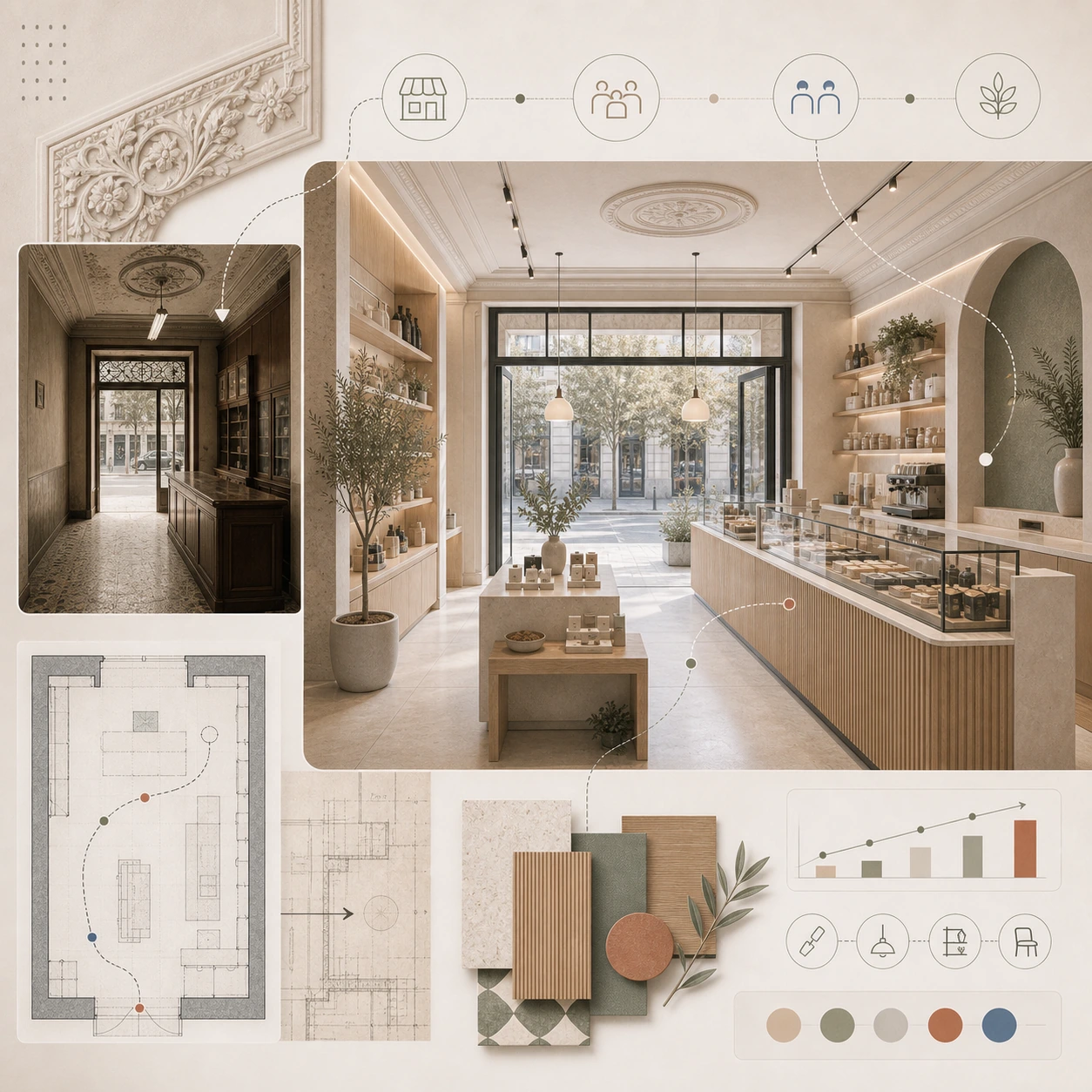
Hay un tipo de proyecto que nos llega con una complejidad muy específica: el propietario de segunda o tercera generación que hereda un negocio familiar y quiere modernizarlo, pero tiene miedo de perder a los clientes de toda la vida. Es un miedo legítimo. Hay bares, restaurantes y tiendas en Madrid que han reformado y han perdido en semanas una clientela que tardaron décadas en construir. Y hay otros que han reformado bien y han multiplicado el negocio sin perder a nadie relevante. La diferencia está en cómo se hace la reforma y, antes de eso, en qué se decide reformar y qué no.
Primero: entender qué es lo que realmente funciona
Antes de tocar nada, hay que entender por qué el negocio tiene los clientes que tiene. A veces lo que funciona es el producto. A veces es la persona que atiende. A veces es una tradición o un ritual específico del local (el aperitivo de siempre, el postre que no cambia, el hueco donde sienta siempre el mismo). Y a veces, aunque parezca increíble, lo que funciona es una parte del espacio físico que parece anticuada pero que los clientes sienten como suya. La reforma inteligente preserva el elemento de identidad y moderniza todo lo demás.
Lo que casi siempre se puede modernizar sin impacto en la clientela
La iluminación: el cliente fiel a un bar de barrio no ha construido su afecto por ese bar por la iluminación fluorescente del techo. Cambiarla a algo más cálido mejora el espacio sin tocar nada que le importe a nadie. Los baños: son el elemento que más crítica recibe en reviews y el que más fácilmente se puede mejorar sin afectar la identidad del local (una inversión de €8.000-€15.000 mejora la puntuación media de Google de forma medible). El orden y el almacenamiento visible: resolver el almacenamiento sin cambiar la estética es siempre una ganancia sin riesgo. La carta: el rediseño de la carta actualiza el negocio sin tocar el espacio.
Lo que hay que tocar con mucho cuidado
La barra: en muchos bares de Madrid, la barra es el corazón del local. Si tiene que renovarse, el proceso tiene que ser cuidadoso: mismas dimensiones, mismo punto de visión desde la calle si es posible, materiales que dialoguen con lo que había. Los elementos singulares con historia: el azulejo de los años 60, la barra de mármol original, los apliques de latón de siempre. La conservación de estos elementos, integrada en una reforma más amplia, produce resultados mejores que su sustitución.
El proceso de reforma con clientes existentes
Comunicar antes: el cliente fiel no quiere que le sorprendan con un local completamente distinto. Una comunicación honesta antes de empezar la obra genera comprensión y a veces incluso entusiasmo. Hacer la reforma por fases cuando es posible: en locales de hostelería, una reforma por fases permite seguir operando con parte del local abierto, manteniendo el hábito de los clientes durante la obra. Tener un elemento de continuidad visible en el nuevo espacio: algo del local anterior que tenga un lugar en el nuevo. No es nostalgia. Es identidad que se mantiene.
Escenario de presupuesto: reforma de local heredado en Madrid
Reforma integral conservando elementos de identidad: €60.000-€140.000
Reforma integral con nuevo posicionamiento: €100.000-€220.000
En todos los casos, el diagnóstico previo de qué conservar y qué cambiar es la parte más crítica del proceso. Un error de diagnóstico en este tipo de proyectos cuesta mucho más que el coste de haberlo hecho bien.
¿Vas a heredar o ya has heredado un negocio en Madrid y quieres modernizarlo?
¿Estás preparando un proyecto comercial, hostelero, residencial o de desarrollo? Cuéntanoslo mediante las opciones de contacto que encontrarás a continuación.
There's a type of project that comes to us with a very specific complexity: the second- or third-generation owner who inherits a family business and wants to modernize it, but is afraid of losing long-time customers. It's a legitimate fear. There are bars, restaurants, and shops in Madrid that have renovated and lost in weeks a clientele that took decades to build. And there are others that have renovated well and multiplied their business without losing any key customers. The difference lies in how the renovation is done and, before that, in what is decided to be renovated and what is left unrenovated.
First: understand what really works
Before touching anything, you have to understand why the business has the customers it does. Sometimes it's the product that works. Sometimes it's the person serving. Sometimes it's a tradition or a specific ritual of the establishment (the usual appetizer, the dessert that never changes, the spot where the same person always sits). And sometimes, incredibly, what works is a part of the physical space that seems outdated but that customers feel is theirs. A smart renovation preserves this element of identity and modernizes everything else.
What can almost always be modernized without impacting the clientele
Lighting: A loyal customer at a neighborhood bar didn't develop a fondness for it because of the fluorescent ceiling lights. Changing them to something warmer improves the space without affecting anything that matters to anyone. Restrooms: These are the element that receives the most criticism in reviews and the easiest to improve without affecting the bar's identity (an investment of €8,000-€15,000 measurably improves the average Google score). Organization and visible storage: Solving storage problems without changing the aesthetics is always a risk-free win. The menu: Redesigning the menu updates the business without affecting the physical space.
Things to handle with great care
The bar: In many Madrid bars, the bar is the heart of the establishment. If it needs to be renovated, the process must be meticulous: same dimensions, the same vantage point from the street if possible, and materials that complement what was there before. Unique elements with a history: the 1960s tiles, the original marble bar, the classic brass fixtures. Preserving these elements, as part of a broader renovation, yields better results than replacing them.
The renovation process with existing clients
Communicate beforehand: Loyal customers don't want to be surprised by a completely different space. Honest communication before starting the work generates understanding and sometimes even enthusiasm. Do the renovation in phases when possible: In hospitality establishments, a phased renovation allows you to continue operating with part of the premises open, maintaining customer routines during the construction. Include a visible element of continuity in the new space: Something from the old location that has a place in the new one. It's not nostalgia. It's preserving identity.
Budget scenario: renovation of inherited premises in Madrid
Complete renovation while preserving elements of identity: €60,000-€140,000
Complete renovation with new positioning: €100,000-€220,000
In all cases, the initial assessment of what to preserve and what to change is the most critical part of the process. A diagnostic error in these types of projects costs far more than the cost of having done it correctly.
Are you about to inherit, or have you already inherited, a business in Madrid you want to modernise?
Planning a commercial, hospitality, residential or development project? Tell us about it using the contact options below.
Siguiente paso
Cada buen proyecto empieza con una conversación clara.